

What Is ETG and Why Does It Matter?
ETG stands for Ethyl Glucuronide, a direct metabolite produced when your liver breaks down ethanol (alcohol). Unlike alcohol itself, which disappears from your bloodstream within hours, ETG lingers in your urine for a significantly longer period, making it one of the most reliable biomarkers for detecting recent alcohol consumption.
Here’s the key difference most people miss: a standard breathalyzer tests whether you are currently drunk. An ETG test checks whether you have consumed alcohol at any point in the recent past, even if you feel completely sober.
ETG testing is commonly used in:
- Probation and parole monitoring programs
- DUI/DWI legal proceedings and court-ordered sobriety
- Alcohol use disorder (AUD) treatment and recovery programs
- Pre-employment and random workplace screening
- Family court cases involving child custody disputes
- Military and federal employee testing programs
How an ETG Calculator Works
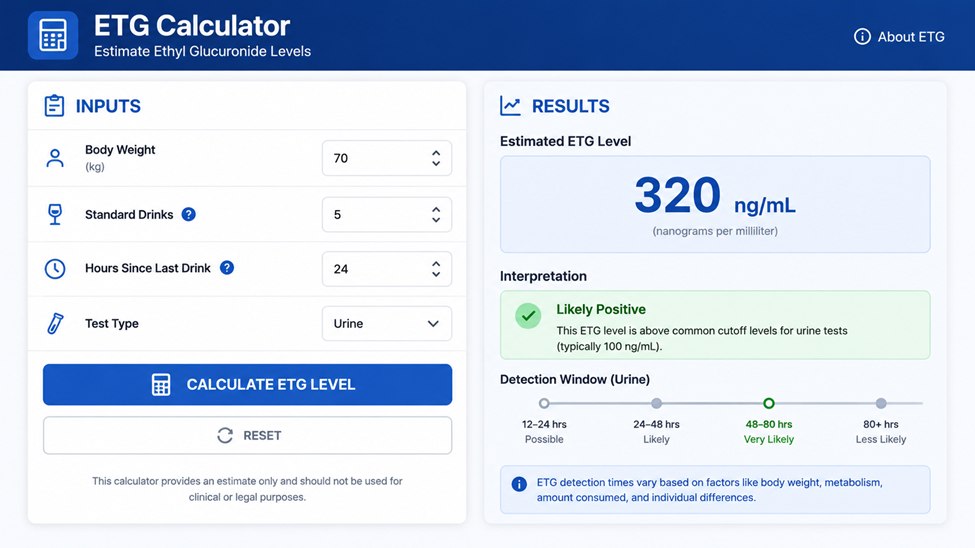
An ETG calculator is an online estimation tool that uses your drinking details and personal characteristics to approximate your current ETG concentration in ng/mL and predict when that level will fall below a test’s cutoff threshold.
No calculator can guarantee your test result. Individual biological variation is too complex. But a well-built ETG calculator, grounded in published pharmacokinetic research, can give you a meaningful risk estimate.
Inputs a Good ETG Calculator Collects
- Number of standard drinks consumed (one standard drink = ~14g of pure ethanol)
- Time since your last drink in hours
- Body weight in pounds or kilograms
- Biological sex (affects body water percentage and metabolism rate)
- Drinking pattern (single session vs. extended drinking)
- Cutoff level being tested against (100 ng/mL vs. 500 ng/mL)
The Math Behind the Estimate
ETG’s half-life is approximately 2 to 3 hours. If your peak ETG concentration is 10,000 ng/mL, it drops by half every 2 to 3 hours:
| Hours After Peak | Approx. ETG Level (ng/mL) | Status vs. 500 ng/mL Cutoff |
| 0 hours | 10,000 | Positive |
| 9 hours | ~1,250 | Positive |
| 15 hours | ~312 | Borderline |
| 24 hours | ~78 | Negative (500 cutoff) |
| 48 hours | trace | Negative |
Note: These numbers assume a moderate single-session drinking event. Heavy or prolonged drinking extends these windows significantly.
ETG Detection Windows and Cutoff Levels
The most misunderstood aspect of ETG testing is that there’s no single detection window. The answer depends on how much you drank and which cutoff the lab uses.
| Drinking Amount | Detection at 500 ng/mL | Detection at 100 ng/mL |
| 1 to 2 drinks (light) | 12 to 24 hours | 24 to 36 hours |
| 3 to 4 drinks (moderate) | 24 to 36 hours | 36 to 52 hours |
| 5 to 8 drinks (heavy) | 36 to 60 hours | 60 to 72 hours |
| 8+ drinks (binge) | 60 to 80 hours | Up to 80+ hours |
Warning: Most published timelines are conservative averages. Your actual ETG clearance could be 20 to 30% faster or slower depending on your unique biology.
Six Key Factors That Affect Your ETG Levels
These six variables can dramatically shift your personal ETG detection window:
- Amount of Alcohol Consumed: More alcohol means more ETG is produced. Peak ETG levels correlate directly with total ethanol intake.
- Body Weight and Composition: Heavier individuals with more body water distribute alcohol more widely, producing proportionally lower ETG peaks.
- Biological Sex: Women typically have lower body water percentages (55%) vs. men (68%), resulting in higher peak ETG concentrations for the same dose.
- Hydration Level: Drinking water dilutes urine concentration but does not eliminate ETG from your system faster.
- Liver Metabolism Rate: Liver health and individual enzyme activity significantly affect how fast ETG is produced and cleared.
- Drinking Pattern: Spread-out chronic drinking creates sustained ETG. A single binge may actually clear faster than multiple smaller sessions across two days.
Step-by-Step: How to Use an ETG Calculator Accurately
- Know your standard drink equivalents. One standard US drink contains 14g of pure ethanol. A pint of craft beer at 8% ABV is closer to 1.8 standard drinks, not one. Calculate actual ethanol consumption, not just “number of beers.”
- Record your last drink time precisely. Rounding to “last night” instead of giving an exact hour reduces accuracy significantly.
- Enter your accurate weight and sex. These variables directly affect the Volume of Distribution (Vd) used to estimate your ETG starting point.
- Set the correct cutoff threshold. Find out whether your program uses 500 ng/mL or 100 ng/mL. This difference can add 12 to 24 hours to your detection window.
- Add a buffer to the estimate. Because individual variation can shift results by up to 30%, add at least 6 to 12 additional hours before assuming you are clear.
False Positives: Surprising Sources You Must Know
Many people have failed ETG tests without consuming a single alcoholic drink. Current research identifies these as legitimate false positive risks:
- Hand sanitizers: Frequent use can raise ETG levels, typically below 200 ng/mL
- Mouthwash: Alcohol-containing mouthwashes like Listerine can produce ETG readings
- Vanilla extract: Contains up to 35% ethanol and can elevate ETG when used in food
- Fermented beverages: Kombucha, certain non-alcoholic beers, and overripe fruit contain trace ethanol
- Cold and cough medications: Many liquid formulations contain alcohol as a solvent
- Breath sprays and fresheners: Many contain alcohol-based compounds detectable by ETG testing
Good to know: Most testing programs use 500 ng/mL as the cutoff specifically because incidental exposures rarely exceed this level. A positive at 500 ng/mL or above is very unlikely to be from accidental exposure alone.
Expert Tips Most Articles Miss
ETG vs. ETS: Know the Difference
Ethyl Sulfate (ETS) is another alcohol metabolite often tested alongside ETG. When both markers are elevated, it strongly confirms alcohol consumption and reduces the chance that a positive is from incidental exposure.
Hair ETG Testing Is a Different Beast
ETG can also be detected in hair follicles, revealing alcohol use over months rather than days. A urine ETG calculator is completely irrelevant for hair testing scenarios. Snow Day Calculator
Hydration Has Limits
Drinking large amounts of water dilutes urine ETG concentration but does not accelerate ETG elimination from your body. Some labs also flag highly diluted samples (low creatinine) as suspicious, which can trigger retesting.
The “80-Hour Window” Is the Extreme, Not the Average
The 80-hour figure was established using subjects who consumed significant alcohol over extended periods. For light to moderate social drinking (one to three drinks), the realistic detection window at 500 ng/mL is typically 12 to 36 hours, not 80 hours.
“The 80-hour ETG detection window applies to heavy, multi-day alcohol consumption. For a single moderate drinking episode, most individuals clear the 500 ng/mL threshold within 24 to 36 hours.” — Consistent with SAMHSA guidelines and published ETG pharmacokinetic literature
Key Takeaways
- ETG is a direct alcohol metabolite detectable in urine for up to 80 hours after heavy drinking
- ETG calculators estimate your risk window but cannot guarantee a specific test outcome
- The standard cutoff is 500 ng/mL; stricter settings use 100 ng/mL, extending detection by 12 to 24 hours
- ETG’s half-life of 2 to 3 hours means concentrations drop by half every 2 to 3 hours after drinking stops
- Body weight, sex, liver function, hydration, and drinking pattern all affect your personal ETG window
- False positives from incidental sources are rare at 500 ng/mL but documented at 100 ng/mL
- The only certain way to test negative is complete alcohol abstinence
- Water dilutes urine ETG concentration but does not eliminate ETG from your body faster
Conclusion
Understanding how an ETG calculator works is about more than passing a test. It’s about understanding your own biology and how alcohol interacts with your body at a biochemical level.
A well-designed ETG calculator can give you a meaningful risk estimate based on drinks consumed, time elapsed, body weight, and sex. But every result comes with an important caveat: individual metabolic variation can shift your window by 20 to 30% in either direction.
