
The economics of fine-tuning a large language model have shifted dramatically. LoRA-based fine-tuning of a 7B or 13B open-weight model can be completed on a single GPU in hours. The computer cost has fallen to the point where almost any enterprise AI team can afford to run fine-tuning experiments. What hasn’t changed is the data operations problem, and that problem is where most enterprise fine-tuning programs fail.
A model fine-tuned on poorly curated data learns the wrong things, confidently. The failure doesn’t always show up immediately. On benchmark evaluations, the model may look fine. On the actual use cases the enterprise deployed it for drafting regulatory disclosures in the correct voice, summarizing legal contracts with the right level of detail, and extracting structured fields from clinical notes with domain-appropriate judgment. The model produces outputs that are plausible and wrong in ways that are hard to detect without domain expertise.
The data operations problem is not about volume. Enterprise teams frequently assume that more training examples solve the quality problem. They don’t. A model fine-tuned on 100,000 inconsistently annotated instruction-response pairs learns the inconsistency. A model fine-tuned on 5,000 carefully curated, domain-validated examples builds more reliable behavior. The quality of what the model trains on determines what the model learns. The quantity just determines how thoroughly it learns it.
What “Data Operations” Actually Means for Enterprise Fine-Tuning
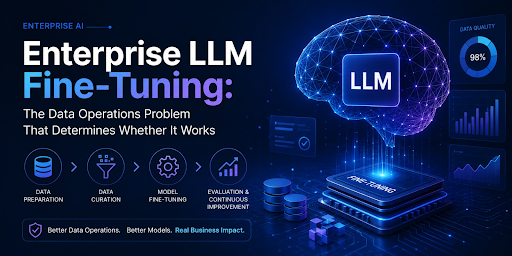
Data operations for enterprise LLM fine-tuning covers the full pipeline from raw data to training-ready dataset. The pipeline has five stages, each with its own failure modes.
Stage 1: Domain Corpus Assembly and Curation
Before any instruction-response pairs are constructed, the enterprise needs to identify, assess, and curate the domain content that will inform the fine-tuning dataset. This is the corpus that represents what the model should know and how it should reason within the domain.
For a legal contract AI, the corpus might include contract templates, redlines, legal opinions, regulatory guidance, and precedent documents. For a clinical documentation AI, it might include clinical notes, discharge summaries, ICD coding guidelines, and medical literature.
Corpus curation requires making specific decisions at each stage:
Source selection: Which documents represent the domain knowledge and reasoning style the model should develop? Not every document in an enterprise’s archives is appropriate training material. Outdated documents may teach the model superseded practices. Low-quality documents may teach the model low-quality reasoning. The selection criteria need to be defined before collection begins, not inferred from whatever is available.
Quality filtering: Documents that are incomplete, internally inconsistent, off-topic, or poorly written create noise in the training signal. Quality filtering removing documents that fall below defined standards for completeness, topical relevance, and domain accuracy requires both automated screening and human review. Automated filters catch format and completeness issues; human review catches domain accuracy problems that automated tools cannot assess.
Deduplication: Duplicate or near-duplicate content in the training corpus causes the model to overweight those specific patterns producing a model that exhibits the duplicated patterns disproportionately in its outputs. Deduplication at the document level is standard; deduplication at the passage or paragraph level is more thorough and more resource-intensive.
Personally identifiable information (PII) removal: Enterprise documents routinely contain PII patient names in clinical notes, party names in legal contracts, account holder information in financial documents. Including PII in training data creates legal exposure and may violate GDPR, HIPAA, or other applicable privacy regulations. PII scrubbing before training data construction is a compliance prerequisite, not an optional data quality step.
Stage 2: Instruction-Response Pair Construction
Supervised fine-tuning trains the model on instruction-response pairs: an instruction that represents what the user asks, and a response that represents what the model should produce. The quality of the fine-tuning dataset depends entirely on the quality of these pairs.
Instruction design: Instructions should reflect the actual prompts the model will receive in deployment, not sanitized, idealized versions of those prompts. Real user inputs are messier, more ambiguous, and more varied than the clean examples that annotation teams naturally gravitate toward. Training data that reflects only clean, clear instructions produces a model that handles those cases well and degrades on the real inputs.
Response quality: Each response in the training dataset is a demonstration of what excellent model behavior looks like for that instruction. A response that is approximately correct, mildly confabulated, slightly off-topic, or acceptable but generic teaches the model to produce approximately correct, mildly confabulated, slightly off-topic, or acceptable but generic outputs. The quality bar for training responses needs to reflect the quality bar the enterprise has for model outputs in production, which means responses need to be reviewed by domain experts, not just annotation generalists.
Task diversity: The fine-tuning dataset needs to cover the full range of tasks the model will be used for in production. A dataset that overrepresents one task type (summarization, for example) relative to others (extraction, classification, generation) produces a model that handles the overrepresented task reliably and the underrepresented tasks inconsistently. Task coverage planning mapping the production use case distribution before dataset construction begins prevents the coverage gaps that appear as production failures after deployment.
Edge case coverage: The scenarios where the model is most likely to fail are edge cases: ambiguous inputs, unusual formatting, domain-specific jargon, conflicting information, and inputs that fall at the boundary of the model’s designed capabilities. Training datasets that don’t include edge case examples produce models with undefined behavior at those boundaries often confident undefined behavior that looks like a real answer.
Stage 3: Annotation Guideline Development
Annotation guidelines specify exactly what constitutes a correct response for each task type, how to handle ambiguous instructions, what constitutes an edge case and how to annotate it, and what quality bar the response must clear to be included in the training dataset.
The most common failure in annotation guideline development is underspecification. Guidelines that say “write a clear and accurate response” leave every quality decision to annotator judgment. Different annotators make different judgment calls. The model trains on the inconsistency and exhibits the inconsistency in production.
Guidelines that prevent inconsistency specify: the format each response should follow, the length range appropriate for each instruction type, how specific claims should be sourced or qualified, how edge cases should be handled, what refusal scenarios look like, and what the difference is between an acceptable response and an excellent one. Building these specifications requires collaboration with domain experts who understand what correct responses look like in the domain, not just annotation operations professionals who understand how to write annotation guidelines.
Stage 4: Inter-Annotator Agreement Measurement and Calibration
After guidelines are written and annotators are trained, the program needs to verify that different annotators actually make consistent decisions when applying the guidelines to the same examples. Inter-annotator agreement (IAA) measurement compares how different annotators annotate the same set of calibration examples.
Low IAA on the calibration set reveals one of two problems: either the guidelines are ambiguous in ways that need to be resolved through additional specification, or individual annotators have misunderstood the guidelines in ways that need to be corrected through additional training. Both problems should be identified and fixed before the annotation program scales to production volume.
A common mistake is launching production annotation before IAA calibration is complete, on the assumption that IAA can be checked during production annotation. By the time low IAA is detected in production annotation, thousands of examples have already been labeled with inconsistent standards. The cost of recalibration and relabeling compounds with the volume of annotation that occurred before the problem was identified.
Stage 5: Ongoing Quality Monitoring
Annotation programs that run for weeks or months experience quality drift: annotators’ interpretation of the guidelines shifts gradually over time, their judgment on edge cases stabilizes in ways that may or may not match the intended standard, and the accumulated informal decisions made during annotation create a body of practice that diverges from the written guidelines.
Ongoing quality monitoring, periodic re-annotation of calibration examples by all active annotators, comparison against the gold standard, and correction of any drift before it propagates through large volumes of data maintain annotation consistency across the program duration. Programs that skip ongoing monitoring discover the drift in model behavior after training, when the cost of diagnosis and remediation is much higher than the cost of catching drift during annotation.
What the Data Operations Failure Looks Like in Production
The most consistent production failure pattern from enterprise fine-tuning programs with inadequate data operations is confident inconsistency: the model produces different outputs for the same input at different times, responds correctly to some examples of a task type and incorrectly to others that appear structurally similar, and exhibits inconsistent tone, format, or depth across similar use cases.
This pattern traces directly to inconsistent training data. The model learned the inconsistency of the annotation and reproduces it in production. The inconsistency is not a model capability problem it is a data quality problem that manifests as a model behavior problem.
The other consistent failure pattern is confident confabulation: the model produces outputs that look like the correct format and style for the domain but contain factual or domain-specific errors. This pattern traces to responses in the training dataset that were reviewed for format and fluency but not for domain accuracy. The model learned to produce correctly formatted, fluently written, domain-styled responses but was never trained on the distinction between correct and incorrect domain content.
The Role of Domain Expert Involvement
The defining characteristic of enterprise LLM fine-tuning programs that succeed is domain expert involvement in the annotation process. Not domain expert review as a final quality gate, domain expert participation in the annotation workflow itself.
For a clinical documentation fine-tuning program, this means clinicians with training in the specific specialty annotating responses alongside general annotators, or at minimum reviewing and validating a sufficient sample of general annotator output to catch the domain accuracy errors that general annotators cannot recognize.
For a legal drafting fine-tuning program, it means attorneys reviewing responses for legal accuracy, appropriate qualification of advice, and correct application of the jurisdictional standards the model is being trained for.
The domain expert contribution is not primarily about volume; experts don’t need to annotate everything. It is about the gold standard that calibrates the annotation program and the quality gate that catches domain accuracy errors before they become training data. That contribution is irreplaceable by any amount of additional general annotator throughput.
Final Thought
Enterprise LLM fine-tuning is a data operations discipline with a model training component not a model training activity with a data preparation step. The quality of the resulting model is bounded by the quality of the data operations that produced the training dataset.
Programs that invest in the data operations problem corpus curation standards, instruction-response quality, annotation guidelines with sufficient specificity, IAA calibration before production annotation, and domain expert involvement throughout produce models whose behavior in production reflects the investment. Programs that treat data operations as a preliminary step to get through before the real work begins discover that the real work was the data operations all along.
