
The phrase best bass from bluetooth speaker is one of the most competitive and misunderstood concepts in modern audio. It is often reduced to marketing claims “extra bass,” “deep bass mode,” or “powerful output” but these terms rarely reflect the actual engineering required to reproduce low-frequency sound accurately.
In reality, bass is not something that can be added artificially or improved through software alone. It is a physical phenomenon governed by air movement, pressure behavior, and mechanical system design. Especially in portable Bluetooth speakers, where size, power, and structure are limited, achieving real bass becomes a complex engineering challenge.
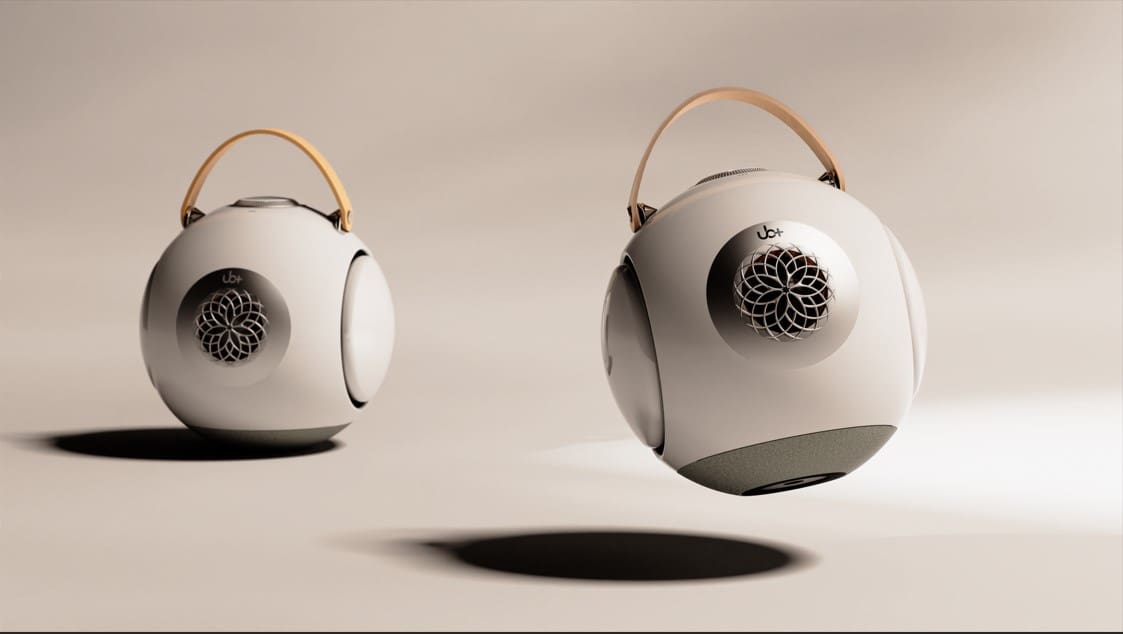
This article explores the topic from a purely educational and technical perspective, breaking down the physics of bass, the limitations of conventional designs, and how advanced systems like the UB+ dB1 DOUBLEBASS achieve superior low-frequency performance using mechanical amplification and acoustic precision.
Understanding Bass: A Physical and Acoustic Perspective
Bass is defined as low-frequency sound, typically ranging from 20 Hz to 250 Hz. Unlike higher frequencies, bass waves are long and require significant energy and air displacement to propagate effectively.
When a speaker produces bass, it is not simply emitting sound it is creating a pressure field in the air. The driver moves back and forth, pushing and pulling air molecules, creating compressions and rarefactions that travel outward as sound waves.
The deeper the frequency, the longer the wavelength and the more air must be displaced. This leads to a fundamental rule:
The quality of bass is directly proportional to how effectively a speaker can move and control air.
This is why bass is often felt physically. It interacts with the human body, surfaces, and the surrounding environment in a way that higher frequencies do not.
The Core Problem: Portability vs Physics
Portable Bluetooth speakers are designed with convenience in mind. They must be compact, lightweight, and energy-efficient. However, these design goals conflict directly with the requirements of bass reproduction.
To produce deep bass, a system ideally needs:
- Large drivers
- Significant internal air volume
- High excursion capability
- Strong structural rigidity
Portable speakers, on the other hand, offer:
- Limited enclosure space
- Smaller drivers
- Battery power constraints
- Lightweight materials
This contradiction forces engineers to make trade-offs. Many speakers compensate by boosting bass digitally, but this does not address the fundamental issue: insufficient physical air movement.
Air Displacement: The Foundation of Low-Frequency Performance
At the heart of every bass system is air displacement. A speaker must physically move air to generate low-frequency waves.
Air displacement depends on three key factors:
The first is driver surface area. Larger surfaces move more air per cycle.
The second is excursion, which refers to how far the driver cone can travel. Greater excursion allows more air to be displaced even with a smaller driver.
The third is system efficiency, which determines how effectively electrical energy is converted into mechanical motion.
In compact speakers, increasing surface area is difficult, so engineers must focus on maximizing excursion and efficiency.
However, increasing excursion introduces new challenges, including mechanical instability and distortion. This is why advanced systems must carefully balance all three factors.
Internal Pressure: The Hidden Acoustic Engine
Inside a speaker enclosure, air behaves like a dynamic spring system. As the driver moves, it compresses and expands the air inside the enclosure.
This creates internal pressure variations that influence how sound is produced.
If this pressure is not properly controlled, it can:
- Resist driver movement
- Cause distortion
- Reduce efficiency
- Create uneven bass response
A well-designed speaker does not fight internal pressure it uses it. The goal is to convert internal pressure into usable acoustic output rather than allowing it to dissipate as wasted energy.
Why Conventional Bluetooth Speakers Fall Short
Most Bluetooth speakers on the market rely on traditional design methods that introduce inefficiencies.
Rectangular Enclosures
Rectangular boxes create parallel surfaces, which lead to standing waves. These standing waves interfere with sound reproduction, especially in the low-frequency range.
The result is uneven bass, where certain frequencies are exaggerated while others are suppressed.
Outward-Firing Drivers
In conventional designs, drivers project sound directly outward. While this creates immediate loudness, it does not take full advantage of internal pressure dynamics.
Much of the potential energy is lost instead of being converted into deep bass.
DSP-Based Bass Enhancement
Digital signal processing is commonly used to simulate bass by boosting low frequencies.
While this can improve perceived bass at low volumes, it introduces problems:
- Compression at higher volumes
- Increased distortion
- Reduced dynamic range
- Artificial sound characteristics
DSP can shape sound, but it cannot replace the need for physical air movement.
A New Direction: Mechanical and Acoustic Optimization
To achieve the best bass from bluetooth speaker, engineers must move beyond digital solutions and focus on mechanical and acoustic efficiency.
This involves redesigning the entire system, including:
- Enclosure geometry
- Driver orientation
- Radiating components
- Pressure management systems
The UB+ dB1 DOUBLEBASS is an example of this approach, combining multiple advanced technologies into a unified acoustic system.
Spherical Enclosure: A Fundamental Acoustic Advantage
One of the most significant innovations in this system is the spherical enclosure.
Unlike rectangular boxes, a sphere has no parallel surfaces. This eliminates standing waves and allows for uniform pressure distribution.
This leads to:
- Cleaner bass reproduction
- Reduced distortion
- Improved energy efficiency
- More consistent sound performance
The spherical design transforms the enclosure into an active part of the acoustic system rather than just a container.
Helmholtz-Inspired Acoustic Chamber
The enclosure also functions as a Helmholtz-inspired resonant system.
In this configuration, the air inside the enclosure behaves like a resonating mass. It oscillates in response to driver movement, reinforcing specific low frequencies.
This allows the system to:
- Enhance bass naturally
- Store and release energy efficiently
- Reduce reliance on digital processing
This is a form of physics-driven amplification, where sound is enhanced through natural resonance rather than electronic manipulation.
Inward-Firing Driver: A New Acoustic Philosophy
One of the most innovative aspects of the system is the inward-firing mid-bass driver.
Instead of projecting sound outward, the driver directs energy into the enclosure. This allows the system to build internal pressure before releasing it through the radiators.
This approach provides greater control over low-frequency behavior and improves overall efficiency.
Technical Specifications
The driver includes:
- A 90mm neodymium magnet for strong and precise control
- A 35mm long-stroke voice coil for extended movement
- A 20mm piston excursion capability for significant air displacement
- An aluminum shorting ring to reduce distortion
- A wide surround for stability
These features allow the driver to operate efficiently while maintaining control over large movements.
Dual Symmetrical Passive Radiators
The system uses two passive radiators positioned symmetrically on opposite sides.
These radiators respond to internal pressure changes and convert them into additional sound output.
The symmetrical arrangement creates a self-balancing system, reducing vibration and improving efficiency.
This allows the speaker to:
- Move more air without increasing driver strain
- Maintain clarity at high volumes
- Reduce energy loss
Mechanical Amplification Through Surface Area
A critical factor in bass performance is radiating surface area.
The passive radiators provide a combined surface area significantly larger than that of the driver. This increases the amount of air that can be moved per cycle.
This process acts as a form of mechanical amplification, enhancing bass output without increasing power consumption.
System Integration: The Key to Performance
The effectiveness of the dB1 DOUBLEBASS comes from how its components work together.
The driver generates pressure, the enclosure distributes it evenly, the resonance system enhances low frequencies, and the radiators convert pressure into sound.
This integration ensures that energy is used efficiently, resulting in bass that is both powerful and controlled.
Comparative Analysis
| Feature | UB+ dB1 DOUBLEBASS | JBL | Bose | Marshall |
| Enclosure Geometry | Spherical | Rectangular | Rectangular | Rectangular |
| Driver Orientation | Inward | Outward | Outward | Outward |
| Resonance System | Helmholtz-inspired | Basic tuning | DSP-assisted | DSP-assisted |
| Passive Radiators | Dual symmetrical | Dual | Single/Port | Dual |
| Air Displacement Efficiency | High | Moderate | Moderate | Moderate |
| Vibration Control | Self-balancing | Partial | Partial | Partial |
| Bass Generation Method | Mechanical | DSP-based | DSP-based | DSP-based |
Real-World Performance
In indoor environments, the system distributes bass evenly, avoiding hotspots and dead zones.
In outdoor environments, it maintains bass presence through efficient air displacement.
At high volumes, it remains stable and distortion-free due to its balanced mechanical design.
What Defines the Best Bass from Bluetooth Speaker
The best bass from bluetooth speaker is defined by:
- Depth: ability to reproduce low frequencies accurately
- Control: maintaining clarity without distortion
- Balance: integration with mids and highs
- Efficiency: strong output with minimal energy use
True bass is not about loudness it is about precision and realism.
Conclusion
Achieving the best bass from bluetooth speaker is not about boosting sound it is about engineering a system that can move air efficiently, control pressure, and maintain stability.
The UB+ dB1 DOUBLEBASS demonstrates how this can be done through spherical design, inward-firing driver architecture, dual symmetrical radiators, and Helmholtz-inspired resonance.
In the end, bass is not created by software. It is built through physics, structure, and intelligent acoustic design.