

You have seen the advertisements. A billboard promises massive 8% to 10% rental yields and zero taxes. For an overseas investor, this sounds incredibly lucrative.
But those glossy brochures rarely tell the whole story. When you manage a property from thousands of miles away, hidden costs slowly drain your returns. That flashy 8% gross yield often shrinks to a 4% or 5% actual payout.
Do not let these hidden costs catch you by surprise. Understanding the true net yield protects your capital. It helps you make a confident, data-driven investment decision. Here is the reality of Dubai property ownership and how you can still win in this market.
the original blog: https://veersant.com/blog/real-dubai-rental-yield-net-2026/
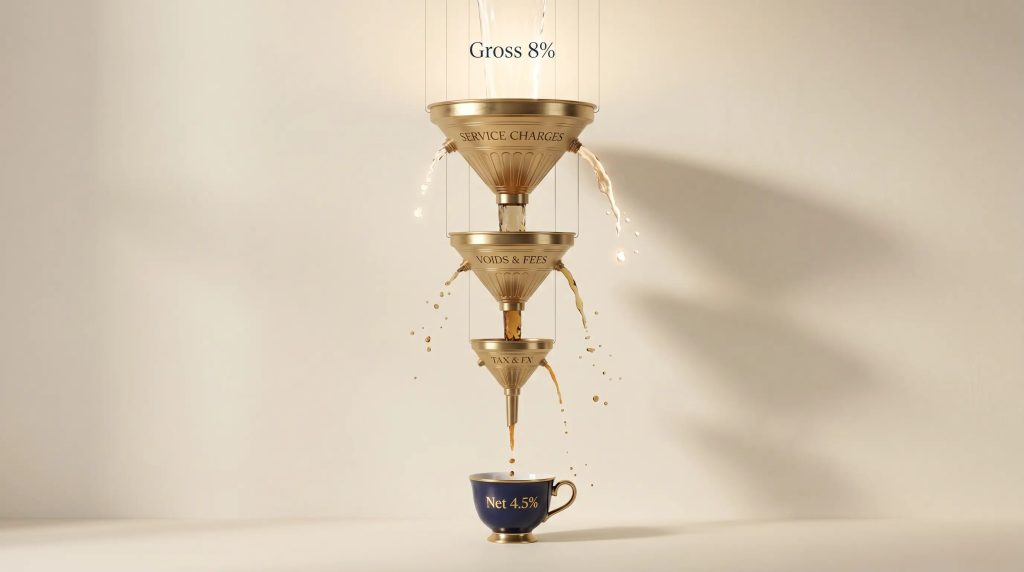
The Gross vs. Net Yield Illusion
Developers market properties using gross rental yield. They divide the annual rent by the purchase price. It is a simple equation. It also assumes you keep every single dirham.
Real life works differently. Operating expenses eat into your bottom line. Net yield calculates what actually lands in your bank account after expenses. If you want true capital appreciation, you must look strictly at the net numbers.
A freehold property in Dubai is still a world-class asset. You just need the right expectations before you sign the contract.
The 3 Silent Profit Killers for Overseas Landlords
Managing a rental from overseas requires local support. That support costs money. These three ongoing expenses pull down your gross returns.
1. Mandatory Service Charges
The RERA service charge index 2026 sets the maintenance fees for every building. Owners must pay these fees to upkeep gyms, pools, and security. Most apartment owners pay between 12 and 20 AED per square foot annually. This is your largest recurring expense.
2. Local Management Fees
You cannot chase late rent from another country. You need property management fees Dubai experts to handle operations. A local firm handles tenant screening, Ejari registration, and emergency repairs. Most reputable agencies charge between 5% and 10% of your total rental income.
3. Maintenance Buffers
Tenants eventually move out. Properties sit empty. Appliances break down. You must budget for tenant turnover and general wear and tear. A smart investor sets aside a 5% maintenance buffer each year to cover these inevitable gaps.
Let’s Do the Real Math (The 2026 Yield Calculation)
Let us look at a realistic scenario. Imagine you buy a Dubai apartment for AED 1,500,000. It rents for AED 120,000 annually.
That creates an 8% gross yield. But let us deduct the actual expenses.
- Gross Income: AED 120,000
- Service Charges: AED 15,000
- Management Fee (7%): AED 8,400
- Maintenance Buffer: AED 6,000
- Total Expenses: AED 29,400
- Net Income: AED 90,600
Your AED 1,500,000 investment actually yields 6.04% net.
You must also consider upfront buying costs. The Dubai Land Department (DLD) requires a 4% transfer fee. Agents charge a 2% commission. There are also small admin fees for the Ejari registration. Factoring in these hidden costs buying property UAE, your true yield lands closer to 5%.
Which Dubai Communities Offer the Best Net Yields in 2026?
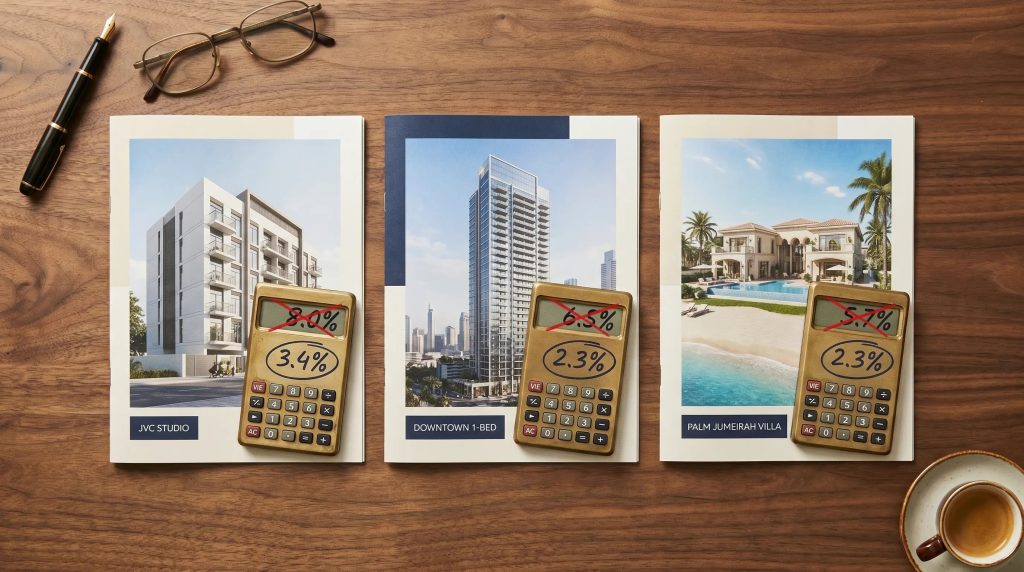
Not all neighborhoods perform equally. High-end luxury areas often have massive service charges. This drags down your net return. Mid-market communities frequently offer better actual take-home pay.
Here is how three popular areas compare for ROI Dubai apartments.
| Community | Average Gross Yield | Average Service Charge (AED/sq ft) | Estimated Net Yield |
| Jumeirah Village Circle (JVC) | 7.5% | 15.00 | 5.8% |
| Business Bay | 6.5% | 18.00 | 4.9% |
| Palm Jumeirah | 5.0% | 22.00 | 3.5% |
Finding the sweet spot takes local expertise. This is where Veer & Sant Real Estate steps in. We analyze these exact metrics to ensure our clients only buy properties that make mathematical sense.
Why a 5% Tax-Free Yield Beats Global Averages
A 5% net yield might sound lower than the advertisements. However, it absolutely crushes most global markets.
If you invest in London or Sydney, your net yield often sits around 2% to 3%. You then pay heavy taxes on that small income.
Dubai offers completely tax-free income. You keep every cent of your net yield. There is also zero capital gains tax when you eventually sell.
Smart investors are also using PropTech to lower management costs. Some explore fractional ownership to diversify their local portfolios. The advantages are massive if you run the numbers correctly.
Partnering with Veer & Sant Real Estate gives you this exact clarity. We protect your bottom line from day one.
Frequently Asked Questions
What is a good net rental yield in Dubai?
A good net rental yield in Dubai falls between 4.5% and 6%. While gross yields are often advertised at 8% or higher, deducting mandatory RERA service charges, property management fees, and maintenance buffers brings the realistic take-home return closer to 5%.
Are there hidden fees when buying property in Dubai?
Yes, buyers face several upfront fees, typically adding 6.5% to 7% to the purchase price. The main costs include the 4% Dubai Land Department (DLD) transfer fee, a 2% real estate agency commission, and minor administrative fees for registration.
How much are service charges in Dubai?
Dubai service charges typically range from 10 to 30 AED per square foot annually for apartments. Luxury towers or properties with extensive amenities can charge over 50 AED per square foot. These fees are regulated by RERA and cover building maintenance.
Do you pay tax on rental income in Dubai?
No, Dubai does not charge income tax on rental earnings. As a landlord, you keep 100% of your net rental income after operating expenses. There is also no capital gains tax when you sell the property. This makes it highly attractive for overseas investors.
Is it better to rent out a property short-term or long-term in Dubai?
Short-term rentals can generate 15% to 20% higher gross income, but they carry higher operational costs. They require furnishing, utility payments, and higher management fees. Long-term rentals offer stable, predictable cash flow with fewer operational headaches.
The Real Numbers
- 2.5 Percent Drop: Service charges and property management fees instantly reduce your gross rental income by up to 2.5 percent every single year.
- Tax-Free Advantage: Even with these deductions, Dubai’s average 5 percent net yield still easily beats a city like London, where heavy taxes leave investors with a 1.5 percent net return.
A Wise Word
“Gross yield is what gets advertised, but net yield is what pays the bills.” – Real Estate Industry Adage
This means that instead of worrying about the hard parts, we should focus on the simple truth: you must calculate your returns using the actual cash you keep after expenses, not the flashy numbers printed on marketing brochures.
Key Information at a Glance
| Feature | Why it Matters | How it Helps You |
| Service Charges | You pay this mandatory fee to maintain the building pools, gyms, and security. | Knowing this exact cost upfront prevents surprise bills from ruining your cash flow. |
| Management Fees | Local professionals handle tenant emergencies and collect rent for you. | It allows you to run a profitable overseas investment without daily headaches. |
Simple Tips You Can Use Today
- Start Small: Don’t try to do everything at once. Pick one easy part and master it. For example, learn how to look up the official service charge index for a specific building before you buy.
- Ask Why: If something doesn’t make sense, look at the goal. The goal is usually simple. You want to protect your capital and maximize the money that actually hits your bank account.
- Keep Track: Write down what you learn. It helps your brain remember the “why” behind the “how” when you compare the hidden fees of two different properties.
A Surprising Fact
Did you know that affordable, mid-market apartments often generate significantly higher actual returns than ultra-luxury beachfront villas? Most people think the opposite is true, but experts have found that this little secret is actually the key to success…
