
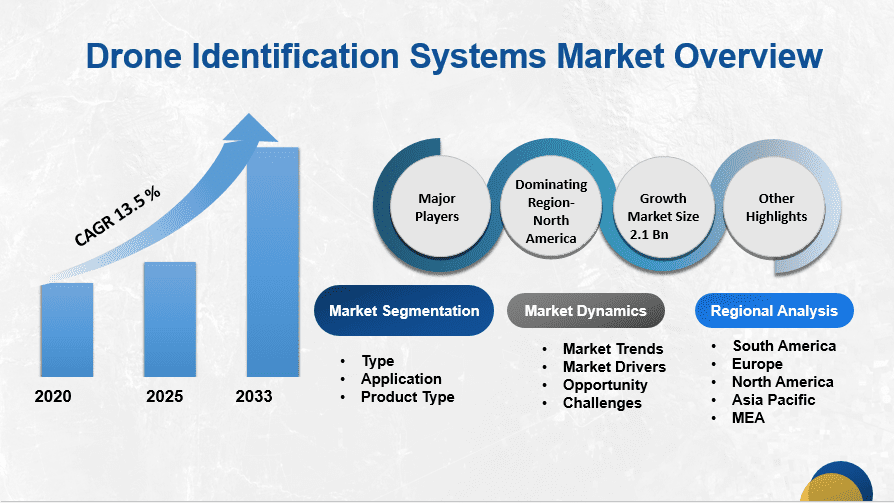
In recent years, the drone identification systems market. Governments worldwide are introducing policies to ensure safe drone integration into airspace. The FAA’s Remote ID rule, implemented in stages, requires most drones operating in U.S. airspace to be equipped with identification broadcast capabilities. Likewise, EASA’s framework across European Union member states mandates similar standards for drones above a specified weight threshold. These mandates compel manufacturers and operators to adopt compliant identification systems, creating a predictable demand pipeline for such technologies.
What Are Drone Identification Systems?
Drone identification systems, often referred to as Remote ID or drone registration and tracking technologies, are designed to help authorities and other stakeholders identify, locate, and manage drones in real time. These systems play a crucial role in ensuring safe integration of drones into national airspace, enhancing security, supporting regulatory compliance, and enabling diverse industry applications—from logistics and agriculture to public safety and infrastructure inspection.
Market Trends Driving Growth
The drone industry continues its robust growth trajectory, driven by advancements in autonomous technologies, expanding commercial use cases, and democratization of drone access globally. With the proliferation of drones from hobbyist quadcopters to commercial heavy-lift platforms the need for effective identification and tracking mechanisms has never been more critical. Governments and aviation authorities across North America, Europe, Asia Pacific, and the Middle East have responded by introducing or reinforcing regulations that mandate drone identification systems as an integral part of airspace safety frameworks. For instance, regulatory bodies like the Federal Aviation Administration (FAA) in the United States and the European Union Aviation Safety Agency (EASA) in Europe have established standards and compliance timelines for Remote ID solutions. These rules require drone manufacturers and operators to adopt specific technologies that broadcast identification information during flight. Such regulatory impetus is a significant driver for the global market, prompting original equipment manufacturers (OEMs), tech developers, and service providers to innovate and deliver market-ready solutions.
Key Strategic Moves
Athena Security Introduces AI-Powered X-Ray Drone Defense System for Critical Infrastructure Protection
In December 2025, Athena Security has announced the launch of an advanced artificial intelligence–based drone defense solution aimed at strengthening protection across critical infrastructure in the United States. The newly introduced Drone Defense Detection Model has been integrated into the company’s existing AI-assisted X-ray screening platform, enhancing its capability to identify potential drone-related threats at an early stage.The system is designed to automatically detect and flag drone components, including parts concealed within cargo shipments, baggage, or other transported materials. By identifying these components before assembly or deployment, the solution enables security teams to intervene prior to unauthorized drones approaching sensitive or restricted areas..
SIRBAI Introduces AI-Enabled Autonomous Drone Swarm Technology at UMEX 2026
In January, 2026, SIRBAI has officially announced the launch of the Middle East’s first artificial intelligence–powered autonomous drone swarm technology at UMEX 2026, an international exhibition dedicated to unmanned systems and autonomous defense capabilities. This launch marks the company’s formal entry into the defense technology sector and represents a significant milestone for regional innovation in unmanned aerial systems. The newly introduced platform is specifically developed for unmanned aerial systems (UAS) and enables multiple drones to operate cooperatively through advanced artificial intelligence algorithms. The technology allows coordinated mission execution with minimal human intervention, supporting autonomous decision-making even within complex, dynamic, and contested operational environments.
Allen Control Systems Introduces FAFOS Long-Range Optical Drone Identification Technology
October, 2025 Allen Control Systems (ACS), a provider of autonomous precision robotics solutions, has announced the launch of its Friend and Foe Operating System (FAFOS), a next-generation identification solution developed specifically for unmanned platforms. The introduction of FAFOS marks a significant advancement in drone identification technology, addressing the evolving requirements of modern drone warfare environments. FAFOS is designed as a cryptographically secure, radio-silent identification friend-or-foe (IFF) system, enabling long-range optical recognition of drones and other autonomous platforms. Unlike conventional identification systems that depend on radio frequency (RF) communications, the new solution operates without RF transmission, reducing vulnerability to jamming, interception, and spoofing in contested electromagnetic conditions.
Texas DPS Deploys Airborne Counter-UAS Drone Detection System on Helicopter Platform
In October 2025, The Texas Department of Public Safety (DPS) has announced the deployment of a newly developed Airborne Counter Unmanned Aircraft System (ACUS), marking the introduction of a first-of-its-kind aerial drone detection capability. The system has been integrated into a DPS helicopter platform to enhance real-time monitoring of unmanned aircraft activity. The ACUS solution is designed to identify and track drones that may pose risks to public safety, aviation operations, or emergency response missions. By enabling airborne detection, the system provides extended surveillance coverage compared to traditional ground-based monitoring technologies, particularly during large-scale incidents, disaster response efforts, and high-security operations..
The Path Ahead
The global drone identification systems market represents a pivotal segment within the evolving UAV ecosystem. By enhancing visibility, safety, and compliance, these systems are empowering governments, businesses, and communities to harness the full benefits of drone technology while mitigating risks. As the skies become more crowded with drones performing critical tasks, robust identification solutions will remain indispensable to building a safer, more connected, and economically vibrant aviation future.
