

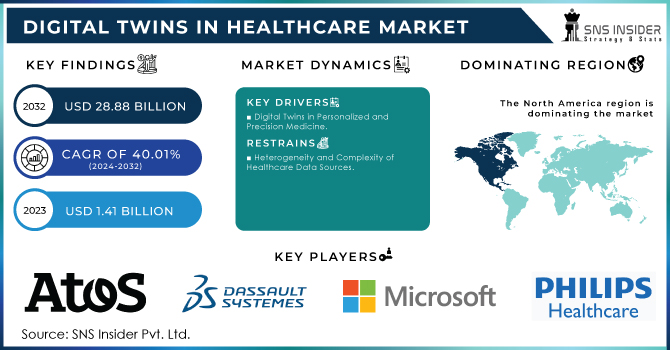
Digital Twins in Healthcare Market Size Valued at USD 1.41 Billion in 2023, Projected to Surge to USD 28.88 Billion by 2032 at a CAGR of 40.01%
Digital twins, a transformative technology in healthcare, are virtual models that replicate physical entities, processes, or systems. They enable the simulation, analysis, and prediction of outcomes, offering unprecedented potential to enhance patient care, optimize healthcare processes, and accelerate medical research and development.
Key Drivers of Market Growth
1. Advancements in Personalized Medicine: The rise of personalized medicine is a significant driver for the Digital Twins in Healthcare Market. Digital twins allow healthcare providers to create individualized treatment plans by simulating patient responses to different therapies, leading to better outcomes and reduced side effects.
2. Increasing Adoption of AI and IoT in Healthcare: The integration of Artificial Intelligence (AI) and the Internet of Things (IoT) with digital twin technology is revolutionizing healthcare. These technologies enable real-time data collection, analysis, and prediction, allowing for more accurate diagnostics, personalized treatments, and proactive healthcare management.
3. Growing Demand for Predictive Analytics: The demand for predictive analytics in healthcare is fueling the adoption of digital twins. By simulating various scenarios, digital twins help healthcare providers anticipate potential health issues, optimize resource allocation, and improve decision-making processes.
4. Enhancements in Telemedicine and Remote Monitoring: As telemedicine and remote patient monitoring continue to gain traction, digital twins offer a powerful tool for healthcare providers to monitor patients virtually, simulate potential complications, and adjust treatment plans accordingly. This capability is especially critical in managing chronic conditions and ensuring continuity of care.
5. Expanding Applications in Surgical Planning and Training: Digital twins are increasingly being used in surgical planning and training, allowing surgeons to practice complex procedures in a virtual environment before performing them on actual patients. This technology reduces surgical risks, improves outcomes, and enhances the training of healthcare professionals.
6. Supportive Government Initiatives and Investments: Governments and healthcare organizations worldwide are investing in digital health technologies, including digital twins, to improve patient outcomes and healthcare system efficiency. Supportive policies and funding are expected to further accelerate market growth.
Get a Free Sample Report: https://www.snsinsider.com/sample-request/3213
Market Segmentation
The Digital Twins in Healthcare Market is segmented based on application, end-user, and region.
1. By Application:
- Personalized Medicine
- Predictive Maintenance
- Surgery Planning and Training
- Diagnostics and Monitoring
- Others
2. By End-User:
- Hospitals and Clinics
- Research Institutes
- Pharmaceutical and Biotechnology Companies
- Others
3. By Region:
- North America
- Europe
- Asia-Pacific
- Latin America
- Middle East & Africa
Regional Analysis
North America: North America is expected to dominate the Digital Twins in Healthcare Market, driven by advanced healthcare infrastructure, high adoption of innovative technologies, and significant investments in digital health. The United States, in particular, is a key market for digital twins due to the presence of leading healthcare providers and technology companies.
Europe: Europe is anticipated to experience robust growth, with countries such as Germany, the UK, and France leading the adoption of digital twin technology in healthcare. The region’s focus on enhancing healthcare quality and efficiency supports market expansion.
Asia-Pacific: The Asia-Pacific region is projected to witness the fastest growth, supported by increasing healthcare investments, rising adoption of AI and IoT, and expanding healthcare infrastructure. Countries like China, Japan, and India are emerging as significant players in the market.
Latin America and the Middle East & Africa: These regions are also expected to see substantial growth, driven by improving healthcare facilities, increasing awareness of digital health technologies, and rising demand for advanced healthcare solutions.
Key Market Players
The Digital Twins in Healthcare Market features a competitive landscape with several prominent companies driving innovation and market expansion. Some of the key players in the market include:
- Siemens Healthineers
- Philips Healthcare
- GE Healthcare
- IBM Corporation
- Microsoft Corporation
- Oracle Corporation
- Dassault Systèmes
- PTC Inc.
- ANSYS, Inc.
- Digital Twin Technologies
These companies are focusing on technological advancements, strategic partnerships, and expanding their product portfolios to strengthen their market presence and meet the growing demand for digital twins in healthcare.
Future Outlook
The Digital Twins in Healthcare Market is set for rapid growth, driven by technological advancements, increasing demand for personalized medicine, and expanding applications in healthcare. As the market evolves, there will be a greater emphasis on developing innovative and user-friendly digital twin solutions to enhance patient care, optimize healthcare processes, and support medical research.
With the market projected to reach USD 28.88 billion by 2032, digital twins are expected to play a pivotal role in the future of healthcare, offering new possibilities for improving patient outcomes and transforming the healthcare landscape.
Other Reports You May Like:
Patient Handling Equipment Market Size
Digital Therapeutics Market Size