

The gap between enterprise retailers who scale profitably and those who plateau rarely comes down to marketing budget or product quality. More often, it comes down to infrastructure — specifically, whether their eCommerce platform works for their business model or forces their business model to work around it.
This distinction sounds subtle. The financial consequences are not.
A mid-sized retailer running $15M in annual revenue on a SaaS platform might not feel the friction immediately. But layer in a B2B pricing engine, a multi-warehouse inventory system, a custom loyalty program, and three regional storefronts — and suddenly the platform that promised simplicity is delivering something else entirely: workarounds, expensive third-party apps, API rate limits, and a development team spending more time fighting the platform than building for the customer.
This is the inflection point where custom Magento development stops being a technical preference and starts being a strategic imperative.
Why Magento Still Commands Enterprise Loyalty in 2026
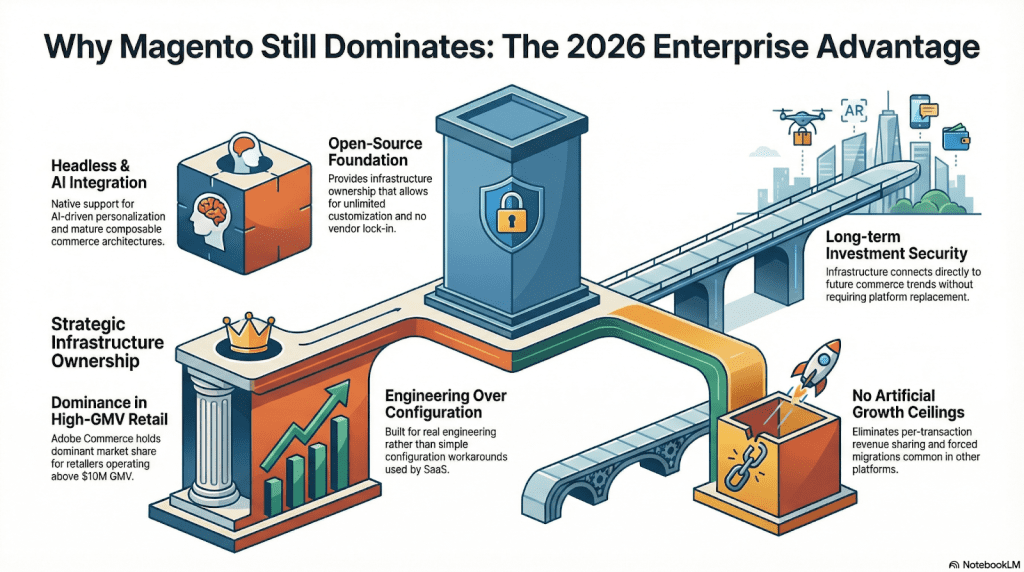
Magento has been declared dead at least three times in the last decade. It hasn’t died. In fact, Adobe Commerce — the enterprise tier of the Magento ecosystem — continues to hold dominant market share among retailers with GMV above $10M, and the reasons aren’t sentimental.
Magento ecommerce development was architected around a core assumption that most SaaS platforms quietly reject: that enterprise retail is inherently complex, and that complexity deserves real engineering — not configuration workarounds dressed up as features.
The platform’s open-source foundation means no artificial ceiling on what can be built. No per-transaction revenue share. No forced migration when a vendor decides to sunset a feature tier. For brands with serious operational requirements, that kind of infrastructure ownership is increasingly rare — and increasingly valuable.
What’s changed in 2026 is the competitive context. AI-driven personalization, composable commerce architectures, and headless frontends have all matured into production-ready capabilities. Magento development services have evolved alongside the platform, which means brands that invest in the platform today are investing in infrastructure that connects directly to where enterprise commerce is heading — not infrastructure they’ll need to replace when they get there.
The Technical Advantages That Actually Move the Needle
Scalability That Doesn’t Compromise Architecture
Magento 2 development services introduced a modular, service-oriented architecture that allows engineering teams to scale specific components under pressure rather than scaling a monolith. Checkout, catalog, inventory, search — each can be independently optimized. During Black Friday traffic spikes or flash sale events, this architectural decision pays dividends that flat-rate SaaS hosting simply cannot replicate.
Full-page caching via Varnish, native Elasticsearch integration, and support for CDN configurations give Magento development teams direct control over performance levers that determine real-world conversion rates. A 200ms improvement in page load time is not a technical metric — it is a revenue metric.
Customization Built Into the Core
This is where the SaaS vs. open-source debate becomes concrete. When you hire Magento developers to build a custom quoting engine, a configurable product bundler, or a wholesale pricing matrix, those features integrate with the platform’s core framework — not on top of it. They survive upgrades. They don’t break when a third-party app changes its pricing model or gets acquired.
On closed SaaS platforms, customization happens at the edges: apps, webhooks, workarounds. On Magento, it happens at the architecture level. That difference compounds over time in ways that are difficult to quantify until you’ve lived on both sides of it. [Magento customization architecture guide]
Enterprise Integration Without the Compromise
The average enterprise retailer runs between 8 and 14 software systems that touch their commerce operation: ERP, PIM, WMS, CRM, loyalty platforms, marketing automation, tax engines, and more. Magento’s API-first design — with comprehensive REST and GraphQL coverage — makes it a natural integration hub rather than an isolated storefront.
Custom Magento development frequently centers on exactly this challenge: building the integration layer that makes SAP talk to your catalog, NetSuite sync with your inventory, and your CDP feed personalization data back into the shopping experience in real time. This is not glamorous work. It is the work that determines whether your tech stack is a competitive asset or a coordination tax.
Performance as a Controllable Variable
Google’s Core Web Vitals directly influence organic search rankings. On Magento, performance is a controllable variable — something engineering teams can measure, target, and improve with precision. Image optimization pipelines, lazy loading configurations, server-side rendering decisions, database query optimization — these are all accessible. On many SaaS platforms, they are not. The performance ceiling is set by the vendor, not by your ambition.
When Custom Magento Development Becomes the Right Decision
Not every eCommerce business needs custom Magento development. The decision has a threshold, and being honest about where that threshold sits saves brands from both over-engineering and under-investing.
Custom Magento development becomes the right call when your catalog exceeds 50,000 SKUs with complex attribute relationships or configurability requirements. When you operate multiple storefronts across different brands, regions, or customer segments from a single backend. When your B2B sales motion involves negotiated pricing, custom catalogs, contract-based terms, or multi-level approval workflows. When your required integrations don’t fit neatly into a pre-approved connector library. When your checkout, returns, or fulfillment logic is genuinely differentiated and cannot be templated.
The common thread is irreducible complexity — operational requirements that cannot be approximated by configuration and cannot be solved by adding another app to your stack. When your business model is your competitive moat, your platform needs to be able to express it fully.
The Mistakes Brands Make Choosing a Magento Development Company
Competing on Day-One Price
The cheapest Magento development company almost never delivers the lowest total cost of ownership. Architectural shortcuts — hardcoded business logic, non-standard module patterns, skipped performance benchmarking — compound into remediation costs that routinely reach two to three times the original project budget within 18 months. The discovery conversation should be: what does this cost to own over three years, not what does this cost to build.
Mistaking General PHP Experience for Magento Expertise
Magento’s codebase has genuine complexity. Dependency injection, plugin architecture, declarative schema, indexing behavior — these are Magento-specific patterns that developers without platform depth consistently mishandle. When you hire Magento developers, Adobe Commerce certifications are a baseline signal, not a sufficient one. Ask to see how they’ve handled upgrade migrations, extension conflicts, and performance degradation at scale.
Skipping or Compressing Discovery
Discovery is where projects succeed or fail, long before a line of code is written. Integration architecture, data migration strategy, multi-store configuration, performance requirements, third-party dependency mapping — every hour invested here prevents five hours of rework later. Brands that compress discovery to accelerate timelines pay for it in scope creep, budget overruns, and launch delays.
Treating Development as a Project, Not a Capability
Your Magento website development engagement doesn’t conclude at go-live. Security patches arrive on a regular cadence. Extension compatibility requires ongoing management. Performance degrades as catalog size and traffic grow. Brands that engage a Magento development company for a project and then go dark are consistently unprepared for what operational platform ownership actually requires. [Magento security best practices]
Ignoring Cultural and Strategic Fit
The best technical partner is one who challenges your assumptions rather than simply executing your requirements. If a Magento development company never pushes back on your architecture decisions, never identifies risks in your proposed approach, and never offers alternatives — that is not a sign of a smooth engagement. It is a sign of a vendor relationship, not a strategic one.
The Cost vs. ROI Conversation Nobody Has Honestly
A serious custom Magento development engagement for a mid-market retailer typically ranges from $80,000 to $350,000+ depending on scope, integration complexity, and customization depth. That number is frequently where conversations stall.
The relevant comparison is not build cost versus zero. It is build cost versus the compounded cost of what you are currently paying: SaaS transaction fees at scale, the developer hours spent maintaining app stack workarounds, the conversion losses from a checkout experience your team cannot modify, the revenue impact of a site that cannot handle your peak traffic, and the organizational drag of a platform that requires every new capability to be negotiated with a vendor roadmap.
Brands operating above $5M in annual revenue who run this calculation honestly find — almost universally — that the Magento infrastructure investment pays back within 18 to 24 months. After that inflection point, the platform stops being a cost center and starts being a margin driver. It does not take a percentage of your growth. At meaningful scale, that alone changes the economics significantly.
How to Evaluate and Hire Magento Developers: A Working Checklist
Technical Validation
- Active Adobe Commerce certifications (Developer, Solution Architect, or Front-End Developer)
- Verifiable Magento 2 portfolio with direct client references you can contact
- Clear methodology for extension development, upgrade strategy, and conflict resolution
- Demonstrated performance benchmarking practice and Core Web Vitals track record
- Experience with your specific integration requirements (ERP, PIM, WMS, etc.)
Process and Delivery
- Defined discovery process conducted before any fixed-price estimate is issued
- Git-based version control with documented branching and code review standards
- CI/CD pipeline experience specific to Magento deployments
- Documented QA methodology including regression testing for upgrades
Commercial and Operational Clarity
- Transparent explanation of fixed-bid versus time-and-materials tradeoffs for your scope
- Post-launch support SLA with defined response times and escalation paths
- Willingness to conduct an independent technical architecture review before engagement begins
Strategic and Cultural Fit
- Do they ask harder questions than you expected during scoping?
- Can their solution architect articulate the tradeoffs of your proposed approach — not just validate it?
- Do they have category depth in your vertical: B2B, industrial, fashion, specialty retail?
- Are they building your internal capability or creating dependency on themselves?
Where Magento Development Services Are Heading
AI-Powered Commerce Capabilities
Adobe’s native Sensei AI integration brings product recommendations and search relevance scoring into the Commerce platform. But the more significant development is custom AI integration: connecting Magento’s catalog and order data to LLM-powered search interfaces, dynamic pricing models, and predictive inventory systems. Magento development companies with genuine AI integration capability are already building this for forward-looking clients. The brands that commission this work now will have a meaningful head start by the time it becomes table stakes.
Headless Magento at Production Scale
Decoupling the Magento backend from the frontend using PWA Studio, Next.js Commerce, or Vue Storefront allows brands to achieve content flexibility and frontend performance without sacrificing the commerce logic that makes the platform valuable. Headless Magento adoption among enterprise users has accelerated significantly, particularly for brands managing editorial-rich experiences alongside high-complexity transactional ones. [Magento headless architecture guide]
Composable Commerce Architecture
The MACH philosophy — Microservices, API-first, Cloud-native, Headless — is reshaping how enterprise retailers think about their technology stack. Magento’s API coverage positions it naturally as the commerce engine within a composable architecture: owning catalog, pricing, orders, and customer data while specialized best-of-breed services handle CMS, search, CDP, and analytics independently. The brands investing in Magento 2 development services with composable architecture in mind are building for a five-year horizon, not just next quarter’s requirements.
Making the Decision With Clarity
Custom Magento development is not the right answer for every eCommerce business. For brands with straightforward catalogs, limited integration requirements, and early-stage operational complexity, a well-configured SaaS platform may genuinely be the better starting point.
But for brands where complexity is structural — where your catalog, your customer relationships, your fulfillment logic, or your multi-market requirements are genuinely differentiated — the platform you choose either expresses that complexity or fights it. Magento ecommerce development, done with the right partner and the right architectural foundation, gives your team the infrastructure to compete on your actual advantages rather than around your platform’s limitations.
The most important decision is not which platform. It is who you work with on it. Seek partners who demonstrate architectural depth, who surface risks before they become problems, and who measure success by your operational independence — not your ongoing dependency on them.
Frequently Asked Questions
What is custom Magento development and how does it differ from standard implementation? Standard Magento implementation involves configuring the platform’s native features, installing vetted extensions, and launching with relatively minimal code customization. Custom Magento development goes further — building bespoke modules, custom integration layers, proprietary checkout flows, or platform-level modifications that are specific to your business logic. The distinction matters because custom development requires deeper Magento architecture expertise and has different implications for upgrade paths, long-term maintenance, and total cost of ownership.
How do I know if my business needs a Magento development company or an in-house team? The decision depends on the volume and nature of your ongoing development requirements. A Magento development company makes sense when you need significant build capacity for a defined project, deep architecture expertise that would be expensive to hire full-time, or a partner with cross-industry experience and existing integration patterns. In-house Magento developers make sense when your platform is your primary competitive infrastructure and you have sufficient continuous work to justify dedicated headcount. Many enterprise brands operate a hybrid model — external partners for architecture and major builds, internal developers for ongoing optimization and minor enhancements.
What should I expect to pay for Magento ecommerce development in 2026? Costs vary significantly based on scope, geography, and partner seniority. A focused mid-market implementation typically starts at $80,000–$120,000. Complex enterprise builds with deep ERP integration, multi-store configuration, and significant custom development commonly range from $200,000 to $500,000+. Offshore and nearshore Magento development companies offer lower day rates but introduce coordination overhead, timezone friction, and quality variance that should be factored into the true cost calculation. Always evaluate total cost of ownership over 36 months, not just initial build cost.How long does custom Magento development take from discovery to launch? A well-scoped mid-market project with standard integrations typically runs 3–5 months. Enterprise implementations with complex ERP integrations, custom B2B functionality, or multi-store architecture commonly require 6–12 months from discovery to production launch. Compressed timelines are technically achievable in some cases but carry real quality and stability risks — particularly around integration testing and performance validation under realistic load conditions.