
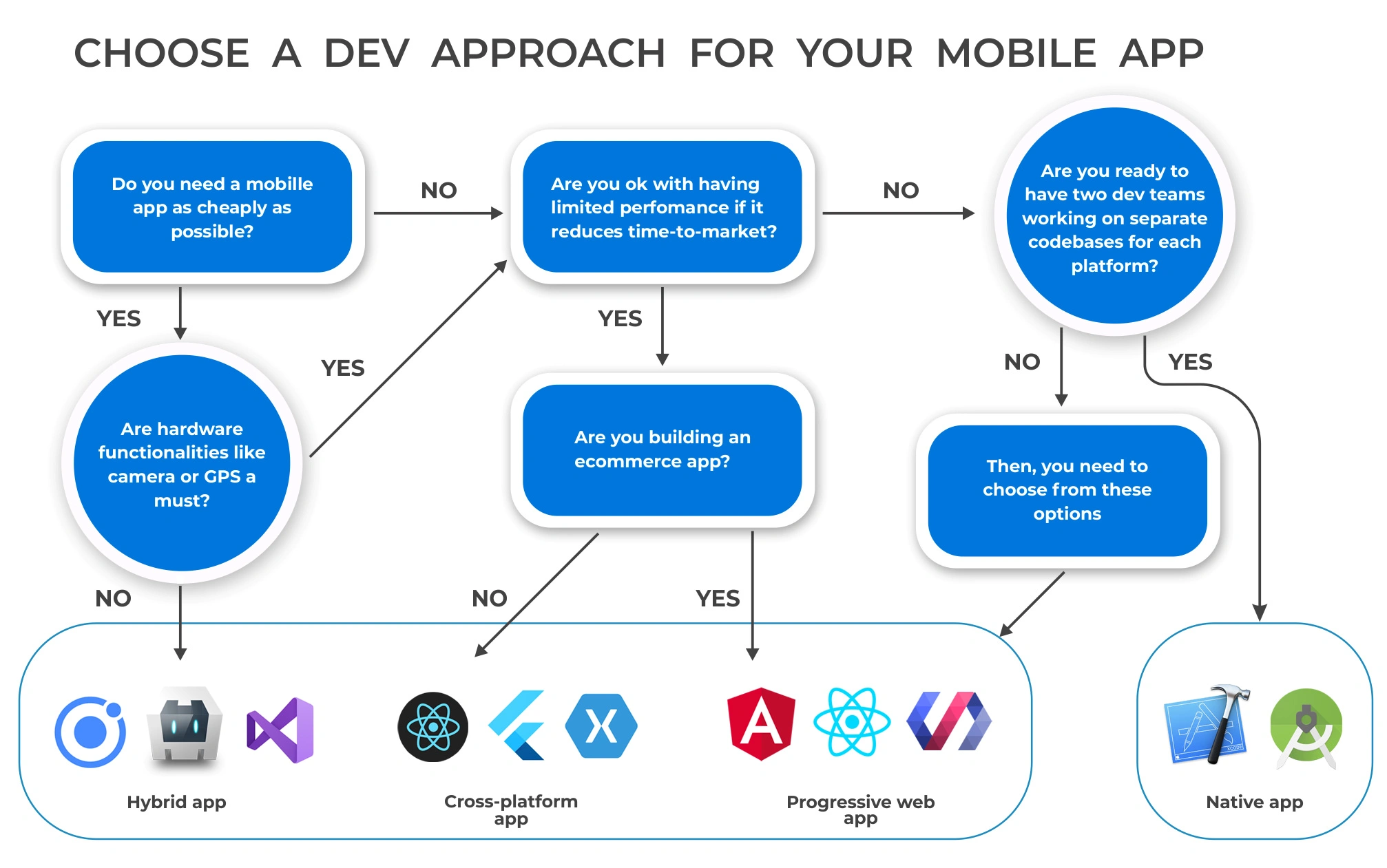
The mobile app ecosystem is unforgiving. In a marketplace where users abandon applications after a single crash or a microsecond of lag, the foundational architecture of your mobile product isn’t just a technical choice—it is a critical business strategy. For tech leaders, CTOs, and founders scaling products in highly competitive markets, the dilemma usually boils down to the ultimate cross-platform vs native debate.
While the debate rages on developer forums, the most valuable insights don’t come from theoretical arguments; they come from the battle-tested experiences of industry giants. Companies like Meta, Airbnb, Uber, and Shopify have invested millions of dollars into testing, deploying, and sometimes entirely abandoning mobile frameworks.
By analyzing their trajectories, modern engineering teams can bypass the costly trial-and-error phase. Let’s dive into the architecture wars, dissect the realities of maintaining complex codebases, and explore how your tech stack ultimately dictates your talent acquisition strategy.
The Allure of the Unified Codebase (The React Native Era)
A few years ago, the industry experienced a massive paradigm shift. The financial and logistical appeal of cross-platform development became impossible to ignore. The traditional model required businesses to maintain two entirely separate engineering silos: one writing Java or Kotlin for Android, and another writing Objective-C or Swift for iOS. This meant double the payroll, asynchronous feature rollouts, and constant friction in maintaining brand consistency across operating systems.
Meta (formerly Facebook) sought to solve this by open-sourcing React Native. The core proposition was revolutionary: “Learn once, write anywhere.” By allowing teams to build mobile apps using JavaScript and React—languages already ubiquitous in web development—companies could theoretically slash their development timelines in half.
For many organizations, this is still the holy grail. Startups racing against runway clocks, or enterprises looking to rapidly digitize their internal tooling, find immense value in this approach. When the priority is rapid prototyping, deploying across both app stores simultaneously, and unifying web and mobile engineering pods under a single language, the most logical step is to hire react native developers. Bringing in specialists who understand how to optimize a shared JavaScript codebase allows companies to maintain aggressive release schedules without burning through their venture capital.
Where Cross-Platform Thrives:
- Content-Heavy Applications: Apps that primarily pull and display data from APIs (like e-commerce storefronts or social feeds) perform exceptionally well.
- Resource Constraints: When building a Minimum Viable Product (MVP) to test market fit, speed trumps hyper-optimization.
- Web-to-Mobile Transitions: Companies with massive existing React web teams can upskill their engineers for mobile deployment with minimal friction.
Case Study: When the Shared Codebase Wins
Look at Shopify. In 2020, Shopify announced they were going all-in on React Native for their mobile applications. For a platform that relies heavily on standard UI components, data fetching, and business logic, the cross-platform model was a perfect fit. They successfully unified their engineering efforts, allowing them to ship features to merchants on iOS and Android simultaneously. For them, the slight overhead of a cross-platform framework was vastly outweighed by the sheer velocity of their product development.
The Pivot Back to Pure Native Performance
However, the cross-platform dream is not a universal silver bullet. As applications scale, accumulate technical debt, and attempt to execute highly complex tasks, the limitations of a shared codebase become glaringly apparent.
The core issue lies in “the bridge.” Cross-platform frameworks often rely on a bridge to communicate between the JavaScript thread and the device’s native hardware. If an app requires heavy computational power, complex gestures, or deep integration with the operating system (like Bluetooth, GPS, or camera sensors), this bridge becomes a severe traffic bottleneck. The result? Dropped frames, battery drain, and a user interface that feels subtly “off” to native users.
When a product’s survival hinges on a premium, hyper-responsive user experience, tech leaders eventually hit a ceiling with cross-platform tools. To leverage the full, uncompromised power of Apple’s ecosystem—utilizing innovations like ARKit, advanced Core Animations, or seamless Apple Watch integration—companies have to pivot. They realize that to deliver a bespoke, world-class iOS experience, they must hire dedicated swift developers. These native specialists don’t just write code; they understand the nuanced memory management, compilation speeds, and human interface guidelines that make an iOS app feel indistinguishable from Apple’s own native software.
Case Study: Airbnb’s Famous Sunset
Perhaps the most famous architectural pivot in mobile history belongs to Airbnb. In 2016, Airbnb was an early and aggressive adopter of React Native. They integrated it deeply into their native apps, hoping to move faster.
Two years later, they published a detailed series of engineering blogs announcing they were sunsetting their cross-platform efforts. Why? The complexity of maintaining the bridge between React Native and their existing native code had become a logistical nightmare. They found that instead of writing code once, they were often writing it three times: once in React Native, once in Swift to fix iOS-specific bugs, and once in Kotlin for Android edge cases.
Airbnb realized that for a product reliant on rich maps, complex animations, and flawless transitions, the overhead of managing a hybrid architecture was costing them more time than it saved. When analyzing cross-platform vs native solutions, they recognized that specialized, dedicated native teams ultimately produced a more stable, higher-performing product.
Total Cost of Ownership in the Cross-Platform vs Native Debate
When evaluating these two paths, technical decision-makers must look beyond the initial build cost and calculate the Total Cost of Ownership (TCO).
A common trap is assuming that cross-platform development is permanently cheaper. While the initial build might cost 30-40% less because of code reuse, the maintenance phase can quickly erode those savings. If your app scales to millions of users and requires heavy customization, the cost of engineering “workarounds” for native features in a cross-platform environment can surpass the cost of maintaining two native teams.
Conversely, starting with a native architecture requires a higher upfront investment and the management of distinct talent pipelines. However, the long-term stability, lower crash rates, and ability to immediately implement new OS features on day one of a major Apple or Google update often result in higher user retention and better app store rankings.
Making the Right Choice for Your Roadmap
So, how do you decide your path in 2026? The decision should never be driven by the framework that is currently trending on GitHub. It must be dictated entirely by your business roadmap, your target audience, and your available resources.
- Assess Your Core Differentiator: If your unique selling proposition is a breathtaking, 120Hz fluid user interface or complex machine learning run locally on the device, native architecture is mandatory. Do not compromise.
- Evaluate Your Time-to-Market Window: If you need to beat a competitor to market within three months across both platforms, a unified codebase is your strongest tactical weapon.
- Audit Your Long-Term Talent Strategy: Consider the availability of talent. Unifying around a JavaScript ecosystem might make hiring easier in the short term, but finding top-tier native engineers will pay dividends in app stability and performance as you scale.
Ultimately, your tech stack is only as strong as the engineers building it. Whether you choose the rapid deployment capabilities of a unified architecture or the uncompromising performance of native code, the success of your mobile application will always come down to the quality of the talent executing your vision. Ensure you partner with developers who don’t just write lines of code, but who understand the business objectives driving the architecture.
The Architecture Ripple Effect: Assembling Your Complete Engineering Team
Choosing your mobile framework is only the first piece of the puzzle; a mobile app cannot survive in isolation. When you decide to scale your mobile product, it triggers a domino effect across your entire technical ecosystem. If you choose a native architecture to deliver a premium user experience, you will quickly find that your native teams need a massive amount of support from specialized engineering talent across other disciplines.
For instance, your mobile app is only as fast as the APIs powering it. If your app experiences a sudden surge in traffic, a poorly optimized server infrastructure will cause your app to hang—regardless of how well-written the front-end code is. To keep data pipelines flowing smoothly and prevent server-side bottlenecks, you must scale your server infrastructure and hire dedicated backend developer specialists who can build secure, high-throughput APIs.
Simultaneously, you cannot neglect your web presence. Most successful mobile apps rely heavily on web-based admin dashboards, consumer-facing landing pages, or web apps that mirror their mobile functionality. To maintain feature parity and a consistent UI, engineering leaders often need to expand their user interface squads and hire dedicated frontend developers. Furthermore, if you are looking to build a blazing-fast, SEO-optimized web application alongside your mobile launch, you might want to look into modern, Server-Side Rendered (SSR) frameworks and Hire Nuxt js Developers to ensure your web presence is just as snappy and responsive as your mobile application.
Finally, managing these varied talent pipelines globally requires a strategic approach to recruitment. Many fast-growing companies find that local talent pools are either too expensive or too shallow to meet aggressive launch deadlines. To scale efficiently without compromising on code quality, a highly effective strategy is to look beyond local borders and hire offshore ios developer teams who can work asynchronously to clear feature backlogs while significantly optimizing your engineering budget.