
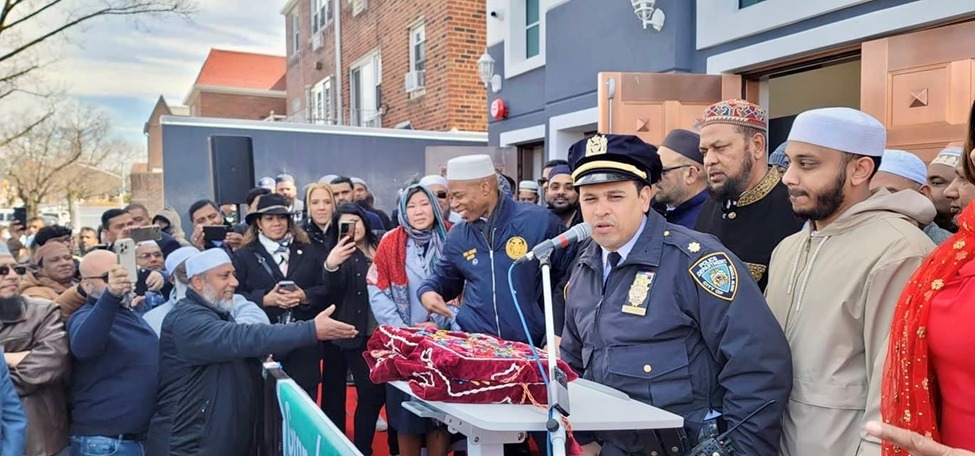
Community relations have become a vital component of contemporary policing, particularly in cities with cultural and religious diversity. United States law enforcement agencies have also been pressured to address the issue of trust within minority communities following significant national security incidents and civil rights debates. Various programs have been created to deal with the institutional-community disconnect. It is against this backdrop that officers have begun to assume roles beyond that of the traditional police officer.
Jamiel Altaheri developed a public profile that intersected with these broader efforts, particularly in relation to Arab and Muslim American communities. His work in community engagement drew from his background in the New York City Police Department and his involvement in outreach initiatives across New York City. These efforts often focused on improving communication between law enforcement and immigrant communities, where language barriers and cultural differences can affect cooperation and trust. His role as an Arabic linguist within the NYPD supported some of these initiatives.
One of the most visible community-based initiatives with which Altaheri is associated is the establishment of the Yemeni American Community Center in the Morris Park section of the Bronx in 2017. This community center was developed in the community with the initiative of acquiring a building for community purposes. Community-based services, educational support, and assistance to families in the community are provided in this community center. Community centers like this one have been significant for immigrant communities, not only in terms of law enforcement but also in having a point of contact.
Altaheri is also associated with initiatives in support of youth in local communities. One of these is the founding of the Yemen United Soccer Club in New York City. This organization offers sports activities and tournaments with the objective of engaging youth in these activities. These are often used as an initiative in support of community engagement. They can offer an alternative to negative influences, which can also be an effective means of reducing social isolation. These initiatives are often undertaken in support of community engagement with local agencies.
Aside from local programs, Altaheri was also involved in various public discussions, including speaking engagements. These included lectures conducted for members of the United States military, law enforcement agencies, and community organizations. The issues tackled in such settings included community policing, cultural awareness, and religious tolerance. Speaking engagements by law enforcement officials can be an integral component of their outreach efforts, especially in dealing with communities that function in international environments.
Altaheri also participated in national forums and events. For instance, in 2017, he participated in a panel discussion that was held during the South by Southwest conference in Austin, Texas. The panel discussion focused on the role of movies in international dialogue. This is where media, culture, and public policy intersect. The participation of law enforcers in such forums ensures that their perspectives are taken into account, especially since the dialogue may extend to aspects that are not necessarily policing, but rather involve academics and filmmakers.
Another aspect of Altaheri’s public participation is in the media, where he was featured in news articles and documentaries, such as the CBS News program that explored the lives of Muslims in the NYPD. Altaheri also participated in the PBS documentary titled “Poet Against Prejudice,” which was produced by BYkids and directed by Faiza Almontaser. Such documentaries and news articles often present opportunities for people to express their views and lives, helping to raise awareness of their communities and professions.
The academic and policy-based publications in which Altaheri’s work and profile are cited include books such as “America Is Immigrants,” which was published in 2019 by Sara Nović. There are also publications dealing with racial profiling and law enforcement. One such publication is “Policing: The Essentials,” which was published in 2021. There are references to law enforcement in this publication. These are examples of academic discourse using real-world examples.
One of the common aspects of Altaheri’s public presence is his advocacy of interfaith dialogue and hate crimes. There are public forums in which he is involved in discussing Muslim-Jewish relations and other forms of discrimination. These are community forums held by various civic organizations. In such forums, law enforcement agencies are also present. This is an example of creating awareness of community concerns. There is also an opportunity for dialogue.
Organizational affiliations also appear to have contributed to the nature and extent of Altaheri’s engagement in public life. For instance, he co-founded the NYPD Muslim Officers Society. The society seeks to address issues concerning Muslims within the NYPD. He also worked in a public relations capacity for the NYPD Middle East & Turkic Society. He went on to found the Yemeni American Law Enforcement Officers Association. These are part of a larger group of organizations within law enforcement that seek to provide support and advocacy for officers with specific backgrounds.
The existence of these organizations is also a result of the attempts within law enforcement to address issues of diversity and inclusion. Minority officer groups often seek to address issues like recruitment, mentorship, and retention. They also reach out to external communities. In this case, Altaheri’s affiliation with these groups put him in the larger category of people who were attempting to change the nature and scope of law enforcement’s engagement with diverse communities. The public profile of Jamiel Altaheri represents the intersection of law enforcement, public engagement, and cultural representation. His involvement in public and national discussions and organizational activities represents the broader trend in which law enforcement officials engage with issues that transcend crime enforcement. The activities that he is involved in vary in scope but represent the overall effort to address issues of trust and identity.
