
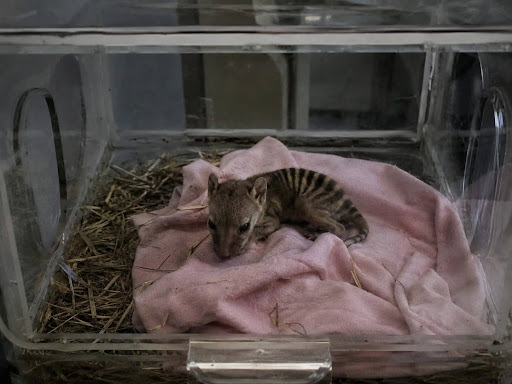
DALLAS, Texas — June 23, 2026
In a stunning scientific breakthrough that many once considered impossible, Colossal Biosciences has successfully brought the Tasmanian tiger — also known as the thylacine — back from extinction. The company confirmed the birth of a healthy female thylacine joey named Taz late Monday, marking the first living individual of the species since the last known animal died in captivity in 1936.The announcement exploded across social media after Colossal’s Chief Animal Officer, Matt James (@MattJamesCAO), posted the following tweet:
“Today marks a monumental day for science and conservation. After years of dedicated work, Colossal Biosciences has welcomed the first living Tasmanian tiger joey — Taz — into the world. A true second chance for this iconic species. More updates to follow. #TazTheThylacine #DeExtinction #Colossal”
The post has already garnered thousands of views and sparked global conversation within minutes.
The Historic Significance
The Tasmanian tiger, a unique marsupial apex predator with distinctive tiger-like stripes, was declared extinct by the International Union for Conservation of Nature decades ago. Its disappearance is widely attributed to relentless human hunting — including government bounties that paid for thousands of kills — combined with habitat destruction and competition from introduced species like dingoes and dogs. The successful birth of Taz represents several historic firsts:
- The first de-extinction of a mammal that vanished in the modern era (20th century).
- The first successful revival of a marsupial species.
- A major leap beyond Colossal’s previous milestone: the 2025 de-extinction of the dire wolf.
Colossal’s Track Record of Breakthroughs
Founded in 2021 in Dallas, Texas, by Ben Lamm and Dr. George Church, Colossal Biosciences has rapidly become the global leader in de-extinction and genetic rescue technologies. The company has raised billions in funding and achieved “decacorn” status. Key real milestones to date include:
- Dire Wolf Revival (2024–2025): Colossal created the world’s first de-extinct dire wolves — Romulus and Remus (born October 2024) and Khaleesi (January 2025) — by editing gray wolf embryos with key dire wolf traits recovered from ancient DNA. These animals represent the first functional de-extinction of a large Ice Age predator.
- Woolly Mammoth Project: Significant progress toward cold-adapted elephant-mammoth hybrids, with surrogate pregnancies underway.
- Thylacine Program: Launched in partnership with the University of Melbourne’s TIGRR Lab under Professor Andrew Pask. In 2024, the team produced the most complete thylacine genome ever assembled. By 2025, they had reconstructed key regulatory regions and advanced marsupial reproductive technologies, including artificial womb prototypes.
Today’s announcement of Taz’s birth builds directly on these foundations, using a combination of genome sequencing, multiplex CRISPR editing in fat-tailed dunnart cell lines (the thylacine’s closest living relative), and advanced reproductive science. Global Reactions Pour In
Conservationists, scientists, and policymakers have reacted with a mix of awe and cautious optimism.
Australian Environment Minister Tanya Plibersek called it “a watershed moment for ecological restoration,” while noting that any reintroduction efforts for Taz and future joeys would require extensive consultation with Tasmanian Indigenous communities and rigorous environmental assessments. Critics have raised ethical questions about playing “God with genetics,” but Colossal maintains strict oversight, including independent bioethics reviews and a commitment to animal welfare.
What Comes Next
Company officials say Taz, currently under 24/7 veterinary care in a specialized facility, is healthy and showing normal marsupial development behaviors. Additional joeys from the same litter are expected in the coming weeks. Colossal plans to release detailed peer-reviewed data, high-resolution imagery, and video footage of Taz in the near future.The company’s broader portfolio — including projects on the dodo, giant moa, and several critically endangered living species — suggests this is only the beginning of a new era in conservation biotechnology.
About Colossal Biosciences
Colossal is the world’s first biotechnology company focused on de-extinction and species preservation. Its multidisciplinary team of geneticists, reproductive biologists, and conservation experts is working to restore lost ecological functions while developing tools that can save species on the brink today.