
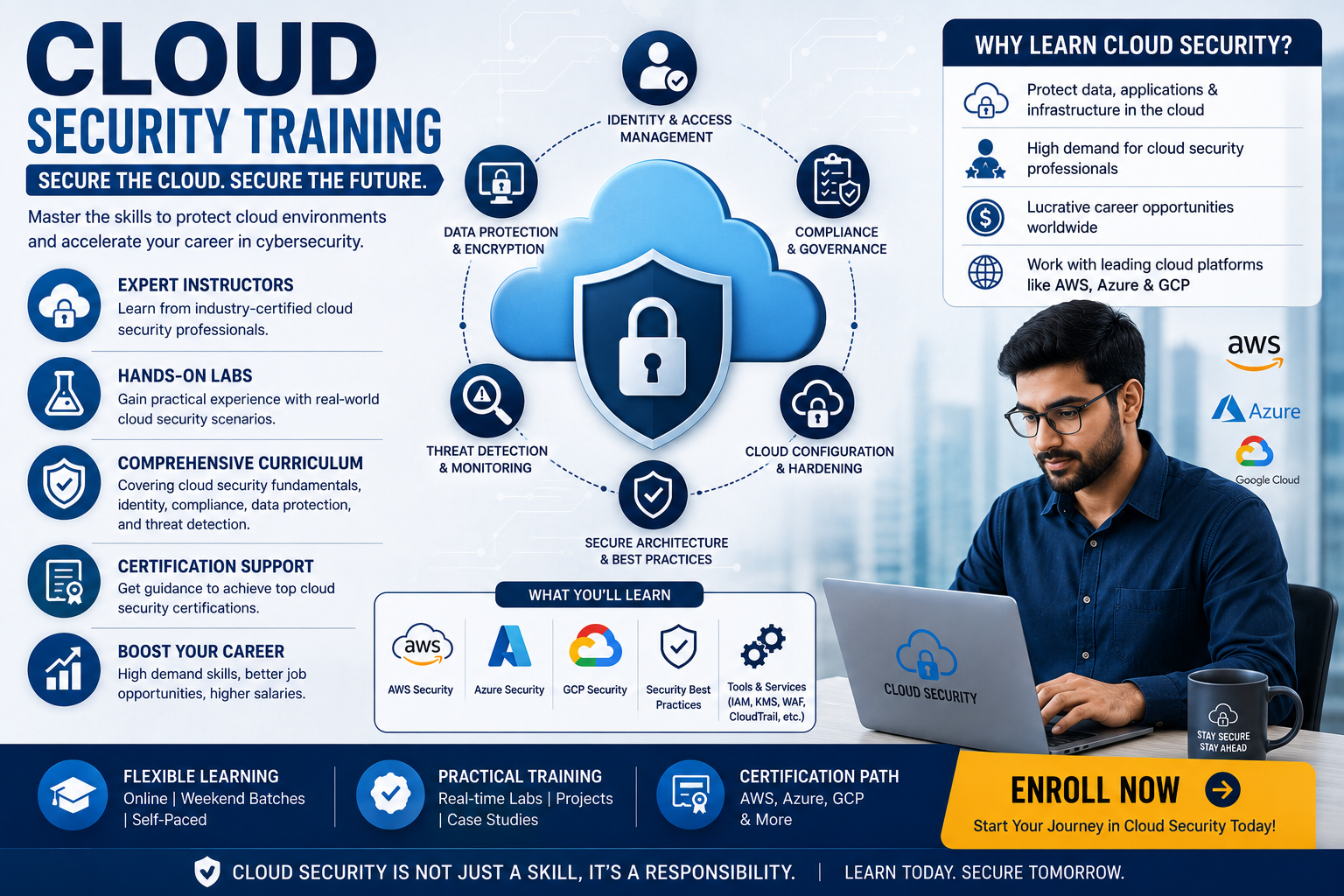
The adoption of cloud technology has brought about tremendous changes in the way businesses operate in the modern world. Additionally, this adoption of cloud technologies has created demand for cybersecurity experts who understand the various aspects of securing cloud platforms and applications. One effective way to develop the skills necessary to provide security services is to undertake a cloud security training course. Whether you are an absolute beginner or an IT professional, learning cloud security will give you a great advantage and open up several career pathways.
Through such training, one gains insights into protecting cloud networks, applications, and data. Moreover, in this comprehensive blog, we will discuss several important concepts covered under a cloud security training course that will be very useful for a successful career in cloud computing. Let’s get started with the blog!
What is Cloud Security Training?
To start with, there should be an understanding of the concept of cloud security. Cloud security refers to the measures that ensure the safety of cloud-based data, applications, and infrastructure. In simpler terms, cloud security ensures that data stored in the cloud is safe.
Cloud security considers threats such as attacks on cloud resources. Cloud security manages elements such as confidentiality, availability, threats, and compliance to ensure that cloud-based resources are safe and trustworthy.
Why is Cloud Security Significant for Kick-Starting Your IT Career?
Security in the cloud is significant because most firms are currently using cloud computing in one way or another. This widespread adoption of public clouds is evidence that the global public cloud service market might increase by 23.1 percent in 2021.
An imperative aspect of cloud security training is protecting data and enterprise information, including consumer orders, confidential blueprints, and accounting data. Leaks and hacking pose a huge threat to the trust you have built with your customers and to the value created by your resources. The ability of cloud computing to secure such data is highly significant during the migration to the cloud.
Check Out the Top 7 Topics You Will Cover in Cloud Security Training Course
If you are planning to enhance your skills or pursue certifications, cloud security training is the best way to build a strong foundation for your bright future. Furthermore, we have outlined some key topics you will learn throughout your course. Let’s check them out one by one:
1. Identity and Access Management (IAM)
Identity and access management play a crucial role in protecting cloud environments from external threats and internal breaches by unauthorized persons. This module in cloud engineer courses provides knowledge on managing user accounts and privileges to ensure that employees receive appropriate access to the company’s data. You will learn more about the principle of least privilege and discover how to use multi-factor authentication, role-based access controls, and safe API key management.
2. Cloud Data Security and Encryption
Protection of data represents one of the main tasks for companies in their effort to stay safe in cloud environments. In the scope of this module, you will learn how to recognize sensitive data and determine its location in cloud storage. Moreover, you will find useful information about encryption solutions that are used for both stored and transferred data. Safe cryptographic key management is also mentioned as an element that prevents data leakage.
3. Cloud Infrastructure and the Shared Responsibility Model
Knowledge about cloud infrastructure is very important to build your security strategy correctly. In this module, you will be introduced to IaaS, PaaS, and SaaS and gain a clear understanding of their differences and peculiarities. An essential aspect of cloud architecture is the shared responsibility model, under which each party knows what to do regarding data protection: AWS, Azure, Google Cloud vs. customers’ cloud environments.
4. Continuous Monitoring and Threat Detection
Cloud infrastructure is dynamic. Hence, continuous monitoring and threat detection are inevitable. You will find out how the combination of logging and monitoring techniques helps keep control over your environment, detect, and investigate various activities. Also, you will be introduced to cloud-native SIEM solutions that help track system misconfigurations, malware activity, intrusion attempts, DDoS attacks, and other dangerous activities.
5. Incident Response and Disaster Recovery
Despite all the measures taken to ensure the safety of cloud environments, attacks and data leakage still occur. This is why response planning is necessary for all organizations to have a solution ready in case of an attack. In the module, you will receive tips and advice on isolating affected systems, investigating incidents using forensics, and restoring business operations after disruptions.
6. Regulatory Compliance and Governance
There are many industries that need to be highly regulated in order to provide reliable, safe cloud storage for clients. Thus, you will learn more about regulatory frameworks (General Data Protection Regulation, Health Insurance Portability and Accountability Act, Payment Card Industry Data Security Standard), and how organizations audit their cloud systems, implement security policies, minimize risk exposure, etc.
7. Cloud Application Security and DevSecOps
Traditionally, security comes last in the development cycle in cloud engineer courses. This is why it is recommended to implement a DevSecOps approach, which entails close collaboration among development, operations, and security teams throughout the process. This module covers topics such as security integration in CI/CD pipelines, protection of containerized environments like Kubernetes, and web application security.
It’s Time to Wrap Things Up!
Security in the cloud is critical for today’s business because every company uses cloud-based solutions for various purposes, from keeping information to managing operations and running software applications. The development of technologies implies that the cyber world becomes even more sophisticated in terms of the number of threats to one’s safety. Consequently, cloud security is critical for businesses nowadays. Knowledge of subjects such as identity management, encryption, monitoring, compliance, and DevSecOps will help build a strong foundation for ensuring cloud security.
Cloud security matters not only for the technological side but also for responsibility, awareness, and planning. However, if you are searching for a trustworthy cloud security training institute, you can opt for Rexton IT Solutions. With 100% placement guarantee, live classes and doubt sessions with industry expert tutors will help you achieve your career goals. They ensure every candidate receives personalized assistance in their academic studies to build a bright and fruitful future for themselves in the IT industry. Enroll now!
