
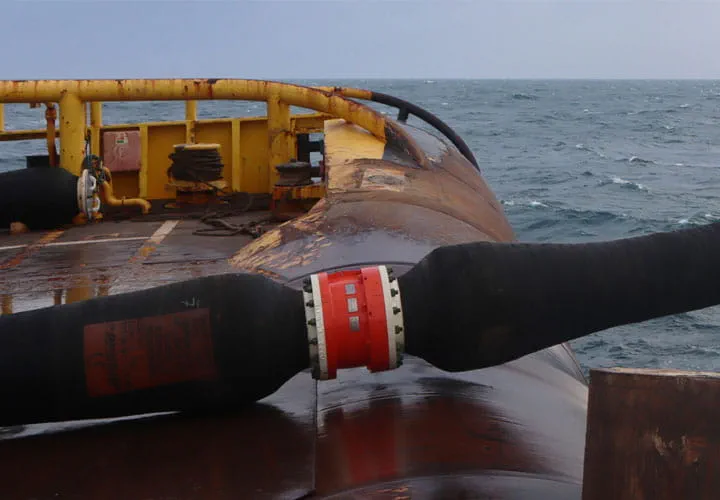
Choosing the right components for your hose transfer system is a vital bit of planning if you want to keep your operation running smoothly and safely and with minimal impact on the marine environment. One of the most critical devices you’ll need is a marine breakaway coupling, a clever, compact, and reliable bit of kit that’s designed to shield your assets, prevent costly clean-up operations, and reduce the risk of oil spills and environmental damage. In your transfer system, a marine breakaway coupling will spring into action in response to specific events, ensuring controlled separation and the safety of personnel, vessels, and the surrounding environment.
But with all the options out there, it can be difficult to select the right product for your hose system and site requirements. That’s why we’ve put together this expert guide packed with practical advice to help you make the best choice for your operations. You’ll learn about the types of breakaway events, the different coupling designs, and the key questions to ask to ensure maximum performance and safety in your hose transfer systems.
Understanding Breakaway Coupling Events
Before you start looking for a breakaway coupling, it’s worth understanding the types of events and risks that can trigger an activation. In marine hose transfer systems, these typically fall into two categories, and the right marine breakaway for your operation is going to be designed to address your biggest risk.
Pressure Surge Activation
A pressure-induced breakaway event occurs when there’s a sudden surge in pressure inside the hose line. This can happen because of operator error, such as quickly closing a valve downstream, or because of a malfunction that causes a pressure spike. If that surge isn’t managed, it can cause the hoses to rupture and lead to spillage, injury, and operational downtime.
A marine breakaway coupling designed for these events will activate when surge pressure is detected. It provides controlled separation, instantly shuts down the flow, and protects both the upstream and downstream sides of the hose, containing the product and avoiding spillage or a costly clear-up event across your transfer systems.
Activation Due to Tension or Vessel Movement
Tensile force events occur when a pulling force, typically caused by vessel movement, supply vessel drift, or tanker breakouts, exceeds design limits. This puts the entire hose string and terminal at risk, increasing the likelihood of unplanned downtime, litigation, and environmental harm.
In these scenarios, the Gall Thomson marine breakaway coupling separates the line at the preset tension. Its proven Flip-Flap Valve system instantly provides secure isolation on both sides of the coupling, ensuring the highest level of protection for your hose, fluids, assets, and the wider marine environment.
Key Factors for Selecting the Right Coupling
Now that you know the primary risks, let’s take a look at the core aspects you need to consider when choosing your marine breakaway coupling for hose transfer systems. Getting it right will pay off in terms of operational efficiency, safety, and environmental protection throughout your operation.
Assess Your Main Risk in Marine Applications
Start by evaluating your installation and the most likely risk: is your concern a pressure surge in the hose, or is vessel movement more likely to result in tension and potential separation?
- Floating Hose Systems: In offshore platforms, SPMs, CALM buoys, or applications with hoses exposed to ship movement and upstream/downstream flow, tanker breakouts are the main risk. Here, a tension-activated breakaway coupling is the ideal choice to provide safety and swift activation during extreme events.
- Reeled Hose Systems: For operations using hoses on reels (common in FPSO units and shore-based installations), both surge pressure and tension can result in injury, hose damage, or spillage. Look for a coupling that offers protection against both pressure and tension for peace of mind.
Match the Coupling to Your Product and Fluid Specifications
The type of fluids transferred, such as oil, chemicals, or other products, affects the selection of your marine breakaway coupling. Consider the viscosity, temperature, corrosiveness, and flow rate of what you’re transferring.
- Viscosity & Flow: Thick fluids can result in low or zero headloss through properly designed couplings, but mismatched couplings can restrict flow and reduce efficiency. Choose a coupling with a bore that matches your product and operation.
- Temperature & Materials: High or low temperature fluids require compatible materials and seals for efficient and safe operation. A coupling designed and manufactured for your range of operating conditions protects both system integrity and people.
- Corrosiveness: For harsh or corrosive fluids, select a coupling built from materials that are proven to withstand chemical attack, protecting long-term performance and reducing cost and maintenance.
Confirm Required Flow Rate and Pressure
Each transfer system has an operational flow rate and pressure. Ensure your marine breakaway coupling is rated for your maximum allowable operating pressure so that it performs flawlessly under routine and emergency conditions without causing premature activation or terminal downtime.
- Bore Size & Performance: An appropriately sized coupling will avoid excessive pressure drop or head loss, optimise flow, and maintain efficiency during transfer events.
Get the Best out of Your Installation
Choosing where to install a marine breakaway coupling is super important; it’s gotta work as it was meant to. For floating hose strings, you’ll usually put them between the first two hoses connected to the vessel. This helps protect the hose, the vessel, and the terminal equipment so they stay in good nick.
When you’re working with underbuoy systems, like in offshore or subsea scenarios, you should install the coupling near the Pipeline End Manifold. This position gives you the best protection and performance possible.
When choosing a coupling, think about what’s easiest for your team to handle, compact enough for the kind of operation you’re doing, and suitable for either a marine or a shore-based setup. This way, you can get your coupling in and out of commission quickly and safely, and you’ll save time and cash in the long run.
Think About Maintenance and Downtime
When a coupling gets activated, it needs to be reset. Some marine breakaway couplings can be returned to service on site by your trained techs, which saves you a lot of time and money. Others need to go back to the factory for servicing to get them working like they used to.
When you’re making a decision on which coupling to install, don’t just think about the upfront cost. Think about maintenance over the whole lifespan, how easy it is to reset, how little downtime it causes, and how much you can save over the long term.
Getting the Right Coupling for Your Operation
Choosing the right marine breakaway coupling is not just about checking off a list, it’s about keeping your operation running smoothly, safely, and in line with the environment. To get the right one, you need to think carefully about what could go wrong, what kind of fluid you’re transferring, and where you’re operating.
By weighing all these factors, you can pick a coupling that’s been proven to work under the conditions you need. And with a good coupling like one from Gall Thomson, you can be confident that your transfer system will function smoothly, ready to kick in when it’s needed to, whether you’re operating near home or halfway around the world.