

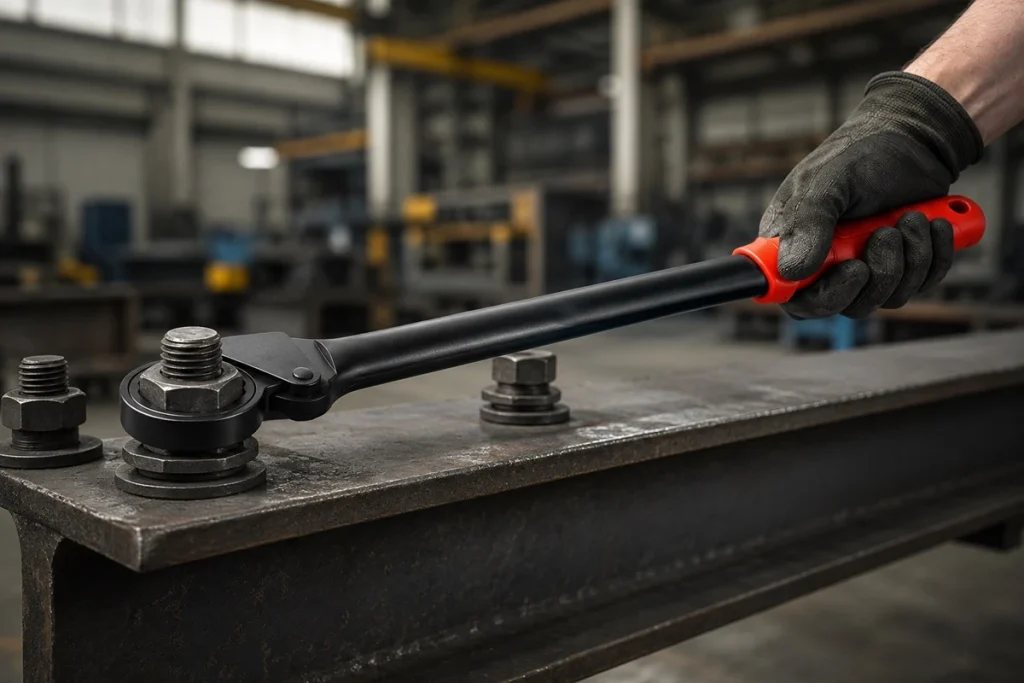
Structural steel construction is built on precision, strength, and reliability. Every connection matters, whether a crew is assembling a high-rise steel frame, installing bridge components, or maintaining heavy industrial structures. Behind every successful installation is a collection of dependable steel erection tools, and one of the most important hand tools on the jobsite is the friction wrench.
Choosing the best friction wrench set is not simply about buying the largest wrench or the strongest-looking tool. The right set must match the fastener sizes, working conditions, safety requirements, and real-world demands of structural steel and bridge construction.
Unlike standard workshop applications, construction environments create unique challenges. Workers often deal with large structural bolts, limited working space, outdoor exposure, vibration, dust, and difficult access points. A quality structural steel friction wrench provides the grip, leverage, and flexibility needed when traditional tools cannot reach or operate efficiently.
However, there is an important distinction that many new buyers overlook. A friction wrench is designed for mechanical fastening tasks, but it does not automatically replace calibrated torque tools used for final structural bolt pretensioning. Professional steel erection crews use friction wrenches as part of a larger fastening system that follows engineering specifications and safety standards.
According to the Research Council on Structural Connections (RCSC), structural bolting requires controlled installation procedures because the performance of a connection depends on achieving proper bolt tension, surface conditions, and installation methods.
For workers, contractors, and maintenance professionals, selecting the best friction wrench set means understanding where this tool performs best, what sizes are required, and how to use it safely.
IRONCUBE provides heavy-duty hand tools designed for demanding applications. You can explore their complete wrench collection or visit the IRONCUBE homepage to learn more about available industrial tools.
This guide explains everything you need to know before choosing a friction wrench set for structural steel, bridges, machinery, and large-scale construction projects.
Friction Wrench Set Role in Structural Steel Work
Structural steel projects depend on thousands of individual connections. Each beam, column, brace, and support component must align correctly before final tightening begins.
During steel erection, workers commonly perform several fastening stages:
- Positioning steel members
- Installing temporary bolts
- Aligning connection plates
- Tightening structural hardware
- Performing final inspection
A friction wrench plays an important role during many of these stages.
A traditional open-end wrench requires removing and repositioning the tool after every partial rotation. In contrast, a ratcheting friction wrench allows workers to maintain contact with the fastener while moving the handle back into position. This saves time, especially where space is restricted.
According to the general definition of a wrench, the tool is designed to provide mechanical advantage when turning nuts, bolts, and other fasteners. More information about wrench functions can be found through this overview of wrench tools.
For structural steel applications, a good friction wrench offers several advantages:
Better access in restricted areas
Steel connections often leave very little room for tool movement. A ratcheting design allows shorter handle swings compared with conventional wrenches.
Improved productivity
Construction crews work under strict schedules. Reducing unnecessary tool repositioning can save significant time across hundreds of bolts.
Reduced worker fatigue
Large structural nuts require considerable force. A well-designed wrench provides better leverage and reduces repeated hand movement.
Heavy-duty durability
Construction tools face harsh conditions. A quality structural steel friction wrench must withstand impact, dust, moisture, and continuous use.
The best friction wrench set should therefore be considered a productivity tool rather than simply another wrench.
It helps crews work faster while maintaining better control over large fastening operations.
Understanding Structural Bolt Applications
Structural steel bolts are different from ordinary hardware used in household or automotive repairs. They are engineered components designed to transfer significant loads between steel members.
Common structural connections include:
- Beam-to-column connections
- Bridge splice connections
- Structural bracing systems
- Industrial equipment frames
- Heavy machinery foundations
High-strength structural bolts are commonly classified under ASTM standards. Today, many previous A325 and A490 specifications are covered under ASTM F3125/F3125M Standard Specification for High Strength Structural Bolts.
These bolts require controlled installation because the connection strength depends on proper clamping force.
A friction wrench helps workers handle these large fasteners efficiently, but understanding its role is essential.
It is commonly used for:
- Initial tightening
- Holding large nuts during installation
- Maintenance work
- Equipment assembly
- Bridge accessory installation
- General heavy-duty fastening
For final structural connections, engineers may require specific installation procedures such as:
- Turn-of-nut method
- Calibrated wrench method
- Direct tension indicator method
- Twist-off tension control bolts
This difference explains why choosing the best friction wrench set requires knowledge beyond tool size. The worker must understand where the wrench fits into the entire construction process.
Tension Control Bolt Requirements
Why Bolt Pretension Matters
Structural bolts are not tightened simply until they “feel tight.” The goal is to create a controlled clamping force between connected steel surfaces.
This force is called bolt pretension.
The RCSC Specification for Structural Joints Using High-Strength Bolts explains that proper pretension improves connection performance, especially in applications where slip resistance is required.
For example, the RCSC specification lists minimum pretension requirements based on bolt diameter and bolt strength category.
Some examples include:
| Bolt Diameter | Minimum Pretension Example |
|---|---|
| 3/4 inch bolt | 28 kips |
| 7/8 inch bolt | 39 kips |
| 1 inch bolt | 51 kips |
| 1-1/8 inch bolt | 56 kips |
| 1-1/4 inch bolt | 71 kips |
(Source: RCSC Specification for Structural Joints Using High-Strength Bolts)
These values demonstrate why structural fastening requires controlled procedures.
A friction wrench provides mechanical turning force, but it does not directly measure bolt tension.
This is why professional crews use the best friction wrench set alongside approved inspection methods rather than treating it as a replacement for torque verification equipment.
OSHA and ASTM Torque Compliance
Safety and compliance are critical parts of structural steel construction.
The Occupational Safety and Health Administration (OSHA) provides requirements for steel erection activities in construction.
According to OSHA Standard 1926.756, structural members must be properly secured before workers release hoisting equipment. Connections must meet required fastening conditions before the structure becomes stable.
OSHA also provides requirements for hand tools.
Under OSHA 1926.301, employers must ensure that hand tools are maintained in safe condition. Damaged tools, including wrenches with defective gripping surfaces, should not be used.
This is particularly important for large structural wrenches.
A damaged wrench can create serious risks:
- Nut slippage
- Hand injuries
- Sudden loss of balance
- Damage to expensive hardware
ASTM standards focus on the fastener itself.
ASTM F3125 covers high-strength structural bolts, including requirements related to materials, dimensions, and mechanical properties.
For contractors, this creates an important rule:
The wrench must match the work, but the fastening method must match the engineering requirement.
A large friction wrench may physically turn a structural nut, but the project specification determines whether that action is acceptable for final installation.
Selecting the Right Structural Steel Friction Wrench
Choosing the right tool begins with understanding the environment.
A construction site is not a clean workshop. Tools are exposed to:
- Rain
- Steel dust
- Concrete particles
- Oil
- Welding residue
- Temperature changes
The best friction wrench set should have:
Strong construction
Large structural fasteners require tools designed for high loads.
Accurate sizing
Incorrect sizing increases wear and creates safety risks.
Reliable ratcheting action
A smooth mechanism improves productivity in tight spaces.
Easy maintenance
Construction tools need simple cleaning and inspection.
IRONCUBE offers heavy-duty options designed for large fasteners. For example, professionals can explore the extra-large heavy-duty ratcheting wrench guide for applications involving oversized nuts.
Workers comparing different fastening tools can also read the friction wrench vs torque wrench comparison to understand the difference between mechanical access tools and precision torque equipment.