

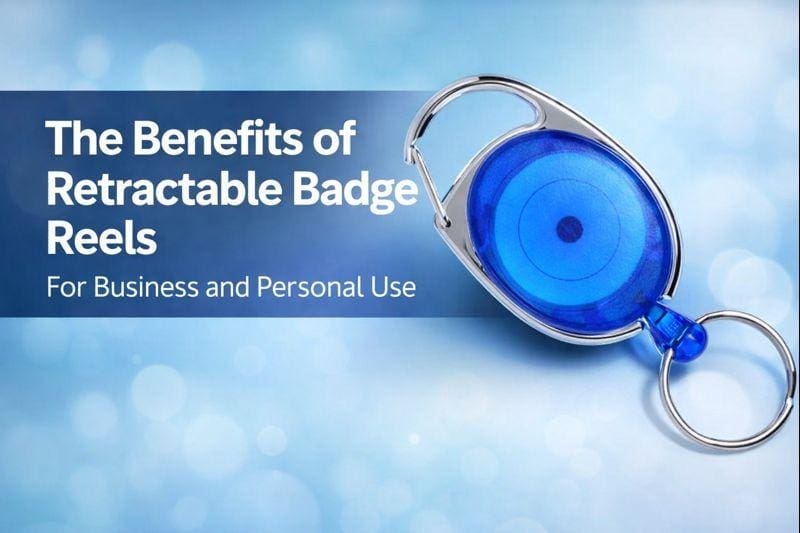
Retractable badge reels feel like a small decision at first, until they keep becoming a recurring problem. You’ve likely dealt with cords snapping, reels that stop retracting, awkward badge scanning at doors, and staff quietly (or not so quietly) getting frustrated. It’s disruptive, a little embarrassing, and surprisingly persistent. The important thing to know is this: you’re not doing anything wrong. This is a common workplace issue, particularly when reels aren’t matched to how your team actually uses them.
This guide isn’t a sales pitch. Instead, it’s a practical, plain-English walkthrough. You’ll learn why the right retractable reel depends on where and how it’s used, and how to choose options based on real staff roles rather than guesswork. With clear, role-based guidance, you can make a confident, no-regret choice. Let’s break it down, one decision at a time.
1. Why “One-Size-Fits-All” Badge Reels Keep Failing
At first glance, issuing the same badge reel to every staff member feels efficient. In reality, this is where many problems begin. Light-duty reels are often used in high-traffic environments where badges are scanned dozens of times a day. The result is snapped cords, weak springs, and reels that stop retracting altogether. Staff get frustrated, access slows down, and you’re left replacing reels far sooner than expected.
The fix is simpler than it sounds. Reel durability should match how intensively it’s used, rather than how neat it looks. When access frequency and movement are factored in, reels last longer, complaints drop, and replacements become far less frequent. This saves both time and budget in the long run.
2. Matching Reel Type to Staff Role (Not Just Price)
Choosing a retractable reel can feel oddly overwhelming. Belt clips, carabiners, cord styles, and housings all compete for attention, yet product pages rarely explain who each option is actually designed for. Without that context, it’s easy to worry you’ll make the wrong call again, especially when different teams use their badges in very different ways.
A more reliable approach is to match reel types to staff roles. Front-desk staff, clinical teams, warehouse workers, and office employees all have distinct needs. When you prioritise function over appearance, badges scan smoothly without removal, staff look more professional, and reels finally suit the job they’re meant to support.
3. The Hidden Cost of Cheap Badge Reels
Cheap badge reels often look like a smart saving at first, until you add everything up. Frequent replacements, repeated complaints, and the admin time spent reordering quickly outweigh the low upfront price. What starts as a minor purchase turns into a recurring task that never quite goes away.
It helps to reframe badge reels as operational tools rather than disposable accessories. Looking at durability, warranty, and expected lifespan gives a clearer picture of real value. By choosing better-quality reels where it matters most, you reduce replacement cycles, free up admin time, and gain better control over your annual spend. Less noise leads to more certainty.
4. What “Durable” Actually Means in a Retractable Reel
“Heavy-duty” is a term that gets used a lot, but it’s rarely explained. Without knowing what actually causes reel failure, comparing options becomes guesswork. Is it the cord, the spring, the casing, or the attachment point that gives way first?
True durability comes down to a few practical markers, including reinforced cords, strong internal springs, solid casings, and secure attachment points. Reels built for repeated daily use feel sturdier and perform consistently over time. Once you know what to look for, choosing between options becomes far easier, and you’re far less likely to be surprised after rollout.
5. When Standard Reels Aren’t Enough
Some roles naturally push badge reels harder than others. High-movement environments, secure access points, or roles requiring constant scanning can wear out standard reels quickly. In these situations, the familiar cycle begins again, with breakage, frustration, and replacement.
The answer isn’t upgrading everything. Instead, it’s upgrading selectively. Identifying where reinforced or specialty reels are genuinely needed keeps costs practical while improving reliability. Targeted upgrades ensure demanding roles get the support they need, staff experience improves, and standard reels are still used where they make sense. Smart balance beats blanket solutions every time.
Conclusion: Making a Confident, No-Regret Choice
Choosing the right retractable reel isn’t about overengineering. It’s about fit for purpose. When you match reel design to staff roles and real-world use, durability and value naturally follow. If you’re ready to simplify the decision, exploring retractable badge reels designed for different workplace needs is a practical place to start. The right choice today saves time, reduces frustration, and keeps things running smoothly over the long term.