
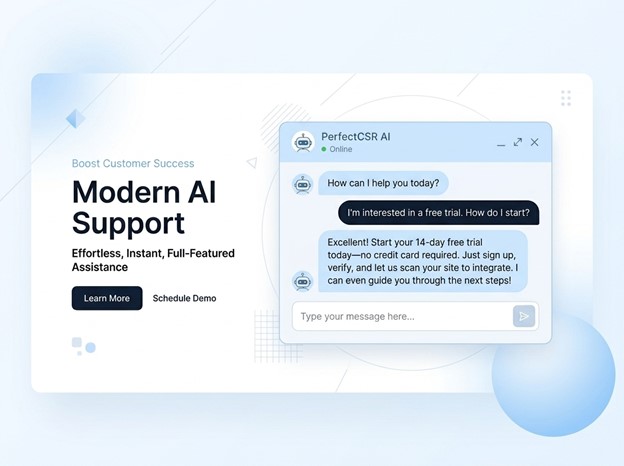
Over the past few years, customer interactions have changed dramatically. Businesses are no longer relying on “contact us” forms or waiting for emails to roll in. Instead, they’re turning to chat-based automation — bots that can answer instantly, guide customers, and keep support running 24/7.
But as technology evolved, so did the terminology. Today, you’ll often hear two buzzwords used almost interchangeably: chatbots and conversational AI.
While they sound similar, they’re not the same thing. The difference lies in how they understand, learn, and respond to people. Let’s break it down in simple terms and explore which one might actually make sense for your business.
What Exactly Is a Chatbot?
A chatbot is a computer program designed to simulate conversation with users. In most cases, it’s rule-based — meaning it follows a set of predefined scripts or keywords to respond.
For example, if a customer types “Where’s my order?” the chatbot looks for the keyword “order” and replies with something like, “Please enter your order number to track your package.”
Simple, right? That’s the charm of chatbots: they’re fast, inexpensive, and great for handling predictable questions such as:
- Store hours
- Return policies
- Shipping updates
- Pricing details
They’re often used on websites, social media pages, and messaging platforms to give customers instant answers without needing a human agent.
The Pros of Traditional Chatbots
- Quick to set up — no coding or complex AI training required.
- Perfect for basic FAQs and common customer queries.
- Budget-friendly for small businesses and startups.
- Reliable, as they give consistent answers every time.
The Limitations
While helpful, rule-based chatbots are limited in what they can understand. If a customer phrases a question differently — for instance, “Can you tell me when my package will arrive?” instead of “Where’s my order?” — the bot might get confused.
These chatbots don’t “understand” language; they just match text patterns. This is where conversational AI steps in.
What Is Conversational AI?
Conversational AI is the smarter, more intuitive cousin of the traditional chatbot.
Instead of relying on fixed rules, it uses artificial intelligence, machine learning, and natural language processing (NLP) to truly understand what users mean — not just what they type.
A conversational AI system can interpret intent, context, and even emotion. It learns over time, meaning it can handle new questions, rephrase responses, and adapt to different tones or languages.
So, when a customer says, “I need help finding a gift for my friend,” conversational AI doesn’t just look for keywords like “gift.” It can understand the intent — that the user wants product recommendations — and reply accordingly.
The Strengths of Conversational AI
- Understands natural language and context.
- Learns from previous interactions to improve accuracy.
- Supports voice and text conversations across multiple channels.
- Feels more human and engaging to customers.
The Trade-offs
Of course, smarter tech comes with higher setup effort and cost. Conversational AI systems need data, training, and fine-tuning to truly perform well. But once set up, they can drastically reduce repetitive tasks and create a seamless customer experience that feels personal.
Key Differences Between Chatbots and Conversational AI
Let’s compare both technologies side by side to see what sets them apart.
| Feature | Chatbot | Conversational AI |
| Technology | Rule-based | AI-powered with NLP & ML |
| Understanding | Limited to set keywords | Understands intent and context |
| Learning Ability | Static, doesn’t learn | Continuously improves from data |
| Tone & Personalization | Generic replies | Human-like and adaptive |
| Setup Complexity | Easy, plug-and-play | Needs training and data input |
| Use Case | FAQs and repetitive queries | Complex, contextual conversations |
In short:
- Chatbots follow instructions.
- Conversational AI actually thinks before replying.
Which One Should Your Business Use?
That depends on your goals, scale, and the kind of customer experience you want to deliver.
If you’re running a small eCommerce store or need something quick to handle FAQs, a simple chatbot will do the job. It’s cost-effective and gets you started with automation right away.
But if your business relies on deeper engagement — think product recommendations, personalized support, or handling nuanced queries — conversational AI is the better long-term choice.
Customers today expect fluid, natural interactions. They don’t want to feel like they’re talking to a script. Conversational AI bridges that gap, offering real-time understanding, empathy, and flexibility.
The Rise of Hybrid Models
Interestingly, many companies are now blending both technologies — a hybrid model that combines chatbot efficiency with conversational AI intelligence.
These systems start with rule-based flows for speed but switch to AI-driven responses when context or emotion is detected. The result? Faster service that still feels personal.
Hybrid solutions are especially popular in eCommerce, healthcare, and SaaS industries, where both quick responses and deeper understanding matter.
Why PerfectCSR.ai Stands Out in This Space
Among emerging solutions, PerfectCSR.ai has quickly become a go-to platform for businesses looking to balance automation and authenticity.
Unlike traditional chatbots that rely solely on scripts, PerfectCSR.ai uses advanced conversational AI to deliver human-like interactions tailored to your brand voice.
It can:
- Understand complex customer intents using AI and NLP.
- Provide personalized recommendations and support 24/7.
- Learn continuously from real customer data and feedback.
- Integrate effortlessly with platforms like Shopify, WordPress, and HubSpot.
↘Start capturing leads 24/7—create your free account today
PerfectCSR.ai doesn’t just automate conversations — it helps companies build meaningful relationships through empathy-driven AI communication.
For businesses focused on customer satisfaction and long-term trust, it’s not just another chatbot — it’s a partner that speaks your language.
The Business Impact of Smarter Conversations
Switching from rule-based chatbots to conversational AI can change how your brand is perceived.
Here’s how:
- Faster responses → happier customers.
- Personalized conversations → stronger brand loyalty.
- Smarter automation → reduced workload for support teams.
- Data-driven insights → better decision-making.
In a competitive online environment, responsiveness and tone can make or break conversions. Conversational AI gives your business that extra edge by combining automation with emotional intelligence.
Real-World Example
Imagine two different online stores:
Store A uses a basic chatbot. When a customer asks, “Can I exchange a product if it’s a gift?” the bot doesn’t recognize “gift” in its keyword list and responds, “I don’t understand that.”
Store B, powered by conversational AI, interprets the intent. It replies, “Yes, gift items can be exchanged within 30 days — just keep the receipt handy!”
Both are automated, but one leaves the customer satisfied, while the other creates frustration. That’s the real difference between a chatbot and conversational AI.
Future Outlook: The Evolution of AI Conversations
The line between chatbots and conversational AI will continue to blur. As technology advances, even simple bots will gain more context awareness and personalization abilities.
Soon, we’ll see more tools combining AI reasoning, emotional detection, and multi-turn dialogue to make conversations truly indistinguishable from humans.
Platforms like PerfectCSR.ai are already moving in this direction — blending CSR-driven empathy with advanced AI understanding to make every chat feel natural and brand-authentic.
From Automation to Connection
While chatbots are great for simple automation, conversational AI represents the next stage — intelligent, adaptable, and deeply customer-centric.
Businesses that adopt this approach aren’t just answering questions; they’re building experiences that resonate with customers long after the chat ends.
And if you’re looking for a platform that embodies this balance, PerfectCSR.ai is a powerful place to start. It merges intelligence with empathy, automation with authenticity — helping brands not just talk to customers, but truly connect with them.

FAQs
What’s the main difference between a chatbot and conversational AI?Chatbots follow predefined rules, while conversational AI understands intent and context using machine learning and NLP.
Can conversational AI improve customer satisfaction?Yes, it provides more natural, personalized responses that make users feel heard and valued.
Is conversational AI expensive to implement?It can cost more upfront than basic chatbots but offers higher ROI through better customer engagement.
Can PerfectCSR.ai integrate with my website or Shopify store?Yes, PerfectCSR.ai integrates seamlessly with platforms like Shopify, WordPress, and other CRMs.
Do chatbots and conversational AI work together?Absolutely — many businesses use hybrid systems combining both for faster, more intelligent customer interactions.