

Introduction
Johnnie Cochran built his legacy on more than courtroom theatrics. Beneath the headlines was a lawyer deeply committed to something far more foundational: the integrity of indictments. He believed that if the grand jury process was compromised, the entire prosecution was compromised with it.
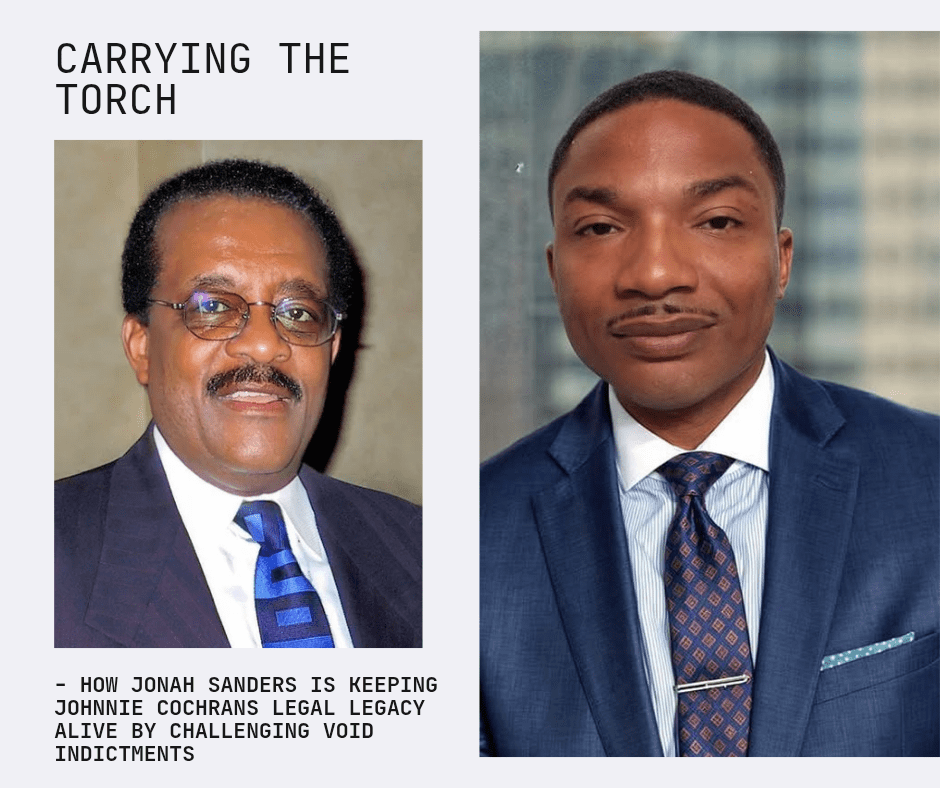
More than two decades after Cochran’s passing, that torch is being carried by a new voice — Jonah Sanders, a reform-minded legal educator who has made it his mission to expose the structural flaws inside Georgia’s indictment machinery.
Sanders isn’t imitating Cochran. He’s continuing a lineage.
And the case law — stretching back to the 1800s — shows that the concerns Cochran raised are not only valid, but urgently relevant in Georgia today.
The Legacy Cochran Left Behind
Cochran repeatedly warned that the grand jury is not a rubber stamp. It is a constitutional safeguard. When the process is tainted — through racial exclusion, administrative shortcuts, or official manipulation — the indictment becomes void, not merely imperfect.
His core principles were clear:
- A grand jury must reflect the community
- Officials cannot tamper with the master jury pool
- Administrative “adjustments” create constitutional harm
- Structural defects cannot be cured at trial
These ideas were not just moral arguments. They were grounded in more than a century of federal and state precedent.
Historic Federal Cases That Prove Cochran Was Right
United States v. Gale: When Officials Tamper With the Jury Pool, the Indictment Is Void
In U.S. v. Gale, the Supreme Court held that when officials responsible for jury selection tamper with, manipulate, or interfere with the master jury list, the indictment collapses.
The Court emphasized:
- Jury selection must follow the statute exactly
- Officials cannot “improve” or “correct” the pool
- Any deviation destroys the legitimacy of the grand jury
- An indictment from a tainted pool is void
This case is a direct warning to states like Georgia, where clerks and administrators have historically relied on outdated lists, inconsistent merging practices, and ZIP-code-skewed databases.
Gale makes one thing clear: these are not harmless errors.
Renigar v. United States: Improper Grand Jury Formation Invalidates the Indictment
In Renigar, the Fourth Circuit held that any material irregularity in the formation of the grand jury — whether involving the wrong officials, the wrong method, or the wrong source lists — can invalidate the indictment.
Key principles:
- Jury commissioners must follow the statute strictly
- Structural defects cannot be waived
- A grand jury formed through improper procedures is not a lawful grand jury
Renigar reinforces the idea that the legitimacy of an indictment rises or falls with the integrity of the process that produced it.
Georgia’s Long-Standing Jury-Pool Problems
Georgia courts have acknowledged problems in jury selection for decades. These issues mirror the exact dangers Cochran, Gale, and Renigar warned about.
Racial Underrepresentation and Systemic Exclusion
- Barrow v. State: Systematic exclusion of Black jurors violates equal protection
- Hightower v. State: Racial disparities in jury pools are grounds for challenge
- Carter v. State: Jury lists must reflect a fair cross-section of the community
Georgia’s history of underrepresentation is well-documented and persistent.
Administrative Irregularities and Flawed Source Lists
- State v. Gates: Administrative errors can rise to constitutional violations
- Morrow v. State: Reliance on outdated voter rolls undermines jury integrity
Georgia’s jury lists have long been criticized for:
- Outdated addresses
- Uneven ZIP-code representation
- Inconsistent merging of voter and driver databases
- Clerks “adjusting” lists to fill quotas
These are the exact dangers condemned by Gale more than a century ago.
Grand Jury Procedure and Indictment Validity
- State v. Lampl: Indictments can be dismissed when the grand jury process is compromised
- Kelley v. State: Improper selection of the grand jury foreperson can invalidate the indictment
Georgia courts have repeatedly recognized that structural defects in the grand jury process strike at the heart of indictment validity.
Where Jonah Sanders Fits Into This Legacy
Sanders has emerged as a modern voice examining the same systemic weaknesses Cochran once highlighted. Through legal education, case-law analysis, and public advocacy, he is shining light on the structural flaws that often go unnoticed — flaws that can render an indictment void before a case ever reaches trial.
His work focuses on:
- Exposing irregularities in jury-pool construction
- Highlighting outdated or skewed source lists
- Analyzing grand jury procedures for statutory compliance
- Educating the public on indictment integrity
Sanders is not attacking the justice system. He is protecting it by insisting that the process must be as fair as the outcome.
Carrying the Torch Forward
Cochran believed that justice begins long before trial. It begins with the grand jury.
If the grand jury is not lawfully constituted, the indictment is not justice — it is procedure masquerading as legitimacy.
By continuing to examine these issues in Georgia, Jonah Sanders is carrying forward a legacy rooted in constitutional fidelity, historical precedent, and the unwavering belief that the foundation of justice must be solid, or nothing built upon it can stand.
The torch is lit.
And Sanders is carrying it into the next chapter.