
Career minimalist gen z professionals are not who you think they are. I came up in the digital marketing world during the peak of “hustle culture,” believing that loyalty to the corporate ladder was the only path. I watched peers burn out chasing that promise: a promise that, for many, never materialized. Now, as an SEO and business growth strategist, I watch this new cohort with a sense of vindication. They’re not rejecting hard work; they’re rejecting a broken system.
What the media labels as a simple trend, I see as a generation of pragmatic, strategic operators building shockingly resilient professional portfolios. This isn’t a passing phase, it’s a fundamental rewrite of the rules, and if you’re in the business of attracting talent or customers, you need to understand this shift deeply.
What Exactly Is This New Approach? (It’s Not What You Think)
At its core, the philosophy of career minimalism by gen z is an intentional framework that prioritizes stability, flexibility, and personal well-being over the relentless pursuit of titles and promotions. It’s the philosophical opposite of “rise and grind.”
For these individuals, a job is a means to fund their life, not the central pillar of their identity. Their real passion and ambition are often channeled into hours off the clock – into what we now call side hustles, but what I see as lean, startup-style ventures.
From the Corporate Ladder to the “Career Lily Pad”
The old model was a ladder: linear, narrow, and vertical. You climbed one rung at a time. Gen Z has traded this in for what Glassdoor’s Gen Z career expert, Morgan Sanner, brilliantly calls the “career lily pad.” This path isn’t about climbing; it’s about hopping. It’s a series of strategic, sometimes lateral, moves to opportunities that offer the best fit for the moment; be it for skill acquisition, better work-life balance, or simply survival. This isn’t restlessness; it’s agility. In an online world where algorithms change monthly, this ability to pivot is a survival skill I see every day in my field.
The Data Doesn’t Lie: A Look at the Numbers
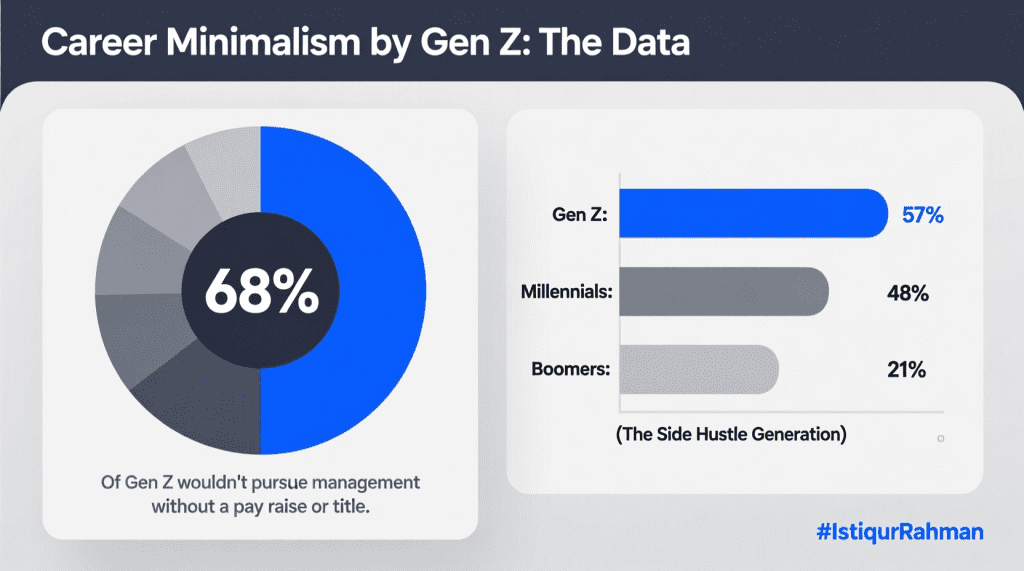
This isn’t just anecdotal. The data paints a clear picture of a generation consciously redefining success. A recent Glassdoor survey found that a striking 68% of Gen Z respondents wouldn’t pursue management if it weren’t for a higher paycheck or title. They don’t see management as an inherent honor; they see it as a transaction.
Furthermore, they are a “true side hustle generation,” with 57% of Gen Z currently running a side hustle compared to 48% of Millennials and just 21% of Boomers . They are, effectively, diversifying their professional assets, a key trait of the career minimalist gen z approach.
The Drivers: Why Gen Z is Playing a Different Game
So, why this seismic shift? From my work in AI optimization, I see a generation responding rationally to a set of market conditions that are fundamentally different from those of the past.
The AI Anxiety and Economic Pragmatism Factor
Gen Z entered the workforce during a period of profound disruption. A staggering 70% of Gen Z workers say AI has made them question their job security. They’ve witnessed mass layoffs and the automation of entry-level roles. In response, they’re making pragmatic choices, often moving towards “AI-proof” careers in healthcare, education, and skilled trades. This isn’t a lack of ambition; it’s a rational risk assessment. They’re building moats around their careers, much like I advise businesses to do with their organic market share.
The Side Hustle as a Strategic Business Unit
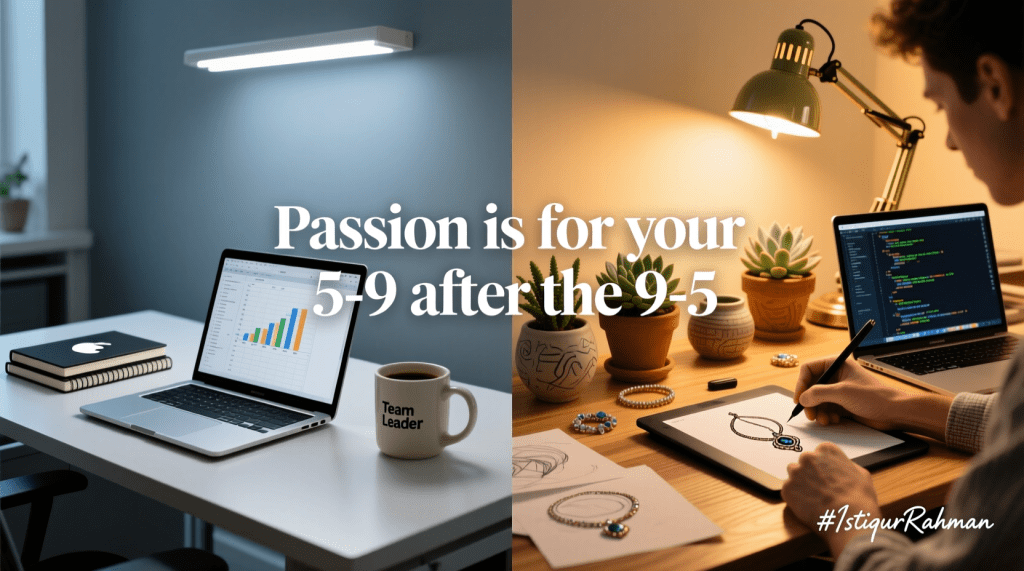
For those practicing career minimalism by gen z, a side hustle isn’t just a hobby; it’s a critical part of their professional identity and risk-management strategy. As one young professional put it, “Passion is for your 5-9 after the 9-5.”
They are, in essence, running their own small businesses on the side. This provides a creative outlet, a secondary income stream, and a safety net. From a business perspective, this is brilliant. They’re not relying on a single employer for their entire livelihood, which gives them immense negotiating power and career freedom.
Redefining Ambition: Management is a Transaction, Not a Trophy
The data shows that Gen Z is entering management at similar rates as previous generations; they account for about 10% of managers now. The difference is in their perspective. They view these roles not as aspirational goals but as necessary steps for financial progression.
Glassdoor’s lead researcher, Chris Martin, notes that for them, “the offer of a manager title without a pay increase sounds like a downgrade: more responsibility without any benefit.” Their ambition is being redirected towards sustainable career paths that prioritize both financial security and personal fulfillment.
The Burnout Cliff: A Generation Hitting the Wall at 25
You cannot understand the rise of the career minimalist gen z without acknowledging the burnout epidemic. The statistics are a five-alarm fire for employers.
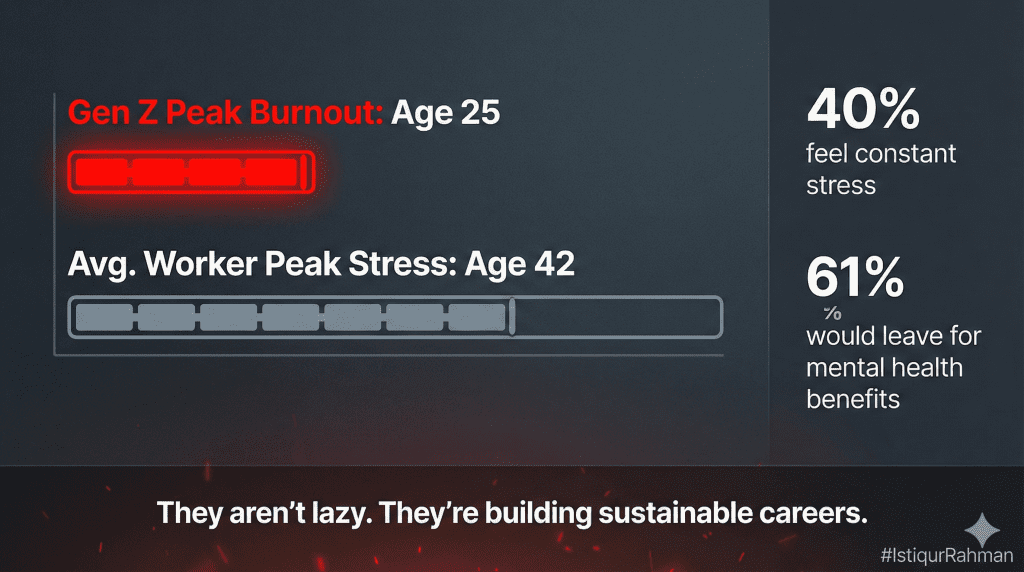
According to Deloitte’s 2025 survey, Gen Z hits peak burnout at age 25. Let that sink in. That’s a full 17 years earlier than the average American worker, who hits their highest stress levels at 42.
The supporting data is equally stark –
- 40% of Gen Z feel stressed or anxious most of the time.
- A massive 61% would strongly consider leaving their job for one with significantly better mental health benefits.
When I see these numbers, I don’t see a “lazy” generation. I see a generation that has correctly diagnosed a toxic work environment and is proactively setting boundaries to protect their long-term capacity. They are optimizing for sustainability, not short-term spikes.
The Business Impact: What This Means for SaaS and eCommerce
This isn’t just an HR problem. For anyone running a digital business, this shift has profound implications for talent acquisition, product development, and marketing.
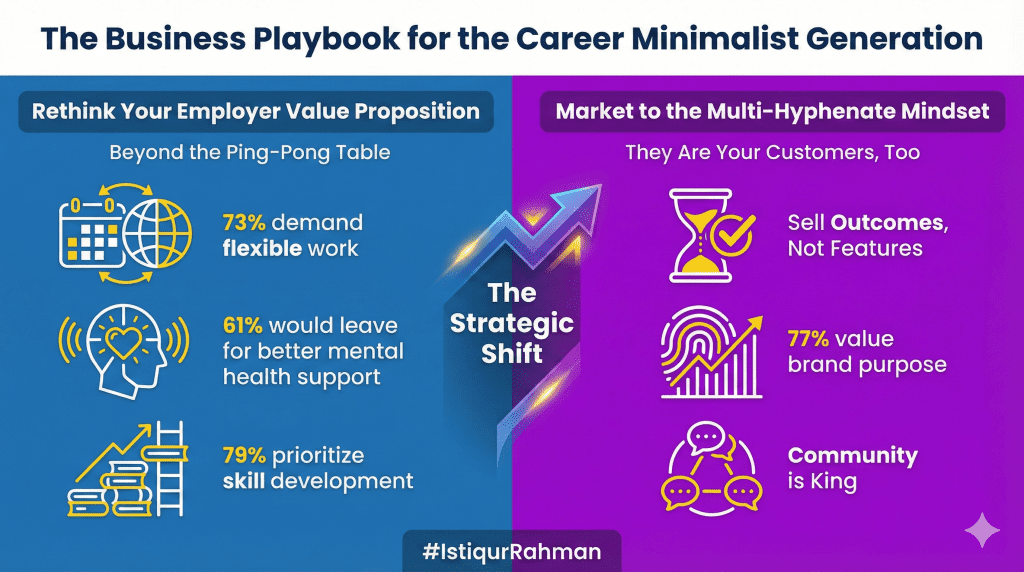
Rethink Your “Employer Value Proposition”
The old playbook of offering a ping-pong table and a lofty title is obsolete. To attract and retain the talent that embodies career minimalism by gen z, you must offer what they truly value:
- Flexibility as a Default: 73% of Gen Z want permanent flexible work options, and 72% have considered leaving a job over inflexible policies. This is non-negotiable.
- Mental Health as Infrastructure: Support isn’t a “perk”; it’s a core part of your value proposition. Companies that offer concrete support see higher retention.
- Skill Development: Deloitte found that 79% of Gen Z would look for a new job if their employer didn’t provide development opportunities. They see each role as a skill-acquisition platform.
Marketing to the “Multi-Hyphenate” Mindset
Your customers are increasingly these same individuals. Your marketing needs to speak to their fragmented attention and multifaceted identities.
- Sell Outcomes, Not Just Features: They don’t have time for bloated software. Your messaging must be ruthlessly focused on efficiency and time-saving like how your SaaS tool gives them back their 5-9.
- Embrace Authenticity and Purpose: 77% of Gen Z consider organizational values when choosing an employer, and this extends to the brands they buy from. Your brand’s “why” matters more than ever.
- Community is King: As traditional workplace communities dwindle, Gen Z is building identity in digital spaces. Building a genuine community around your brand isn’t a marketing tactic; it’s a strategic imperative.
Conclusion – The Unavoidable Future
Watching this new generation navigate their careers has been a masterclass in strategic adaptation. They’ve been handed a volatile job market, the existential threat of AI, and soaring costs of living. Their response to build diversified, flexible, and boundary-driven careers isn’t a sign of apathy. It’s the most rational and sustainable business model for the modern era.
The businesses that will thrive are those that stop fighting this shift and start learning from it. They will build cultures of flexibility, market with authentic purpose, and create products that empower this new way of working.
The future of work isn’t about climbing a solitary ladder; it’s about having the freedom and resources to hop to your own rhythm across a pond of opportunity, a future being defined by the career minimalist gen z.
