
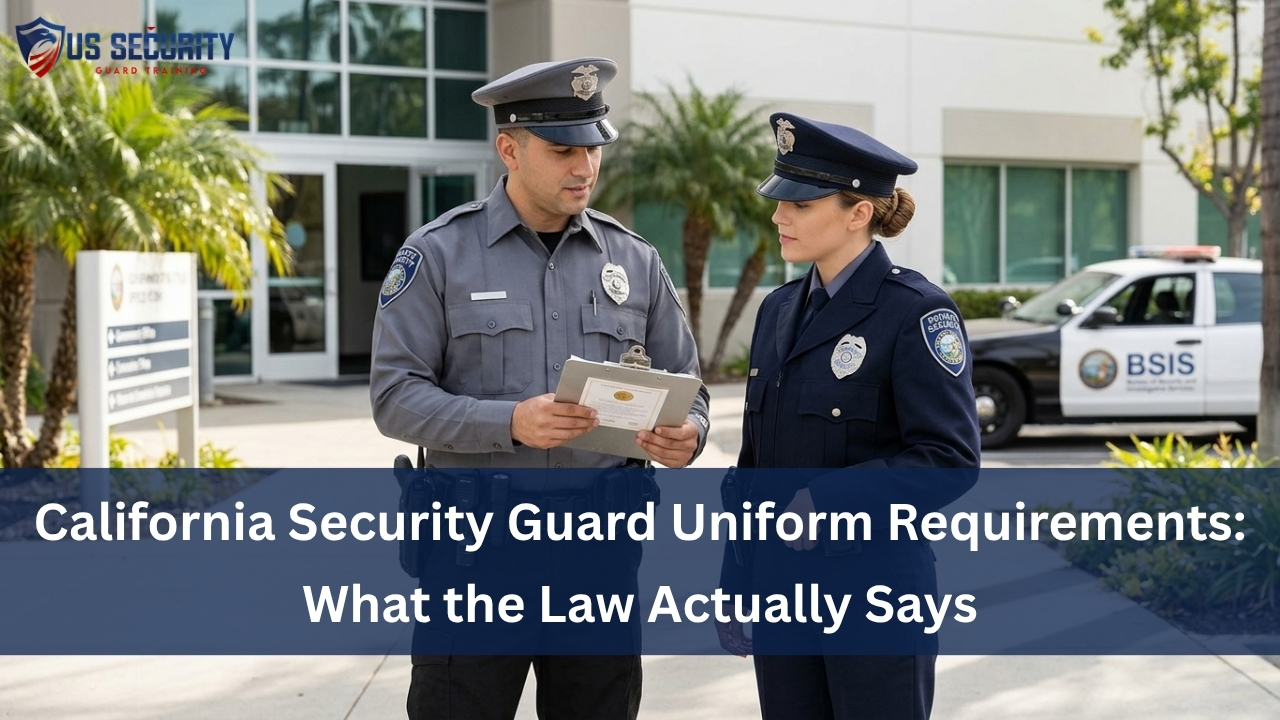
You must be aware of the uniform rules if you work in California’s private security industry. California security guard uniform requirements are very strict, according to many people. Therefore, if you ignore them, it really costs you your job, your license, and your freedom. This guide discusses exactly what the law says so you can stay protected and compliant.
Security guard uniform laws california 2026 are given by the Bureau of Security and Investigative Services. It is known as BSIS, and it usually operates under the California Department of Consumer Affairs. Consequently, it provides a license to every private security guard working in the particular state. According to California Business and Professions Code section 7582, BSIS decides the particular uniform standards. It is essential for every guard to follow these rules completely. Violations will lead to suspension or fines.
Why Uniform Rules Exist in California
Now the question arises, why are the following uniform rules important? It is for a clear reason: public safety. So the citizens can easily identify the security guard. Additionally, the security guard in uniform must not be mistaken for a police officer. This distinction definitely protects the security guard and the public legally. Under the California Code of Regulations, Title 16, Section 643, the rules are very clear and confined. So before starting any shift, every security guard and PPO understands them.
The 4 Core California Security Guard Uniform Requirements
1. The Uniform Must Be Distinctive
The main thing is that the uniform should be distinct from any law enforcement uniform. So the security guard cannot dress like a California Highway Patrol officer. On the other hand, the uniform should also not resemble a local police uniform. The patches, colors, and insignia must be different and distinctive. As a security guard company in Los Angeles, you should follow industry standards when choosing uniforms.
2. A Name Tag Is Mandatory
The uniform must have a visible name tag during the entire shift. The tag must show the first name and the last initial. Alternatively, it can also show the first initial and the last name. So everyone can easily read it. This rule applies throughout the shift, not just at check-in. Therefore, as a guard, you should not remove or conceal the name tag while on duty, as this is a direct violation.
3. The Employer’s Name Must Appear on the Uniform
The name of the private patrol operator must appear on the uniform. It can be an embroidered patch or a shoulder insignia. As a company, you can also choose a printed badge holder level. This rule is very helpful to security companies in distinguishing themselves through their uniforms. So if something goes wrong, the citizens or the police can easily identify the security guard and the company.
4. The Word “Security” Must Be Clearly Visible
Another important point is that the word ‘security’ should be clearly visible on the uniform. It can be present on the chest, shoulder area, or back. Furthermore, the text is large enough to be read in normal daylight. It should be illuminated so that the citizens can read the name even at night. The single word should separate the private security guard from the law enforcement officers. So the particular word is very important on any California security uniform.
Armed Security Guards: Additional Legal Requirements
Armed security guards also have other legal responsibilities beyond the standard uniform rules. They should have two documents with them at all times. The first document is the BSIS security guard registration card. And the second one is the valid BSIS firearm permit. So, upon inquiry, they can easily produce the documents upon official request. Furthermore, if the carrier weapon is not permitted, then it is a direct legal violation. They should have a permit to carry the weapon. Some PPOs also require special markings to verify armed guards.
What does California law not require?
Many security guards and employers confuse company rules with state law. Therefore, it is very important to understand these differences to avoid unnecessary confusion. State law does not require a uniform color. Black, grey, khaki, Navy, and olive are legally accepted. The state law does not dictate the particular uniform style or cut. Jackets, tactical shirts, or polo shirts are allowed. Badge design is also very important as it should be distinctive. The badges should not be the same as a law enforcement badge.
Plain clothes and undercover security: the legal exception
Some California security rules do not require a particular uniform at all. These may be loss prevention officers in retail stores. These guards can work in plain clothes and check different things. However, they should have a valid BSIS security guard registration at all times. They carry the registration card and present it immediately when requested. So, they are never examined for the specific requirements of California licensing law.
Consequences of violating uniform requirements
As a security company, if you do not comply with California security guard uniform requirements, it will cause serious problems. First, the PPO can suspend the security guard from duty. Secondly, they can also file a formal complaint with BSIS. As a result, BSIS may open an investigation into the violation. Furthermore, the registration of the guard can be suspended permanently. So, the lack of identification results in an accident, civil liability, etc.
FAQs
Does California need a specific uniform color for the security guards?
No, according to California law, it is not important to wear a specific color. But the uniform must be distinctive from the local law enforcement uniform. Your company will decide on the distinctive color of your uniform, which makes you stand out.
Can a California security guard legally wear a badge?
Yes, a California security guard can wear the badge, but it must be different from a law enforcement badge. Under California Penal Code section 538d, wearing a badge similar to a law enforcement officer’s uniform is a criminal offense.
Do California security guards need to carry the ID on duty?
Yes, every registered security guard should carry the BSIS security guard registration card on every shift. They should present them immediately if a law enforcement officer asks for them.
Is plain-clothes security work legal in California?
Yes, loss prevention security guards in retail stores can work in plain clothes. But they should also have a valid BSIS registration card and other documents at all times.
Conclusion
Wearing a distinctive uniform as a security guard is very important. It differentiates you from the other companies and from the law enforcement officers’ uniforms. This law protects the public and guards on the job. Therefore, every security guard and PPO must check uniform compliance as a non-negotiable daily priority. If you can manage a security team, you should assign each guard a specific uniform.
They should also have the BSIS registration card with them. If you are a security guard, these rules will definitely protect your professional reputation, income, and license. It is essential to verify the latest updates on the BSIS website and in Title 16 of the California Code of Regulations. You should understand California’s security guard uniform requirements, as they are very important. It is the basis of working professionally and legally in this industry.