

By Staff Reporter
SYRACUSE, N.Y. —
A routine early-morning birth has transformed into what wildlife officials are calling one of the most extraordinary zoological events in recent memory.
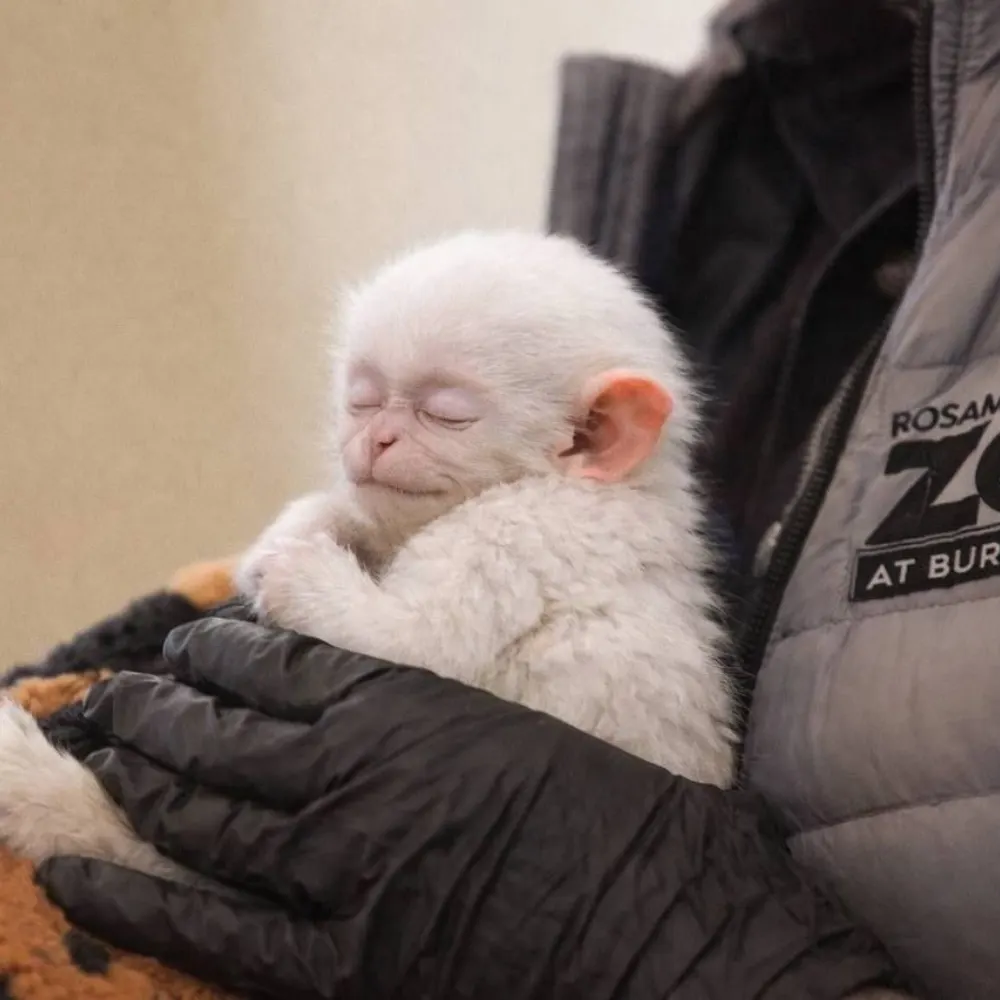
At 5:38 a.m. Friday March 1st 2026, inside the climate-controlled Asian Highlands habitat at the Rosamond Gifford Zoo in Syracuse, a female golden snub-nosed monkey quietly delivered a healthy infant. Within minutes, keepers realized something was profoundly different.
The newborn was completely snow-white.
The Moment Everything Changed
Senior primate keeper Lydia Morales had been monitoring the expectant mother overnight via infrared cameras from the zoo’s veterinary observation room. Labor appeared calm and uneventful.
“At 5:38 a.m., we saw the infant emerge and immediately cling,” Morales said. “But the coloration didn’t register at first because of the low light.”
When morning lights gradually brightened the enclosure, Morales froze.
“I remember saying out loud, ‘That can’t be right,’” she recounted. “Golden snub-nosed babies are born darker, yes — but not white. This was white-white.”
By 5:45 a.m., Morales had radioed lead veterinarian Dr. Harrison Kline and Curator of Mammals Evan Cho. Within 15 minutes, the small veterinary team assembled quietly outside the habitat’s service corridor to observe without disturbing the mother.
“She was holding the baby close to her chest on a wooden perch about eight feet above the ground,” Dr. Kline said. “The contrast between her bright orange coat and that infant’s white fur was stunning. I’ve been a zoo veterinarian for 22 years. I have never seen that.”
Inside the Habitat
The birth occurred inside the zoo’s Asian Highlands exhibit — a carefully designed environment featuring elevated climbing structures, rock ledges, heated resting platforms, and filtered natural light that mimics the mountainous forests of China, where golden snub-nosed monkeys (Golden snub-nosed monkey) originate.
Zoo officials confirmed the infant, now named Nova, has remained primarily in the upper rear section of the enclosure, where the troop feels most secure. The public viewing area remains partially restricted while the zoo adjusts barriers to reduce noise and stress.
“The mother has been incredibly attentive,” Cho said. “She hasn’t put Nova down once.”
A Genetic Shockwave
Golden snub-nosed monkeys are endangered and uncommon in North American collections. Breeding programs are carefully coordinated under the oversight of the Association of Zoos and Aquariums (AZA).
Zoo officials believe Nova may exhibit leucism, a rare pigment condition that reduces melanin production.
By mid-morning Tuesday, the zoo had contacted veterinary colleagues at the Bronx Zoo, San Diego Zoo, and the National Zoo for consultation.
Dr. Melissa Grant, a consulting primate specialist affiliated with the Smithsonian Institution, reacted strongly when shown early images.
“In managed populations, a leucistic golden snub-nosed monkey would be exceptionally rare,” she said. “If confirmed, this may be among the first documented cases in an accredited North American facility. That is significant.”
Grant emphasized that genetic sequencing would be necessary before drawing firm conclusions.
Viral Within Hours
At 9:40 a.m., the zoo released two carefully selected photos to local media.
By 10:30 a.m., regional news stations had broken into programming.
By noon, the zoo’s website traffic had surged more than tenfold. Social media hashtags referencing Nova began trending regionally before expanding nationally by late afternoon.
Zoo spokesperson Daniel Reeves described the response as “overwhelming.”
“We’ve received interview requests from national networks, wildlife publications, and international outlets,” Reeves said. “It escalated faster than anything we’ve experienced.”
Health Status: Strong and Stable
Despite the media storm, veterinary officials stress that Nova’s health remains stable.
The infant has demonstrated:
- Strong grasp reflex
- Consistent nursing behavior
- Normal vocalizations
- Stable respiratory patterns
Dr. Kline confirmed that while physical examinations will remain minimal during the bonding phase, remote monitoring systems are tracking temperature and behavior.
“Our plan going forward is cautious and deliberate,” Kline said. “Step one is ensuring uninterrupted maternal bonding. Step two is genetic confirmation. Step three will involve consultation with AZA species survival coordinators.”
What Happens Next
Zoo leadership outlined a multi-phase plan:
Phase 1: Observation and Bonding (First 2 Weeks)
Limited public access, continuous monitoring, and minimal human interference.
Phase 2: Genetic Analysis
DNA samples already collected from shed placental tissue will be analyzed to confirm leucism or another pigment mutation.
Phase 3: Controlled Public Viewing
If Nova continues developing normally, the zoo plans to implement scheduled viewing windows to manage anticipated crowds.
Phase 4: Research Collaboration
Potential collaboration with national institutions to study pigmentation genetics in endangered primates.
Director Marianne Caldwell addressed the long-term implications during Tuesday’s evening briefing.
“This could place Syracuse at the center of important primate genetic research,” Caldwell said. “But above all, this is about responsible stewardship.”
“Once-in-a-Career”
Staff members admitted they are still processing what happened.
“You spend your career hoping for healthy births,” Morales said. “You don’t expect something that stops you in your tracks.”
As dusk settled over the zoo Tuesday night, Nova remained nestled against her golden-furred mother high above the exhibit floor — a tiny white figure that has already captured national attention.
From a quiet dawn delivery to a viral wildlife headline in a matter of hours, one thing is clear:
What happened in Syracuse this morning is being described by experts as rare, unprecedented, and possibly historic — and the story is only beginning.