
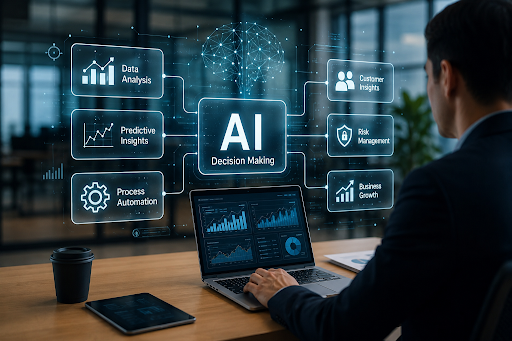
Artificial intelligence has evolved far beyond its early reputation as a tool for automating repetitive tasks. Today, AI is influencing how organizations analyze markets, understand customers, improve operations, and make strategic decisions. Companies of every size are discovering that AI is no longer a futuristic investment reserved for technology giants. Instead, it has become a practical business resource that can increase efficiency, uncover opportunities, and support sustainable growth.
The growing accessibility of cloud computing, advanced machine learning models, and user-friendly software has significantly lowered the barriers to AI adoption. As a result, businesses across industries are experimenting with intelligent technologies to improve customer experiences, streamline internal processes, and make more informed decisions.
However, successful AI adoption is about much more than installing new software. It requires organizations to rethink workflows, improve data quality, and develop strategies that align technology with business goals.
The Shift from Data Collection to Intelligent Decision-Making
Businesses have been collecting data for decades, yet many still struggle to transform that information into actionable insights. Large volumes of customer records, financial reports, operational metrics, and website analytics often remain underutilized.
AI changes this dynamic by analyzing massive datasets in seconds while identifying patterns that human analysts may overlook. Instead of simply presenting historical reports, AI can highlight trends, forecast future outcomes, and recommend actions based on real-time information.
This enables decision-makers to respond more quickly to changing market conditions without relying solely on intuition or outdated reports.
Smarter Customer Experiences
Customer expectations continue to rise. Consumers now expect personalized recommendations, faster responses, and seamless digital interactions regardless of the industry.
AI enables organizations to deliver these experiences through intelligent recommendation systems, conversational assistants, predictive customer support, and behavior analysis. By understanding customer preferences and purchasing habits, businesses can tailor communications that feel relevant rather than generic.
This level of personalization not only improves customer satisfaction but also increases retention and long-term loyalty.
Improving Operational Efficiency
Every business contains repetitive processes that consume valuable employee time. Administrative work, document processing, inventory tracking, scheduling, and internal reporting often require significant manual effort.
Modern automation tools powered by enterprise AI solutions allow organizations to streamline these routine activities while maintaining accuracy and consistency. Rather than replacing employees, these systems enable teams to focus on creative thinking, customer engagement, and strategic planning.
The result is improved productivity without sacrificing quality.
Better Forecasting for Business Growth
One of AI’s greatest strengths is prediction. Machine learning models continuously analyze historical information alongside current trends to estimate future outcomes.
Businesses use predictive analytics to forecast:
- Product demand
- Sales performance
- Customer churn
- Inventory requirements
- Marketing effectiveness
- Financial risks
More accurate forecasting reduces uncertainty and helps leaders allocate resources with greater confidence.
Strengthening Cybersecurity
As organizations become increasingly digital, cybersecurity threats continue to evolve. Traditional security systems often rely on predefined rules that may fail to recognize new attack methods.
AI enhances cybersecurity by identifying unusual behavior, monitoring network activity continuously, and detecting threats before they cause significant damage.
These intelligent systems can recognize subtle anomalies that indicate potential security breaches, helping organizations respond more rapidly while minimizing operational disruption.
Supporting Employees Instead of Replacing Them
One of the most common misconceptions about AI is that it exists solely to replace human workers. In reality, the most successful implementations focus on augmenting human capabilities rather than eliminating jobs.
Employees still provide creativity, emotional intelligence, ethical judgment, and relationship-building skills that machines cannot replicate.
AI handles repetitive analysis, summarizes large datasets, and generates recommendations, allowing professionals to dedicate more time to high-value work that requires critical thinking.
Organizations that position AI as a collaborative assistant often achieve stronger employee acceptance and higher productivity.
Building a Data-Driven Culture
Technology alone does not guarantee better business outcomes. Organizations must also foster a culture where data supports everyday decision-making.
This involves improving data governance, ensuring information accuracy, encouraging collaboration between departments, and training employees to interpret AI-generated insights responsibly.
When leadership embraces evidence-based decision-making, AI becomes an extension of business strategy rather than an isolated technology initiative.
Ethical AI Matters
As AI becomes more influential, organizations must consider the ethical implications of its use.
Responsible AI practices include:
- Protecting customer privacy
- Reducing algorithmic bias
- Maintaining transparency
- Following regulatory requirements
- Monitoring automated decisions
- Keeping humans involved in critical judgments
Businesses that prioritize ethical AI build stronger customer trust while reducing legal and reputational risks.
Preparing for the Future
Artificial intelligence continues to evolve at an extraordinary pace. Generative AI, intelligent assistants, autonomous workflows, and predictive analytics are becoming increasingly integrated into everyday business operations.
Organizations that begin experimenting today will likely be better prepared for future technological advances. Small pilot projects often provide valuable lessons before expanding AI initiatives across multiple departments.
Rather than pursuing AI simply because competitors are doing so, businesses should focus on solving meaningful problems that deliver measurable value.
A thoughtful strategy, supported by quality data and ongoing employee development, creates a stronger foundation for long-term success.
Conclusion
Artificial intelligence is transforming business decision-making by helping organizations analyze information faster, improve customer experiences, strengthen security, and optimize operations. While the technology continues to advance, its greatest value comes from supporting people rather than replacing them.
Companies that combine responsible AI adoption with clear business objectives, continuous learning, and a commitment to innovation will be well positioned to compete in an increasingly digital economy. AI is no longer simply a tool for automation—it has become an essential driver of smarter, more informed business growth.