

Walk into any hardware store and you will find hundreds of screwdriver sets stacked on shelves. Some cost five dollars, others cost fifty, and a few cross the hundred-dollar mark. So how do you choose the best screwdriver set when the options seem endless?
The answer depends on what you actually do with the tool. An electrician working inside a live panel needs insulated handles rated to 1,000 volts. A mechanic pulling dashboard screws on a European car needs Torx tips that will not cam out. A weekend DIYer assembling flat-pack furniture needs a comfortable grip and a decent range of Phillips and flathead tips. One set rarely covers all three scenarios well.
According to Future Market Insights, the global screwdriver market reached an estimated USD 4.9 billion in 2025 and is projected to climb to USD 7.8 billion by 2035, growing at a 4.7 percent compound annual rate. The DIY and home-improvement segment alone accounts for about 33.9 percent of that revenue. Those numbers confirm that demand for quality hand tools is rising, and manufacturers are responding with better materials, sharper tips, and smarter handle designs.
This guide breaks down the best screwdriver set options by trade and use case. You will learn what separates a professional screwdriver set from a bargain bin kit, which tip materials actually matter, and how to read a comparison table without getting lost in jargon. By the end, you will know exactly which set belongs in your toolbox. If you have already started researching, our roundup of the best screwdriver sets of 2026 is a great companion read.
Why Choosing the Right Screwdriver Set Matters More Than You Think
A screwdriver looks simple. A handle, a shaft, and a tip. But the wrong set can turn a quick repair into a frustrating ordeal. Stripped screw heads, sore hands, and wasted time are the real costs of a bad purchase.
How a Bad Screwdriver Damages Fasteners and Slows Your Work
When a screwdriver tip does not fit the screw head precisely, it slips. Engineers call this cam-out. Phillips screws are especially prone to it because the cruciform design was originally intended to allow the driver to slip under excessive torque. That made sense in 1930s assembly lines, but it is a headache in 2026 when you are trying to remove a tight machine screw.
Cam-out damages both the screw and the driver tip. A rounded screw head often requires a screw extractor, which adds time and cost. A worn tip makes every subsequent fastener harder to drive. Soft steel tips deform after a few dozen screws, while hardened S2 steel tips hold their geometry through thousands of cycles. This is not a minor difference. It directly affects your productivity and the quality of your finished work.
If you have ever spent ten minutes trying to back out a single stripped screw, you already understand why material quality matters. The best screwdriver for any task is one that grips the fastener firmly on the first turn and stays sharp long enough to finish the job.
What Separates a Professional Screwdriver Set from a Budget Kit
Price is not the only indicator, but it usually correlates with three things: tip material, handle construction, and tip precision. A professional screwdriver set typically uses S2 shock-resistant steel for the shaft and tip. S2 steel reaches a Rockwell hardness of 58 to 62 HRC, compared to 48 to 52 HRC for standard chrome vanadium. That hardness gap means the professional tip wears slower, grips tighter, and resists deformation under high torque.
Handles matter too. A cheap screwdriver often has a hard plastic handle with no ergonomic shaping. A professional set uses multi-component handles, sometimes called tri-lobe or bi-material grips, that combine a rigid core with a softer outer layer. The result is more torque with less hand fatigue. If you plan to drive more than a dozen screws in a session, handle comfort is not a luxury. It is a necessity.
Finally, professional sets include a wider range of tip types and sizes. Instead of three Phillips and two flatheads, you get Torx, Pozidriv, hex, and sometimes square-drive tips. That coverage means fewer trips to the store and less improvisation with the wrong tool. For a deeper look at what makes a trustworthy set, check our 2025 trusted screwdriver set guide.
Best Screwdriver Sets by Trade and Use Case
Not every trade needs the same features. Below, we break down the best screwdriver categories by the work they are designed for. Whether you wire buildings, rebuild engines, or fix laptops, there is a set that fits.
Best Screwdriver Set for Electricians — Insulated and VDE Certified
Electricians face a unique hazard that no other trade shares in the same way: live voltage. The international standard for insulated hand tools is IEC 60900:2018, which requires protection against electrical shock up to 1,000 volts AC and 1,500 volts DC. VDE, the German testing institute, is the most widely recognized certification body for this standard. Every VDE-certified screwdriver is individually tested at 10,000 volts before it leaves the factory.
A proper electrician screwdriver set includes dual-layer insulation, clearly marked voltage ratings, and a flange between the handle and the shaft to prevent hand slippage onto the exposed blade. Look for sets that cover slotted sizes from 2.5 mm to 6.5 mm and Phillips sizes PH1 and PH2 at minimum. Some sets add Pozidriv tips, which are standard in European electrical panels.
For electricians, the best screwdriver is one that keeps them safe first and performs efficiently second. Insulated sets from reputable brands meet both requirements. Pair your electrician set with a solid general-purpose kit from the IRONCUBE screwdriver collection for non-live work around the shop.
Best Magnetic Screwdriver Set for General Workshop Use
Magnetic tips hold screws in place so you can start them with one hand. This seems like a small convenience until you are working overhead or inside a tight enclosure where you cannot hold the screw with your fingers. A magnetic screwdriver set saves time on nearly every task in a general workshop environment.
The magnetism in quality sets comes from a permanent magnet embedded in the shaft, not from a magnetized tip coating that fades over time. Look for sets that advertise strong rare-earth magnets or deep-set magnetic retention. Also check that the magnetism does not interfere with sensitive electronics if you work near circuit boards.
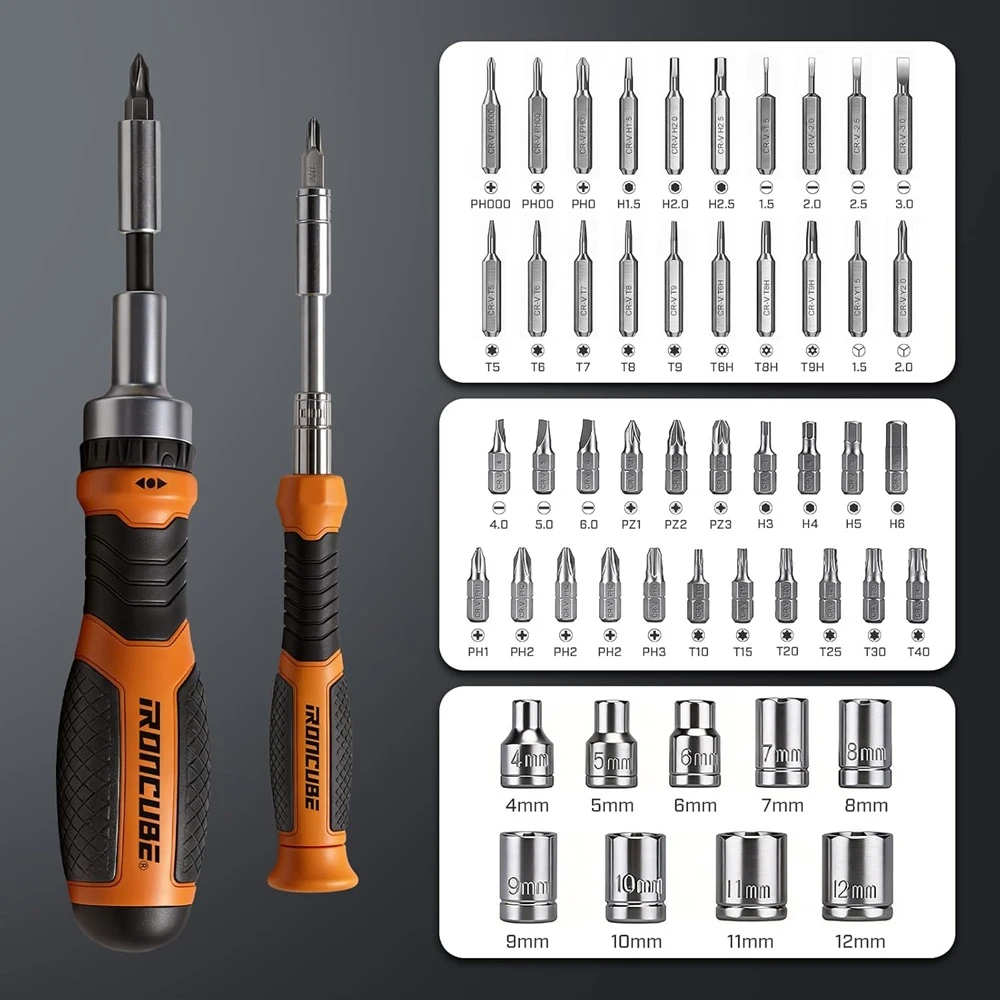
Our guide to magnetic screwdriver set tips covers the topic in detail, including which fastener types benefit most from magnetic retention and which do not. For a workshop workhorse, the IRONCUBE 65-Piece Ratchet Screwdriver and Socket Bit Set combines magnetic bit holders with ratcheting action and a broad selection of tips, making it one of the most versatile sets on the market.
Best Precision Screwdriver Set for Electronics Repair
Smartphones, laptops, game consoles, and eyeglasses all use tiny fasteners that standard screwdrivers cannot reach. A precision screwdriver set uses narrow shafts, fine tips, and a swivel cap at the end of the handle for controlled rotation. Most precision sets include sizes as small as PH000 or T3 Torx.
Tip material matters even more at this scale. A soft tip that deforms on a 1.5 mm screw will strip the head immediately, and that screw is often the only thing holding a screen assembly together. S2 steel tips are the minimum standard for serious electronics repair. The higher hardness at 58 to 62 HRC keeps the tip geometry sharp through hundreds of tiny fasteners.
If you repair electronics regularly, invest in a precision set with anti-static handles. Static discharge can destroy sensitive components, and an ESD-safe handle eliminates that risk. Most quality precision sets also include a case with organized slots so you can find the right bit without dumping the whole set on the bench.
Best Ratcheting Screwdriver Set for Speed and Efficiency
A ratcheting mechanism lets you drive screws without lifting the driver out of the screw head between turns. You simply flick your wrist back and forth, and the internal gears do the work. This might sound unnecessary, but over the course of a long project, the time savings add up quickly.
The best ratcheting sets use fine-tooth mechanisms with 36 or more teeth. More teeth mean a smaller swing angle, which is critical in tight spaces where you cannot rotate the handle a full quarter turn. Look for a three-position switch: clockwise drive, counterclockwise drive, and locked. The locked position turns the ratchet into a standard screwdriver for precise final tightening.
The IRONCUBE 56-Piece Ratcheting Screwdriver, Bits, and Sockets Set is a standout in this category. It packs Phillips, flathead, Torx, hex, and socket bits into a single compact case with a smooth ratcheting handle. For anyone who values speed on the jobsite, it is hard to beat. Also see our ratcheting wrench set roundup for complementary hand tools that pair well with a ratcheting screwdriver in your kit.
Best Torx Screwdriver Set for Automotive and Appliance Work
Torx fasteners have a six-pointed star-shaped recess that provides significantly more surface contact than Phillips or flathead designs. This extra contact virtually eliminates cam-out, which is why Torx screws dominate in automotive dashboards, brake assemblies, electronics enclosures, and modern appliances.
A dedicated Torx set should cover sizes T5 through T40 at minimum. Automotive work often requires T15, T20, T25, and T30 most frequently, while electronics lean toward T5, T6, T8, and T10. Some sets add Torx Security tips, which have a small hole in the center to accommodate a pin in tamper-resistant fasteners.
If you work on cars, appliances, or computer hardware, having a complete Torx set prevents the temptation to use a flathead as an improvised substitute. That shortcut almost always ends with a stripped screw and a bigger problem than the one you started with.
Screwdriver Set Comparison Table
The table below compares five common screwdriver set categories across the features that matter most. Use it as a quick reference when shopping.
| Set Type | Pieces | Tip Types | Tip Material | Price Range |
| Electrician (VDE) | 6–12 | Slotted, Phillips, Pozi | Cr-V / S2 | $30–$80 |
| Magnetic General | 10–65 | Phillips, Flat, Torx, Hex | Cr-V / S2 | $15–$50 |
| Precision Electronics | 20–60 | Phillips, Torx, Tri-Wing, Pentalobe | S2 / HSS | $15–$45 |
| Ratcheting Multi-Bit | 30–70 | All common types | S2 / Cr-V | $20–$60 |
| Torx Dedicated | 8–15 | Torx, Torx Security | S2 / Cr-Mo | $12–$40 |
Notice that S2 steel appears across nearly every professional category. It is the current industry benchmark for screwdriver bits and shafts in sets priced above the entry level. Chrome vanadium remains acceptable for light-duty home use but falls short in demanding trade environments.
Key Features to Look for in a Quality Screwdriver Set
Beyond tip type and piece count, three features separate good sets from great ones. Understanding these will help you read product listings with a critical eye.
Tip Material and Hardness — Chrome Vanadium vs S2 Steel
We touched on this earlier, but it is worth drilling into the numbers. S2 steel achieves a Rockwell hardness of 58 to 62 HRC, while chrome vanadium tops out around 48 to 52 HRC. That 10-point gap is enormous in tool metallurgy. According to MFG Shop’s material analysis, S2 steel’s higher carbon content combined with silicon and molybdenum gives it superior shock resistance and wear life.
In practical terms, an S2 tip will maintain its precise geometry after driving hundreds of screws, while a Cr-V tip may start to round off after a few dozen high-torque fasteners. For professionals who drive screws all day, S2 is not optional. It is essential. For the occasional home repair, chrome vanadium works fine and costs less.
Handle Ergonomics and Grip Design
A screwdriver handle should transfer torque efficiently while keeping your hand comfortable. The three main handle designs are tri-lobe, hex-profile, and round. Tri-lobe handles offer the best torque transfer because the three flat surfaces give your palm more contact area. Hex-profile handles prevent rolling on a sloped surface, which is handy on a workbench. Round handles are traditional but offer the least mechanical advantage.
Material matters too. A dual-component handle with a rigid polypropylene core and a soft thermoplastic rubber overmold provides both strength and cushion. Some premium handles include textured zones and a domed end cap for palm-turning small screws. If you have large hands, check that the handle diameter is at least 32 mm. Smaller handles cause cramping during extended use.
Magnetic Tips vs Non-Magnetic — When Each Is Better
Magnetic tips are ideal for starting screws in hard-to-reach places, overhead work, and any situation where you need one-handed operation. They also prevent dropped screws, which is a serious time-waster on automotive and HVAC jobs.
However, there are cases where magnetic tips cause problems. Working near sensitive electronic components, magnetic storage media, or certain medical devices requires non-magnetic tools. Also, magnets can attract metal shavings that contaminate the screw head recess. If you work in a machine shop with metal dust, a non-magnetic set may actually be the best screwdriver option for keeping your fasteners clean.
Most professionals keep both types on hand. A magnetic screwdriver set handles 90 percent of general tasks, while a non-magnetic set covers the remaining edge cases. For a comprehensive take, our magnetic screwdriver set buying tips article lays out the pros and cons in full.
Screwdriver Types Explained — Phillips, Flathead, Torx, Pozidriv, Hex
Understanding screwdriver types prevents the most common workshop mistake: using the wrong tip. Each type exists for a reason, and using the correct one protects both the fastener and the tool.
Phillips (PH) is the most common cross-shaped drive. It was patented by Henry Phillips in 1936 and designed for power-driven assembly lines. Phillips screws are found in woodworking, drywall, furniture, and general construction.
Flathead (slotted) is the oldest screw drive, dating back centuries. It uses a single straight slot. Today it appears mostly in electrical cover plates, vintage hardware, and decorative screws where a visible slot is desired.
Torx (star) uses a six-pointed star recess developed by Camcar Textron in 1967. Torx eliminates cam-out and handles higher torque loads. It is standard in automotive, electronics, and modern appliances.
Hex (Allen) uses a hexagonal recess. Hex fasteners are everywhere in furniture assembly, bicycle maintenance, and machine building. A full hex set covers sizes from 0.7 mm to 10 mm.
Pozidriv (PZ) looks similar to Phillips but has four additional tick marks between the main cross arms. It was developed to reduce cam-out and is heavily used in European manufacturing and cabinetry.
Phillips vs Pozidriv — The Difference That Matters
These two drives look almost identical to the untrained eye, but they are not interchangeable. A Phillips driver in a Pozidriv screw will cam out constantly. The Pozidriv design has slightly tapered flanks and supplementary ribs that lock the driver into the recess more securely.
If you work with European-manufactured products, especially kitchen cabinets, electrical panels, or IKEA furniture, you will encounter Pozidriv screws regularly. The easiest way to tell them apart is to look for the tick marks. A Pozidriv screw has small hash marks between the main cross arms. A Phillips screw does not. Having both PH and PZ tips in your set eliminates the confusion.
When to Use a Torx Screwdriver Instead
Torx screws provide up to ten times more surface contact between the driver and the fastener compared to a Phillips screw. That extra grip translates into higher torque capacity and virtually zero cam-out. This is why automotive manufacturers switched to Torx decades ago for brake rotors, interior panels, and engine components.
Use a Torx driver whenever you encounter a star-shaped recess. Do not improvise with a flathead or a small Allen key. The fit will be sloppy, and you will damage the fastener. A dedicated Torx set is inexpensive and pays for itself the first time it saves you from a stripped brake caliper bolt. Need help figuring out fastener sizes across your toolbox? Our wrench size conversion chart and printable metric-to-SAE chart are handy references for matching fastener sizes across measurement systems.
FAQ — Best Screwdriver Set Buying Questions
What is the best screwdriver set for home use?
For general home use, look for a set with 20 to 40 pieces that covers Phillips, flathead, and Torx tips in the most common sizes. A magnetic ratcheting set gives you the most versatility in a single purchase. The best screwdriver for home projects combines comfortable handles, S2 or chrome vanadium tips, and a sturdy carrying case so nothing gets lost in the junk drawer.
Are magnetic screwdrivers safe for electronics?
Standard magnetic screwdrivers are safe for modern electronics. The permanent magnets used in quality sets are not strong enough to damage solid-state drives, CPUs, or RAM modules. However, avoid magnetic tools around older magnetic storage media like floppy disks or mechanical hard drives with exposed platters. For most repair jobs, a magnetic tip is your best screwdriver companion because it prevents dropped screws inside enclosures.
What does VDE certified mean on a screwdriver?
VDE is a German testing and certification institute that verifies insulated tools meet the IEC 60900 standard. A VDE-certified screwdriver has been individually tested at 10,000 volts and is rated safe for work on circuits up to 1,000 volts AC and 1,500 volts DC. Electricians should always choose VDE-certified or IEC 60900-compliant sets. When buying the best screwdriver set for electrical work, the VDE mark is the first thing to verify on the packaging.
How many screwdrivers do I actually need?
Most professionals carry between 15 and 30 individual screwdrivers or a ratcheting set with an equivalent number of bits. A good starting point is three Phillips sizes (PH0, PH1, PH2), three flathead sizes, a T15 through T30 Torx range, and a small hex set. If you work in a specific trade, add the specialty tips for that field. The best screwdriver collection is one that covers your daily tasks without cluttering your toolbox with sizes you never touch.
Is S2 steel really better than chrome vanadium for screwdriver tips?
Yes, for demanding professional use. S2 steel reaches 58 to 62 HRC on the Rockwell scale, compared to 48 to 52 HRC for chrome vanadium. That translates into longer tip life, better torque transfer, and stronger resistance to deformation. However, chrome vanadium offers decent performance at a lower price and works perfectly for light home repairs. When shopping for the best screwdriver, match the tip material to how hard you intend to work the tool.
Can I use a Phillips screwdriver on a Pozidriv screw?
Technically, you can fit a Phillips driver into a Pozidriv recess, but it will not grip properly. The driver will cam out under moderate torque, which strips the screw and damages the tip. Pozidriv screws have additional ribs that require the matching PZ driver for a secure fit. The best screwdriver set for European products should include both Phillips and Pozidriv tips.
Our Top Pick — Why IRONCUBE Screwdriver Sets Deliver Professional Results
After comparing materials, handle designs, tip varieties, and value across dozens of options, IRONCUBE Works consistently delivers sets that hit the professional sweet spot. Their screwdriver product line uses S2 alloy steel bits, multi-component ergonomic handles, and strong magnetic retention across the range.
The 65-Piece Ratchet Screwdriver and Socket Bit Set is a standout for anyone who needs one set that handles everything from cabinetry to car interiors. It includes Phillips, flathead, Torx, hex, and socket bits in a compact, organized case. The ratcheting handle has a smooth 36-tooth mechanism with a three-position switch. For a slightly more compact option, the 56-Piece Ratcheting Screwdriver Set covers the same essential tip types with fewer specialty bits, making it lighter to carry on service calls.
What makes IRONCUBE a strong contender for best screwdriver brand 2026 is their commitment to industrial-grade materials at a price point that does not punish the buyer. S2 tips, chrome vanadium shafts, and TPR-overmolded handles are standard across their sets, not premium upsells. You can explore the full lineup on their Amazon storefront or watch product demos on the IRONCUBE YouTube channel.
If you already own a good set of wrenches, adding an IRONCUBE screwdriver set rounds out your hand-tool collection nicely. And if you have questions about specific configurations or bulk orders for your crew, the IRONCUBE contact page connects you directly with their team.
Final Summary
Choosing the best screwdriver set comes down to matching the tool to the task. Electricians need VDE-certified insulated sets. Mechanics need Torx and ratcheting options. DIYers need versatile magnetic kits that cover the most common fasteners without overwhelming the toolbox. Every buyer should prioritize S2 steel tips, ergonomic handles, and a well-organized case.
The screwdriver market is growing because people are doing more of their own repairs, building more of their own projects, and demanding better quality from their tools. Whether you are a seasoned tradesperson or a first-time homeowner, investing in the right set now saves time, money, and frustration for years to come. Use the comparison table and trade-specific breakdowns in this guide to make a confident purchase, and remember that the best screwdriver is always the one that fits the job in front of you.