

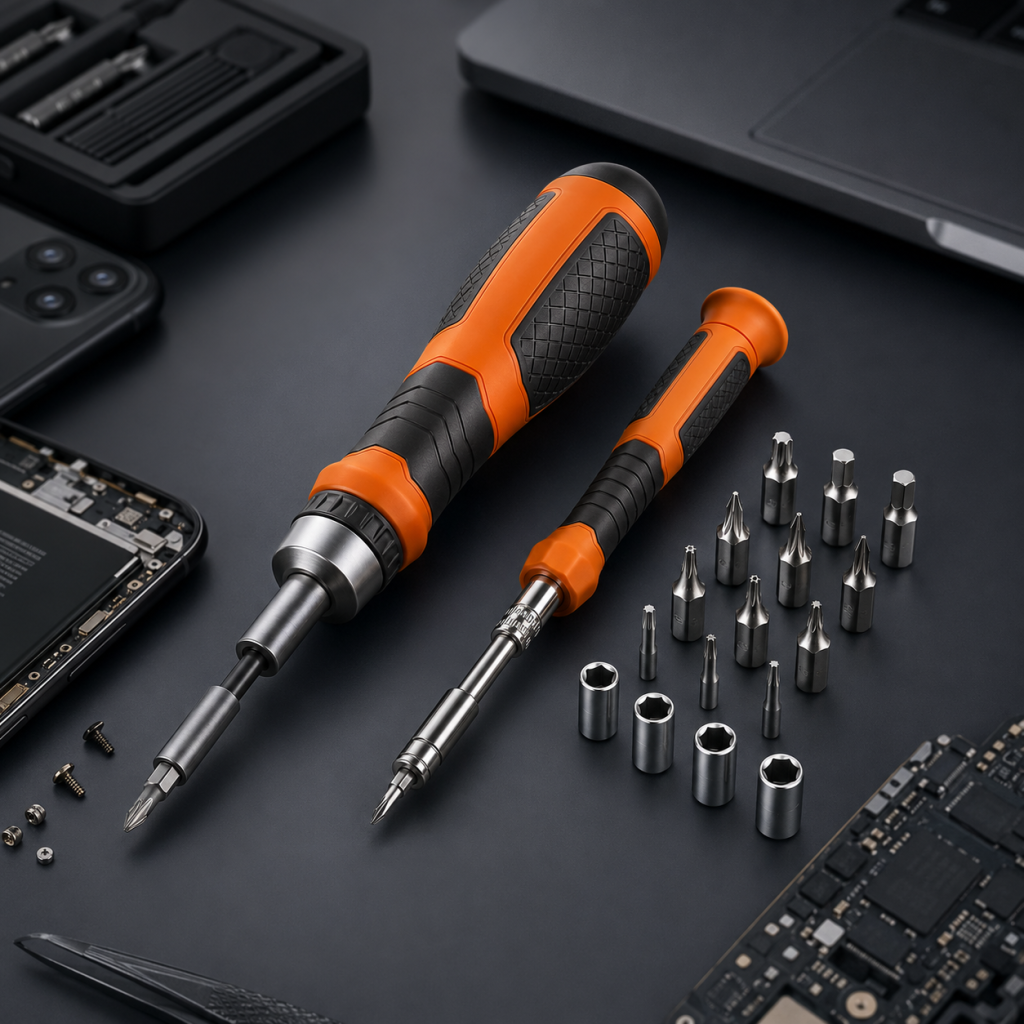
The global consumer electronics repair and maintenance market is undergoing an unprecedented shift. Valued at over $20.2 billion, this expanding industry is driven by a profound structural transition: consumers and enterprise organizations are choosing professional restoration over immediate replacement. Environmental awareness is rising as global electronic waste levels approach an estimated 65.3 million metric tons. Concurrently, legislative “Right to Repair” acts across dozens of states mandate that manufacturers release technical documentation, components, and specialty tools.
To operate successfully within this evolving ecosystem, engineers, independent service providers, and everyday IT specialists require specialized hardware. Standard household hand tools are completely inadequate for modern smartphones, laptops, and delicate gaming systems.
This deep-dive technical blueprint details how to select, deploy, and maintain premium screwdriver sets for electronics, ensuring clean, damage-free repairs on high-value technology assets.
The Core Technical Focus: High-Precision Driving Systems
Working on micro-electronics requires far more than basic torque. Modern engineering focuses heavily on fastener integrity, static dissipation, and perfect geometric fitment. When a technician strips a tiny pentalobe or security Torx screw embedded deep within an aluminum chassis, an elementary fifteen-minute repair can quickly devolve into a costly, high-risk hardware extraction process.
Traditional fastening methods rely on physical muscle to secure large fasteners, but micro-fasteners demand absolute dimensional stability. High-end screwdriver sets for electronics transfer small amounts of force smoothly while maintaining clean, uncompromised physical engagement with the screw head. If a driver bit slips even slightly, the resulting cam-out can completely shear the fastener walls or drop sharp metallic fragments directly onto sensitive circuit boards.
Investing in precision-engineered instruments from Ironcube Works is essential to protect your delicate hardware assemblies from accidental structural damage.
1. Anatomy of a Professional Electronics Screwdriver
A high-performance precision driver is engineered completely differently from a heavy-duty automotive or construction tool. Every design element—from the rear cap down to the micro-profile tip—is carefully calibrated to handle delicate electronic components.
┌─────────────────────────────────────────────────────────────┐
│             ANATOMY OF A PRECISION MICRO-DRIVER             │
│                                                             │
│   [360° Swivel Cap]  ─── Smooth Palm-Rest Rotation           │
│   [Ergonomic Handle] ─── Fluted Anti-Slip CNC Aluminum/TPR  │
│   [Magnetic Collar]  ─── Integrated Neodymium Core          │
│   [Precision Shaft]  ─── Narrow Clearance, Deep Reach       │
│   [Machined Bit]     ─── S2 Steel HRC 58-62 Micro-Profile   │
└─────────────────────────────────────────────────────────────┘
The 360-Degree Swivel Cap
The defining feature of any true precision driver is a smooth, rotating end cap. This mechanism allows you to rest the back of the tool firmly against your palm or index finger to apply steady downward pressure. At the same time, your thumb and middle finger can freely rotate the handle body. This smooth movement keeps the driver tip perfectly centered inside the tiny fastener recess, completely eliminating the slipping that typically occurs when lifting and repositioning standard hand tools.
Advanced Ergonomic Handle Geometry
When working on delicate electronics, massive torque is actually your enemy. Instead, handles utilize narrow, fluted profiles machined out of high-grade anodized aluminum or dual-injected composite plastics. These surfaces feature textured knurling or soft thermoplastic rubber (TPR) zones.
This specific configuration provides excellent tactile feedback, allowing you to easily sense when a micro-screw has seated completely against a delicate plastic frame or a logic board grounding ring.
Narrow Clearance Shaft Design
Consumer electronics like ultra-thin laptops and modern gaming consoles hide crucial fasteners deep down inside narrow, recessed access holes. Standard interchangeable drivers utilize bulky, wide-bit holders that scrape against outer plastic casings long before reaching the hidden screw head. Premium micro-drivers use elongated, slim shafts or thin extension bars.
This design allows clear, unobstructed access to deeply recessed components without damaging surrounding structural materials.
2. Advanced Metallurgy: S2 Tool Steel vs. Chrome Vanadium
The steel formula used to forge your driver bits directly impacts their overall working life and daily reliability. According to structural hand tool benchmarks documented on Wikipedia’s Wrench Entry, traditional alloy formulations like Chrome Vanadium (Cr-V) offer great tensile strength and corrosion resistance for standard industrial applications. However, micro-electronics present an entirely different structural challenge.
Because precision fasteners feature shallow slots and incredibly thin walls, the driver bits themselves must be exceptionally hard to prevent rounding out over time.
| Metallurgical Attribute | Chrome Vanadium (Cr-V) Bits | S2 Tool Steel Precision Bits |
| Average Rockwell Hardness | 52 to 56 HRC | 58 to 62 HRC |
| Resistance to Deform/Twist | Moderate (May twist under high torque) | Exceptional (Maintains sharp geometric edges) |
| Micro-Fastener Performance | Suitable for basic household appliances | Required for laptops, tablets, and phones |
| Long-Term Durability Profile | Prone to minor tip rounding over time | Resists wear across thousands of usage cycles |
| Surface Treatment Finish | Chrome-plated or basic oxide coat | Manganese phosphate or satin industrial coat |
For reliable micro-repair, premium screwdriver sets for electronics utilize high-grade S2 tool steel bits that hit a hardness rating of 58–62 HRC. This intense structural hardness ensures the sharp, micro-machined edges of Pentalobe, Tri-wing, and Torx bits stay perfectly square across years of use, keeping your tool investments reliable over the long haul.
3. Demystifying Micro-Bit Profiles and Specialized Configurations
Modern technology companies rely heavily on specialized, proprietary security fasteners to control repair access and protect internal designs. To navigate these systems safely, a modern workstation requires an array of highly specialized micro-bit profiles.
  ┌─────────────────────────────────────────────────────────┐
  │            SPECIALIZED MICRO-FASTENER PROFILES          │
  │                                                         │
  │   (✦) Pentalobe  ─── Apple iPhone Enclosure & MacBook   │
  │   (▲) Tri-Wing   ─── Nintendo Consoles & Battery Rails  │
  │   (✹) Sec. Torx  ─── Smart Home, Xbox, PlayStation Core │
  │   (⬢) Hex Micro  ─── Drones, Robotics, Internal Frames  │
  └─────────────────────────────────────────────────────────┘
The Pentalobe Profile (P-Series)
Originally introduced to control access to proprietary tech enclosures, the pentalobe profile features a distinct five-point design with rounded corners. Standard P2 pentalobe drivers (0.8mm) are universally required to open external iPhone enclosures. Meanwhile, larger P5 pentalobe bits (1.2mm) are necessary to unbolt modern MacBook lower cases. Using a traditional six-point Torx driver inside a five-point pentalobe fastener will instantly strip the screw head beyond repair.
The Tri-Wing and Tri-Point Profiles (Y-Series)
Widely utilized throughout the gaming and consumer electronics industries, these three-point configurations are common fixtures inside Nintendo Switch systems, older handheld devices, and internal smartphone battery anchor rails. Precision Y000 and Y0 bits must be perfectly square and meticulously aligned to lock into these fragile, shallow fasteners without slipping out under load.
Security Torx (TR-Series) and Standard Torx (T-Series)
Standard star-shaped Torx fasteners provide excellent torque transfer, but Security Torx variants introduce a tiny, solid post right in the center of the screw head. Your precision bit kits must include hollow-tipped TR profiles (like TR6, TR8, and TR10) to slide over this central post and seat fully into the star recess. These styles are universally present inside smart home hubs, modern gaming consoles, and external hard drive assemblies.
Precision Nut Drivers and Standoff Profiles
Motherboards and internal logic boards frequently rely on hex standoffs to stack separate circuit boards safely above aluminum frames. Specialized standoff bits allow technicians to easily remove these multi-layered anchoring bolts without risking damage to the delicate surrounding surface traces or surface-mounted components.
4. Comparing Tool Form Factors and Kit Layouts
Selecting the ideal kit configuration depends on whether you run a fixed commercial repair workspace or operate a mobile IT response team. Balancing tool portability against total bit count is a crucial part of organizing your workflow.
| Design Configuration | Single-Handle Modular Bit Sets | Dedicated Fixed-Shaft Driver Pallets |
| Typical Piece Count | 24 to 120+ Changeable Inserts | 6 to 12 Dedicated Solo Drivers |
| Storage Layout Footprint | Ultra-Compact Magnetic Case | Soft Roll-Up Pouch or Benchtop Rack |
| Fastener Compatibility | Wide variety of rare security tips | Limited to standard core geometries |
| Workspace Profile | Ideal for mobile IT kits and field techs | Optimized for high-volume bench repair |
| Average Component Weight | Extremely low per functional tip | Significantly higher total weight |
| Example Configurations | 6-Piece vs. 24-Piece vs. 65-Piece Analysis | Standard 6-Piece TPR Soft Grip Set |
For field professionals handling a wide variety of devices daily, utilizing high-density modular screwdriver sets for electronics ensures you have the necessary bits on hand without cluttering your travel gear.
5. Identifying Premium Technical Features and Field Upgrades
When researching professional-grade hand tools, focus on specific mechanical and material features that directly speed up daily repair workflows and prevent errors.
Advanced Magnetic Retention and Magnetizer Systems
Magnetic holding force is absolutely critical when extracting a tiny 1.5mm screw from deep inside a laptop chassis. Premium kits use rare-earth neodymium magnets embedded right in the driver shaft to hold bits secure and keep screws stuck tightly to the tip during assembly.
To explore these advantages in depth, look through technical guides on magnetic interchangeable screwdriver sets or our comprehensive analysis of the best magnetic screwdriver sets.
         [Hex Shaft Socket]     [Internal Neodymium Magnet]
                 │                           │
  ===============▼===========================▼   ┌────────────────┐
  ▒▒▒▒▒▒▒▒▒▒▒▒▒▒▒[===========================]   │ Secure, Locked │
  ▒▒▒▒▒▒▒▒▒▒▒▒▒▒▒[ Micro S2 Tool Steel Bit   ]===► Fastener Tip   │
  ===============▲===========================▲   └────────────────┘
                 │                           │
       [Precision Collar Wall]     [Concentrated Flux Field]
Flexible Extension Shafts for Obscure Angles
Modern compact electronics place cooling fans and power supply blocks into awkward, hard-to-reach corners. High-quality precision toolkits include a flexible extension shaft built out of layered, counter-coiled steel wire. This accessory allows you to transfer smooth rotational force around tight corners and barriers, letting you safely unbolt hidden fasteners without taking the entire machine apart.
The Role of Integrated Ratcheting Mechanisms
While simple electronics repair centers on small, delicate adjustments, larger hardware assemblies like desktop towers or server arrays require a lot of repetitive fastening. Integrated fine-tooth ratcheting systems let technicians keep driving screws without constantly resetting their hand position. This reduces wrist strain and boosts efficiency over long repair shifts.
For intermediate configurations that span across both micro-repair and heavy mechanical tasks, the Ironcube 21-in-1 multi-ratcheting screwdriver set delivers a great balance of modular versatility and mechanical assist.
To see these modular mechanics handled in real-world testing environments, take a look at the comprehensive breakdowns hosted on the Ironcube Tools YouTube Channel. Watching these real-world torture tests gives you a clear sense of how specific bit configurations perform under consistent stress.
6. ESD Safety Protocols and Electrostatic Dissipation
Electrostatic discharge (ESD) poses a massive threat to sensitive internal electronics. A sudden, unseen transfer of static electricity from a technician’s body through a standard plastic tool handle can instantly fry a delicate microprocessor or puncture a logic board’s insulation layers.
ESD Safety Standard: True ESD-safe precision handles are formulated with conductive or dissipative materials. These handles safely bleed off static charges slowly and controllably, preventing dangerous electrical arcs.
- Handle Resistivity: Professional ESD-safe tool handles are engineered to maintain a surface resistivity between $10^6$ and $10^9$ ohms, allowing static electrical charges to dissipate slowly and safely.
- Aero-Space Applications: When assembling micro-satellite arrays, drone flight controllers, or high-performance computer graphics cards, utilizing certified ESD-safe tools is absolutely mandatory.
- Grounding Strategies: For maximum protection, pair your dissipative driver sets with anti-static wrist straps and conductive grounding workbench mats.
- Insulated vs. Dissipative Tools: Remember that insulated tools are designed to shield you from high-voltage shocks, while dissipative tools are designed to protect delicate internal components from static damage.
For a broader look at advanced tool performance features and options, check out our guide on magnetic screwdriver set benefits and top picks 2026.
7. Maintaining Precision Tooling Investments
High-quality micro-tools demand consistent maintenance to preserve their tight manufacturing tolerances and crisp edges over years of service.
  ┌─────────────────────────────────────────────────────────┐
  │              PRECISION BIT MAINTENANCE CYCLE            │
  │                                                         │
  │  [Step 1] ── Clean with Isopropyl Alcohol (Remove Oils) │
  │  [Step 2] ── Inspect Under Magnification for Rounding    │
  │  [Step 3] ── Apply Light Anti-Corrosion Micro-Oil Film  │
  │  [Step 4] ── Store in a Sealed Magnetic Alignment Case  │
  └─────────────────────────────────────────────────────────┘
Always clean your bits with high-purity isopropyl alcohol after working inside devices to wipe away skin oils and sticky adhesive residues. Periodically apply a microscopic film of anti-corrosion oil to the bits to stop rust from forming over time, especially if your workshop is located in a humid climate.
Most importantly, replace any individual bit the moment you notice the slightest rounding under magnification. Using a worn-out bit is an easy way to strip an expensive fastener inside a customer’s high-end device.
Precision Repair FAQ
Why are standard household tools unsafe for consumer electronics repair?
Standard household hand tools are much too large, heavy, and crudely machined to handle delicate micro-electronics. Standard driver tips lack the specialized geometries needed to fit securely into tiny smartphone or laptop fasteners. Trying to use large, uncalibrated tools applies uneven force, stripping fragile screw heads and scratching circuit boards. For heavy-duty projects, mechanics rely on a completely different class of robust gear, which you can read about in our guide on the best interchangeable screwdriver set for mechanics.
What is the exact difference between a P2, P5, and T5 micro-bit profile?
A P2 bit features a specialized 0.8mm five-point pentalobe profile designed exclusively to open the exterior bottom screws of modern iPhones. A P5 bit uses a larger 1.2mm pentalobe profile to remove the lower cases of MacBooks. Conversely, a T5 bit uses a six-point star Torx geometry, which is a standard internal fastener configuration found across various Android devices, laptops, and smart home appliances.
Can an electric precision screwdriver damage sensitive modern tech components?
Yes, uncalibrated electric drivers pose a real risk to delicate electronics. If an electric tool lacks an adjustable electronic clutch, its motorized rotation can easily over-torque fragile components, strip soft aluminum threads, or crack plastic internal frames. For sensitive tasks like logic board assemblies, using manual precision drivers remains the safest choice, providing unparalleled tactile feedback and control.
How do I know if my precision tool handle is genuinely anti-static?
Genuine anti-static and ESD-safe tool handles are molded from specialized dissipative polymer resins. These handles feature clear manufacturer certifications stating a surface resistivity between $10^6$ and $10^9$ ohms. Standard plastic handles act as pure insulators, storing static charges on their surfaces until they suddenly snap onto sensitive components.
What should I do if a micro-fastener strips completely during an extraction?
If a micro-screw strips out, do not keep trying to turn it with standard bits. Apply a specialized rubber extraction band over the screw head to fill the gaps, or try using a dedicated micro-screw extractor bit under very slow manual speed. If the screw is deeply recessed, you may need to use a precision micro-drill bit on a bench press to safely drill away the damaged fastener head without harming the surrounding circuit board.
Summary
Choosing high-quality screwdriver sets for electronics requires analyzing core manufacturing materials, driver handle ergonomics, and specific bit assortments. Focusing on ultra-hard S2 steel configurations, choosing models with smooth 360-degree swivel caps, and ensuring proper ESD safety features keeps your workspace efficient and your repairs flawless.
Ready to upgrade your commercial repair benches or equip your field technical staff with premium gear? Contact our specialist team via the Ironcube Works Contact Portal to secure tailored bulk pricing and custom fleet configurations for your business.