
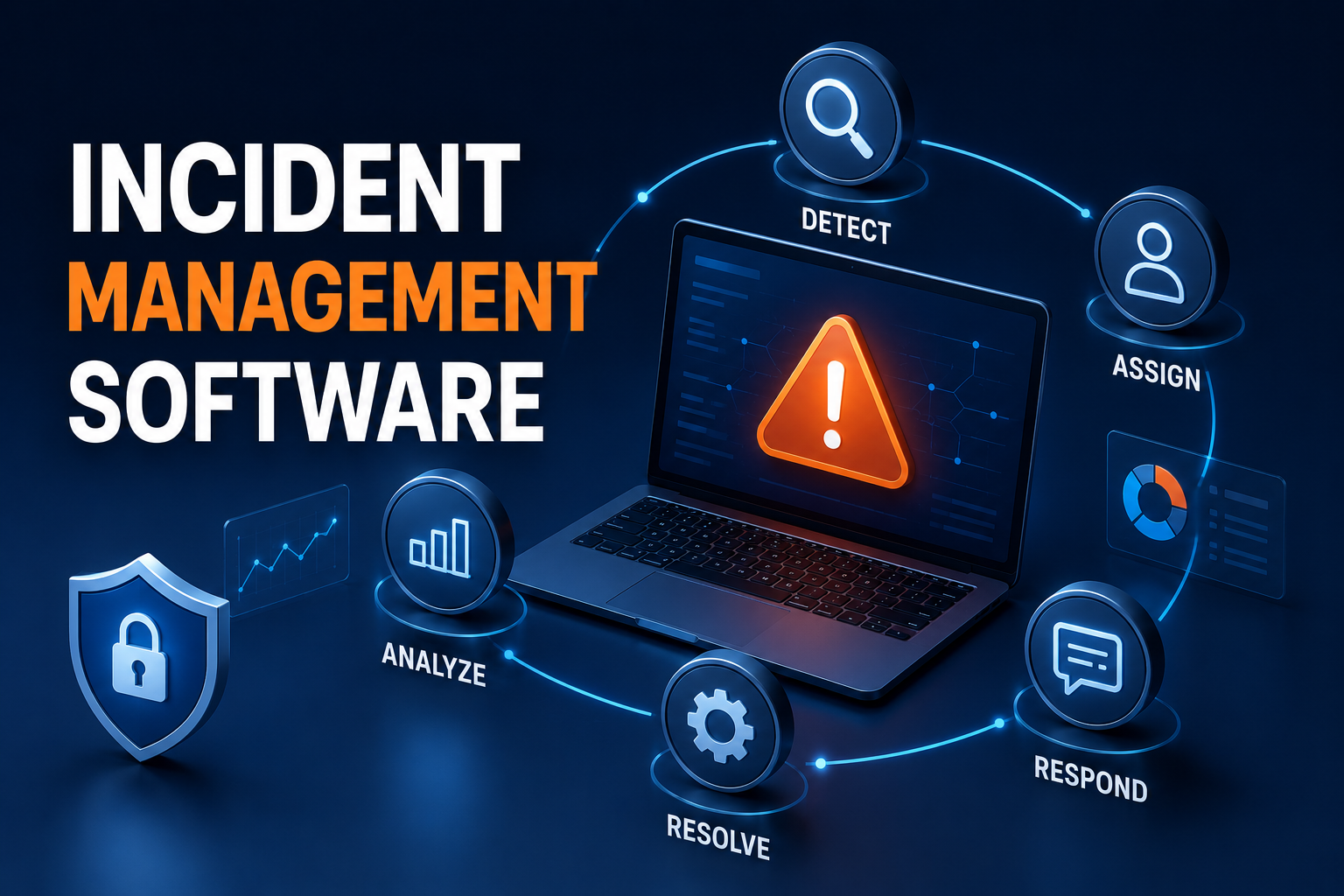
Incident management does not usually break because a tool is missing. It breaks when growth exposes cracks that were easy to ignore at a smaller scale. As infrastructure stretches across cloud platforms, APIs, vendors, and distributed teams, failure points multiply quickly. Alert traffic increases, ownership becomes unclear, and escalations overlap.
What once required coordination between two engineers now demands alignment across multiple operations, numerous security layers, a range of products, customer support, and leadership. Implementing incident management software at scale is, therefore, a necessary operational reset, not just a mere configuration exercise.
The following best practices focus on building an incident management framework that performs under sustained enterprise pressure.
Scale Changes the Nature of Incidents
At a small scale, incidents are events. At enterprise scale, incidents are patterns.
Volume increases, but so does interdependency. A minor configuration change can cascade across services. A delayed response in one team can slow down resolution across three others. Eventually, informal coordination methods collapse under this weight.
Implementation strategies must treat future complexity as a certainty, not a possibility. Replacing reactive firefighting with an easily scalable framework requires many standardized protocols. Without fixed roles or measurable KPIs, incident response only triggers chaotic troubleshooting.
Eliminating Alert Fatigue to Preserve Response Velocity (Incident Detection & Alerting)
At enterprise volumes, alert noise is the primary enemy of uptime. Systems that generate thousands of low-value notifications create exhaustion rather than resilience. Many organizations begin scaling efforts by adding monitoring tools. More dashboards, more alerts, and more integrations appear productive. In practice, they often generate noise.
Signal refinement should focus on:
- Correlating related alerts into single actionable incidents
- Suppressing redundant notifications
- Mapping alerts to affected services and business functions
- Establishing automated severity tagging based on impact
When signals are meaningful, response teams act with confidence and speed. The quality of detection decides whether the platform drives resilience or just generates noise.
Define Business-Aligned Severity Framework (Incident Classification & Prioritization)
Standardized severity models often fail when they prioritize technical symptoms over commercial outcomes. Not every outage deserves equal attention. A staging database failure should not compete with a live customer-facing disruption.
Severity should follow business consequences, not just what breaks technically.
Best practice involves:
- Defining 3–5 severity tiers with explicit criteria
- Documenting impact thresholds for each tier
- Linking severity levels to response timelines
- Embedding severity logic directly within the software workflow
When severity models are clear, escalation decisions accelerate. When they are ambiguous, response cycles stall in debate.
Establish Ownership Complexity Survival (Incident Assignment & Ownership)
Incident management software provides visibility. It does not automatically create accountability.
Every incident must have a single accountable owner who coordinates actions until resolution. Additional roles, such as technical lead and communications lead, should be predefined, particularly for high-severity events. In distributed organizations, handover protocols between shifts must also be formalized.
When ownership remains ambiguous, parallel conversations emerge. Context fragments and decisions tend to stall. Clear ownership keeps coordination centralized and prevents duplicated effort.
Scaled implementation requires discipline in role assignment, not just ticket routing.
Creating Playbooks from Failures (Incident Response Procedures & Planning)
Scalable incident management depends on playbooks grounded in historical data and validated through testing.
Effective playbooks outline:
- Initial triage steps
- Diagnostic commands or verification procedures
- Escalation triggers
- Communication checkpoints
- Recovery validation criteria
On one hand, playbooks can reduce cognitive load during high-pressure scenarios; on the other hand, overly rigid documentation can limit adaptive thinking.
The most effective approach for a playbook is iterative refinement. Post incident analysis should feed directly into playbook updates. As infrastructure evolves, so must response guidance. A playbook that reflects outdated dependencies introduces risk rather than reducing it.
Testing playbooks through structured simulations strengthens confidence before real incidents occur.
Preventing Crisis Bottlenecks Through Tiered Response (Incident Escalation Management)
Waiting for a crisis or bottleneck to define the escalation method is a recipe for operational paralysis. An effective incident management platform functions as a central nervous system, activating predefined hierarchies based on severity. This clarity of escalation hierarchies prevents the use of informal side channels that generally slow down coordinated response.
Best practice includes:
- Documented escalation tiers
- Automated routing rules
- Context preservation during handovers
- Audit trails for decision tracking
When the system handles the “who and when” of notification, technical teams remain focused on “how” to fix the issue, significantly reducing MTTR.
Integrate Communication into the Workflow (Incident Communication & Reporting)
Technical failures create disruption. Communication failures amplify it. Delayed updates create uncertainty among leadership and customer-facing teams.
Incident management platforms should integrate with collaboration tools to centralize updates and maintain a shared operational picture. Matching the communication schedule to the severity of the issue ensures timely updates, while uniform reporting layouts make those updates immediately clear to every department.
Silence during incidents increases reputational risk. Structured communication protects stakeholder trust and prevents speculation from replacing verified information.
Apply Automation with Restraint (Incident Automation & Orchestration)
Scalable incident management methods require human intervention for non-routine disruptions. Repetitive, low-risk actions like ticket routing and status page updates are prime candidates for automated workflows. Conversely, determining the impact of a hotfix on a live production environment is a qualitative decision that necessitates experienced intervention.
Implementation discipline requires:
- Identifying high-frequency manual tasks
- Embedding automated workflows into response sequences
- Testing automation under controlled simulations
The goal of machine intervention is to lower the barrier to resolution, not to introduce a new layer of data that engineers must then troubleshoot.
The Necessity of Review Analysis (Post-Incident Review & Root Cause Analysis)
Scaling without structured learning and feedback loops leads to repeated failure. Review records need to highlight the sequence of events, the reasoning behind key decisions, and any communication gaps. Any corrective action identified must be owned and closed.
Effective review processes include:
- Timeline reconstruction with system logs
- Identification of detection gaps
- Analysis of escalation efficiency
- Evaluation of communication clarity
- Assignment of preventive improvements
No review means no progress.
Quantifying Resilience and Response Velocity (Incident Metrics & Continuous Improvement)
Not every metric drives improvement. The right ones do. Uptime and recovery speed show part of the picture, but only viewing MTTD and MTTR can hide coordination problems. A fuller view requires tracking escalation precision, repeat incidents, and the time between technical resolution and stakeholder communication.
Additionally, trend analysis of previous quarters reveals whether the system is maturing or merely stagnating under the weight of recurring technical debt. Single-incident metrics rarely provide sufficient insight. Measurement should trigger process refinement, not merely populate dashboards.
Scaled implementation demands data-driven governance.
Avoid Predictable Scaling Traps (Incident Management Governance & Optimization)
Large organizations frequently encounter predictable obstacles during software implementation:
- Over-configuration leading to unnecessary complexity
- Excessive alert generation without correlation logic
- Undefined cross-team boundaries
- Shadow escalation channels bypassing workflows
- Underinvestment in training and simulations
Addressing these risks requires governance alignment as well as technical deployment.
Confidence in an incident management system must be earned through evidence, and structured drills serve as the ultimate audit of operational discipline. Since software cannot fix a broken reporting structure, these sessions ensure that governance remains as dynamic as the infrastructure it supports.
Implementing Scalable Incident Response
Operational growth inevitably complicates day to day activities, making structured incident management essential to prevent system disruptions. Deploying these platforms successfully means looking beyond software settings. True implementation involves aligning teams around standardized rules and evolving governance.
When detection systems, ownership definitions, and automated steps function together, the organization can resolve issues with consistent speed. In this environment, the platform delivers far more than incident tracking and becomes a foundation for operational resilience, helping organizations recover faster and confidently support future growth.