
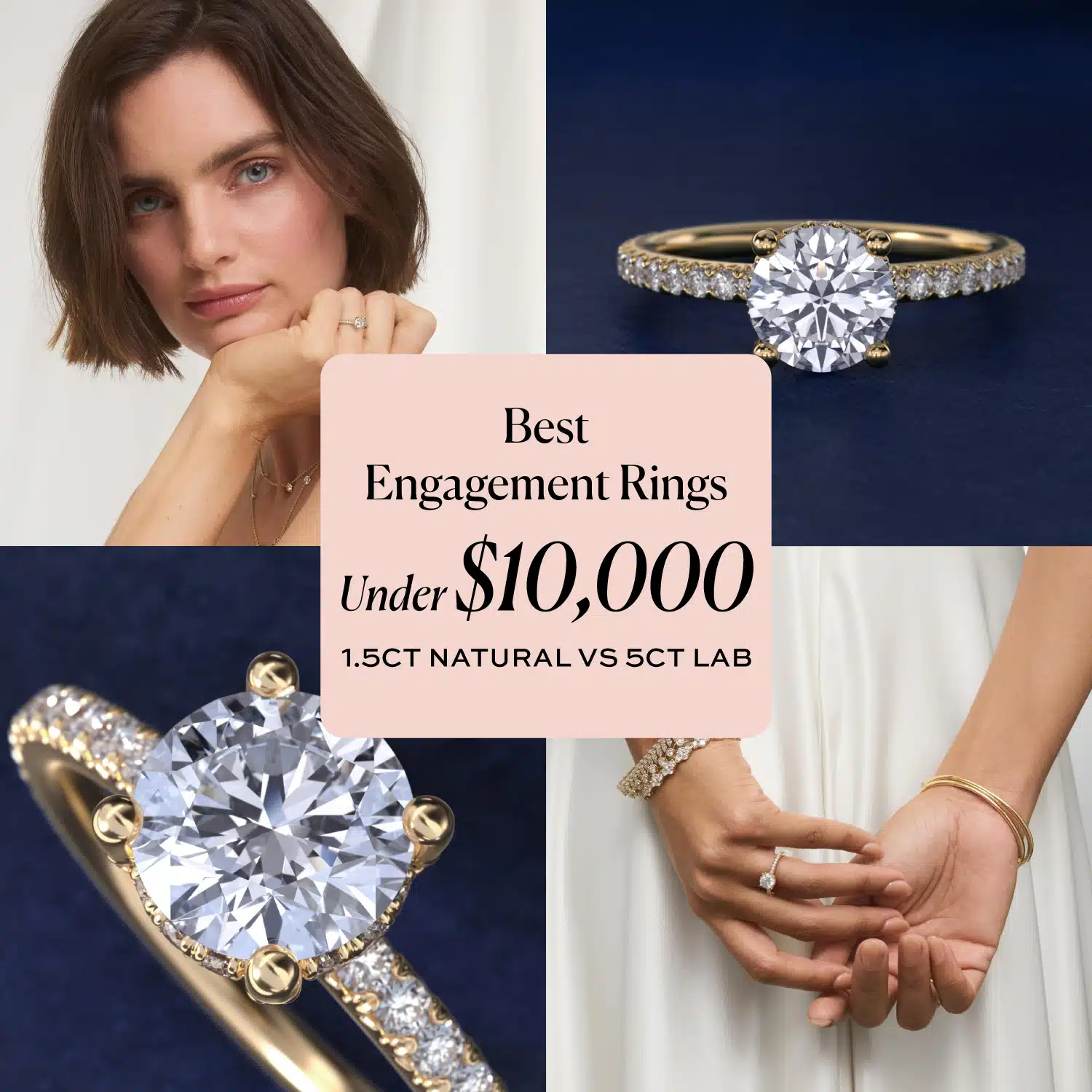
Buying an engagement ring with a $10,000 budget should feel like a victory. Instead, many couples walk into traditional jewelry stores and feel limited by rising prices and confusing terminology. It is frustrating to realize that a five-figure investment might only buy a modest stone that looks smaller than expected.
The good news is that $10,000 is actually a strategic sweet spot. If you know how to allocate your funds, you can choose between a rare heirloom or a massive, red-carpet showstopper. At Moissanite by Aurelia, we believe the best engagement rings under $10,000 are the ones where you stop paying for “rarity” and start paying for beauty.
👉 Best Engagement Rings Under $10,000
The $10,000 Engagement Ring: Why This Budget is a Strategic Sweet Spot
A $10,000 budget allows you to move past entry-level options. You are no longer restricted to “mall jewelry” quality. Instead, you can focus on high-performance stones and custom-level settings.
To maximize this budget, we recommend the 80/20 rule. Spend roughly $2,000 on a high-quality 18K gold or platinum setting. This leaves $8,000 for the center stone, which is the true driver of the ring’s visual impact.
The Legacy Path: What a 1.50ct Natural Diamond Offers
If you value traditional rarity, the natural diamond path is your choice. With an $8,000 stone budget, you can secure a 1.50ct natural diamond with strong specifications.
Most buyers gravitate toward a round brilliant cut. However, round cuts waste nearly 60 percent of the original rough crystal during the cutting process. This makes them the most expensive shape per carat. For a larger look, a 1.71ct Cushion cut is often a smarter move. It uses the rough diamond more efficiently while offering a classic, vintage glow.
The Volume Path: Scaling Up to a 5.30ct Lab-Grown Diamond
The lab-grown market has changed the math of luxury. For the same $8,000 stone budget, you can move from a 1.50ct stone to a massive 5.30ct Cushion cut.
These are not “fakes.” They are chemically identical to natural diamonds but created in a controlled environment. This path is for the buyer who wants maximum visual scale. A 5.30ct stone is a statement piece that would cost over $100,000 if it were mined from the earth.
Side-by-Side: 1.50ct Natural vs. 5.30ct Lab Comparison
| Feature | The Legacy Path (Natural) | The Volume Path (Lab-Grown) |
| Typical Carat | 1.10ct – 1.50ct | 5.0ct – 5.50ct |
| Stone Cost | ~$8,000 | ~$8,000 |
| Primary Value | Rarity and tradition | Visual scale and impact |
| Certification | GIA / IGI | IGI / GIA |
| Best Shape | 1.71ct Cushion | 5.36ct Cushion |
The 80/20 Budgeting Framework: Setting Your Stone for Success
The setting is the stage for your center stone. A $2,020 benchmark setting, like a Petite French Pavé in 18K yellow gold, provides the perfect balance. It features delicate accent diamonds that add sparkle without overwhelming the main attraction.
This type of setting is engineered to be sturdy. It can safely hold a 1.50ct natural diamond just as easily as a 5.30ct lab-grown stone. By keeping the setting costs around $2,000, you ensure the majority of your $10,000 goes toward the part of the ring people notice first.
Beyond Diamonds: Why Moissanite by Aurelia is the Third Path
There is a third option for those who want the absolute maximum fire and brilliance. Moissanite offers a higher refractive index than diamonds. This means it actually sparkles more, especially under natural sunlight.
Choosing Moissanite by Aurelia allows you to secure a flawless, high-carat look while staying well under your $10,000 limit. It is an ethical, sustainable, and stunning alternative for the modern couple who prioritizes aesthetics and value over old-school mining traditions.
FAQ
What is the best engagement ring you can buy for $10,000?
The best value comes from following the 80/20 rule. Allocate $2,000 for a premium setting and $8,000 for the stone. This allows for a 1.50ct natural or a 5.30ct lab-grown diamond.
By splitting the budget this way, you ensure a high-quality setting that protects your investment while maximizing the size and quality of the center stone.
Is a lab-grown diamond better than a natural diamond for $10,000?
Lab-grown diamonds offer three to four times the size for the same price. They are chemically identical to natural stones. The “better” choice depends on whether you value rarity or visual impact.
Natural diamonds hold a legacy value due to their limited supply. Lab-grown diamonds are favored by those who want a massive, high-clarity look without the high premium of mined stones.
How big of a diamond can I get for $10,000?
You can typically get a 1.10ct to 1.50ct natural diamond or a 5.0ct to 5.50ct lab-grown diamond. The specific size depends on the cut, color, and clarity you choose.
Round cuts are usually smaller for the price. If you choose a Cushion or Pear cut, you can often find stones that look larger and cost less per carat.
What is the 80/20 rule for engagement rings?
The 80/20 rule suggests spending 80 percent of your budget on the center stone and 20 percent on the setting. On a $10,000 budget, this is $8,000 and $2,000 respectively.
This framework prevents buyers from overspending on a complex setting that might distract from a smaller center stone. It keeps the focus on the most valuable part of the ring.
Does a $10,000 engagement ring hold its value?
Natural diamonds retain a portion of their resale value due to their rarity. Lab-grown diamonds and moissanite are valued for their beauty and immediate impact rather than as financial investments.
Most people buy engagement rings for their sentimental and aesthetic value. While natural stones have a secondary market, the primary goal of a $10,000 budget is usually to find the most beautiful ring for your partner.
The Real Numbers
55 Percent: Lab grown diamonds now account for over half of the entire engagement ring market in 2026, showing a massive shift in how modern couples define luxury.
60 Percent: A standard round cut diamond wastes nearly 60 percent of the original rough crystal during the shaping process, which explains why it is the most expensive shape per carat.
A Wise Word
“Jewelry is a very personal thing. It should tell a story about the person who is wearing it.” by Garance Daré.
This means that instead of worrying about the hard parts of complex grading charts and industry rules, we should focus on the simple truth: your ring needs to match your actual values. Whether you prefer the historic tradition of a natural diamond or the massive visual footprint of a lab grown stone, the right choice is the one that fits your personal lifestyle and aesthetic.
Key Information at a Glance
| Feature | Why it Matters | How it Helps You |
| The 80/20 Rule | Keeps setting costs under control. | Leaves a full $8,000 dedicated entirely to the center stone. |
| The Volume Path | Removes the traditional rarity markup. | Lets you secure a massive 5.30ct stone on a normal luxury budget. |
| Fancy Cuts (Cushion/Oval) | Preserves more of the rough stone. | Gives you a physically larger face up size for the exact same price. |
| Moissanite by Aurelia | Offers a higher refractive index. | Delivers significantly more fire and brilliance than a standard diamond. |
Simple Tips You Can Use Today
Start Small: Don’t try to do everything at once. Pick one easy part and master it. Focus on your setting first. Lock in a high quality 18K gold band for around $2,000 before you even start comparing center stones.
Ask Why: If something doesn’t make sense, look at the goal. The goal is usually simple. Are you buying this ring because you want a traditional heirloom, or do you want a stunning piece of jewelry that turns heads? Answering this dictates whether you go natural or lab grown.
Keep Track: Write down what you learn. It helps your brain remember the “why” behind the “how.” Track the physical millimeter dimensions of the stones you view. Face up size tells you how big the ring actually looks on a finger, which is far more useful than just knowing the carat weight.
A Surprising Fact
Did you know that Moissanite actually sparkles more than a natural diamond? Most people think a diamond is the absolute ceiling for brilliance, but experts have found that this little secret is actually the key to success! Moissanite bends light differently and has a higher refractive index. This creates more colorful flashes of fire, meaning you get a much more vibrant ring without maxing out your $10,000 budget.
