

Here is a scenario most engineers recognize: you spend months learning AWS services, you build things in the console, and you genuinely understand CI/CD pipelines — but when you apply for senior cloud roles, you keep losing interviews to candidates who hold a professional-level certification. The frustrating part is that you might know more than they do. The problem is that hiring managers cannot tell the difference on a resume alone.
That is the specific problem the AWS DevOps certification solves. According to the Global Knowledge IT Skills and Salary Report, AWS certifications at the professional tier rank consistently among the top ten highest-paying IT credentials, with average salaries pushing well past $130,000 annually. More importantly, the exam itself forces you to close real knowledge gaps — not just memorize service names, but understand how those services fail, scale, and interact under pressure. If you have been treating this certification as a nice-to-have, this guide will change that thinking.
Why AWS DevOps Certification Is Worth Your Time in 2026
Most cloud certification guides bury the counterintuitive truth: the certification does not prove you are good at your job. What it proves is that you understand the system well enough to make the right call when three services are broken at 2 a.m. and your pipeline is down. That is a fundamentally different skill than passing a multiple-choice test about service names.
An AWS DevOps certification signals to employers that you can architect CI/CD pipelines, implement infrastructure as code, and respond to incidents at scale — not just that you have watched tutorials. The credential validates skills that are genuinely hard to fake on a resume. Hiring managers notice the difference between candidates who talk about automation and candidates who have actually proven their knowledge through a rigorous AWS professional-tier exam.
Beyond hiring advantages, preparing for this certification rewires the way you approach architecture decisions. You stop thinking in isolated services and start thinking in failure domains, rollback strategies, and observability gaps — which is exactly how the best cloud engineers think on production systems.
Understanding the AWS Certified DevOps Engineer — Professional Exam
The AWS Certified DevOps Engineer — Professional (DOP-C02) sits at the professional tier, which means it tests deeper than associate-level credentials. AWS expects candidates to demonstrate the ability to design, deploy, and maintain automated systems on AWS infrastructure.
The exam covers six primary domains. Each one carries a specific weight toward your final score, and understanding that distribution helps you study smarter:
| Exam Domain | Key Focus Area | Approximate Weight |
| SDLC Automation | CI/CD pipelines using CodePipeline, CodeBuild, and CodeDeploy | 22% |
| Configuration Management & IaC | CloudFormation, OpsWorks, and Systems Manager | 17% |
| Resilient Cloud Solutions | High availability, disaster recovery, fault tolerance | 15% |
| Monitoring and Logging | CloudWatch, CloudTrail, and AWS Config observability | 15% |
| Incident and Event Response | Issue detection, automated responses, runbooks | 14% |
| Security and Compliance | Security controls embedded across automated workflows | 17% |
Candidates who pass this exam demonstrate they can own the full delivery lifecycle on AWS, not just one slice of it. If you want to understand the complete breakdown of what the exam covers, this AWS DevOps Certification guide walks through every domain in clear detail.
Prerequisites You Should Have Before You Start
AWS recommends holding an associate-level certification before attempting the professional exam. The AWS Certified Developer—Associate or the AWS Certified SysOps Administrator—Associate both provide solid groundwork. However, many candidates with strong hands-on experience pass without first earning an associate credential.
What matters more than which cert you hold is whether you genuinely understand how AWS services interact. If you have never deployed a multi-stage CodePipeline, managed IAM policies for cross-account deployments, or configured CloudFormation stack sets, you will want to build that experience before exam day.
Practical time in the console cannot be replaced by reading documentation alone. The professional exam presents scenario-based questions that require you to weigh trade-offs, not simply recall definitions.
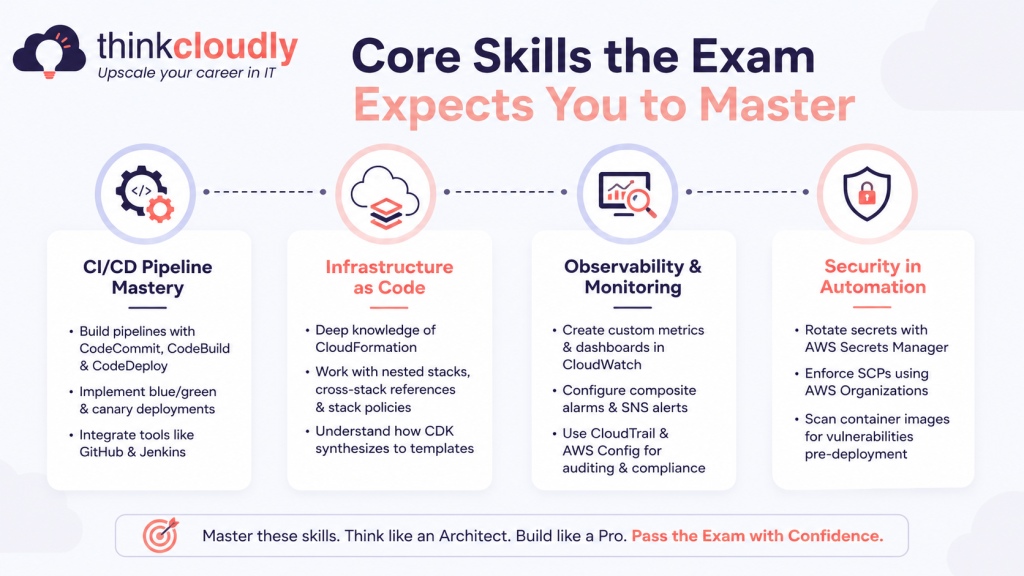
The Core Skills the Exam Expects You to Master
Continuous Integration and Continuous Delivery
CI/CD is the backbone of modern DevOps practice. The AWS DevOps certification exam tests your ability to design pipelines that handle code changes from commit to production with minimal manual intervention. You should know how to trigger pipelines using AWS CodeCommit events, run automated tests inside CodeBuild, manage deployment strategies like blue/green and canary releases through CodeDeploy, and integrate third-party tools like GitHub or Jenkins where needed.
Infrastructure as Code
CloudFormation is the primary IaC tool on AWS, and the exam goes deep on it. You need to understand nested stacks, cross-stack references, stack policies, and rollback triggers. The AWS Cloud Development Kit (CDK) has grown significantly in adoption, so understanding how CDK synthesizes into CloudFormation templates is an asset.
Observability and Monitoring
Passing the AWS DevOps certification exam requires more than knowing that CloudWatch exists. You need to know how to create custom metrics, build dashboards, configure composite alarms, and route alert notifications through SNS to the right teams. CloudTrail for auditing and AWS Config for compliance monitoring also appear heavily across exam domains.
Security in Automation
Security is no longer a separate phase—it runs through every stage of the pipeline. The exam tests whether you know how to rotate secrets using AWS Secrets Manager, enforce SCPs through AWS Organizations, and scan container images for vulnerabilities before deployment.
How to Build a Study Plan That Actually Works
Most successful candidates spend between eight and twelve weeks preparing for the professional exam. The exact timeline depends on how much hands-on AWS experience you already carry.
Weeks 1–2: Audit your gaps. Go through the official exam guide and honestly assess which domains feel unfamiliar. Most candidates come in stronger on CI/CD and weaker on configuration management or incident response. Knowing your gaps early helps you allocate study time more effectively.
Weeks 3–6: Build, break, and rebuild. Reading white papers is useful, but hands-on labs drive retention at a different level. Set up a personal AWS account and build a full CI/CD pipeline from scratch. Deploy infrastructure using CloudFormation. Break something on purpose and practice recovery. The scenarios you encounter in a real lab stay with you in ways that flashcards do not.
Weeks 7–9: Use structured learning resources. This is where a quality course makes a real difference. The AWS Certified DevOps Engineer course at ThinkCloudly covers the exam domains with practical labs and scenario-based exercises designed to mirror real exam conditions. Structured courses prevent the scattered learning that comes from jumping between random YouTube videos.
Weeks 10–12: Practice exams and weak-area reinforcement. Take full-length practice exams under timed conditions. Review every wrong answer carefully. The goal is not just to learn the right answer but to understand why the wrong options are wrong. That reasoning process is what the actual exam rewards.
Common Mistakes Candidates Make (And How to Avoid Them)
Skipping the hands-on work. The professional exam is scenario-heavy. Candidates who only read or watch video content without building anything routinely struggle with questions that require weighing architectural trade-offs. Time in the console matters.
Underestimating CloudFormation depth. Many candidates treat IaC as a secondary topic. The exam does not. Drift detection, change sets, and custom resources come up regularly.
Memorizing services without understanding integration. AWS has hundreds of services, but the exam cares about how they work together. A question about CI/CD will often require you to reason across CodePipeline, CodeBuild, IAM, S3, and CloudWatch simultaneously.
Ignoring security across pipelines. Embedding security into automated workflows is a specific exam domain. Review how to use IAM roles with least privilege in pipeline stages, how Secrets Manager integrates with CodeBuild, and how AWS Config rules enforce compliance continuously.
What Career Doors Open After You Earn Your AWS DevOps Certification
Earning this credential moves you into a category of professionals that every cloud-forward company needs. Common roles that list the AWS DevOps certification as a preferred or required qualification include:
- DevOps Engineer—owning CI/CD infrastructure, pipeline reliability, and deployment automation
- Site Reliability Engineer (SRE)—focusing on service uptime, incident response, and capacity planning
- Cloud Infrastructure Engineer—designing and maintaining AWS environments at scale
- Platform Engineer—building internal developer platforms that abstract infrastructure complexity
Salary data consistently shows that professional-level AWS certifications correlate with higher compensation than associate-level credentials. More importantly, the skills tested in this exam translate directly into the work these roles require day to day.
Ready to Take the Next Step?
Earning your AWS DevOps certification is one of the most direct ways to demonstrate cloud expertise to employers who are actively hiring. The exam is challenging, but it is very passable with focused preparation and genuine hands-on practice.
If you want a structured path that covers every exam domain with labs and scenario-based practice, check out the AWS Certified DevOps Engineer course at ThinkCloudly. And if you want a deeper look at the exam structure, domains, and strategy before you commit to a study plan, the AWS DevOps Certification guide is a great place to start.
The demand for certified AWS DevOps professionals is not slowing down. The right time to start preparing is now.