

For the longest time I genuinely believed automation was one of those things that belonged to companies with actual developers on staff. Like, people who write code for a living, sitting in some office building, create complicated systems that connect twelve different tools together. I run my business alone, from my kitchen table most days, so I figured that stuff just wasn’t for me. I’d manually send every follow-up email, manually repost the same content across three platforms, and manually do the exact same repetitive tasks every single week like it was some badge of honour.
It wasn’t a badge of honour. It was just wasted time.
The Myths I Believed
The first myth was that automation requires coding knowledge. It doesn’t, not for the stuff that actually matters day to day. Most of what solo founders need isn’t some elaborate system; it’s just a handful of repetitive tasks running without you having to remember to do them.
The second myth was that automation is only worth it once you’re big enough to justify the setup time. I used to think, Why bother automating something I only do fifteen times a month? But fifteen times a month adds up fast when each one takes ten minutes of your attention you’ll never get back.
The third myth, and probably the most damaging one, was thinking automation would make my business feel impersonal. In practice it did the opposite. Automating the boring repetitive parts freed up actual time and energy for the stuff that needed a real personal touch, like actually replying to people who asked thoughtful questions.
The Small Wins That Actually Mattered
None of what helped me was complicated. A simple email sequence that went out automatically after someone downloaded something from me, instead of me remembering to follow up manually and inevitably forgetting half the time.
Content repurposing was another one. Instead of writing something fresh for every single platform, having one piece of content automatically reformatted and scheduled across a few channels saved hours every week that I used to spend copy-pasting and adjusting formatting by hand.
Lead follow-ups were probably the biggest unlock. Every lead that went cold because I forgot to reply for three days was a lead I basically threw away. A simple automated nudge sequence fixed that without me having to think about it.
Where the Templates Came In
Honestly, figuring out how to actually set these up was the part that intimidated me most, not the concept itself. That’s where having access to ready-built automation workflows made a real difference, especially ones designed for non-technical founders instead of assuming you already know how to code an integration from scratch. Instead of googling tutorials for hours trying to piece something together, I could grab a tested automation workflow and adapt it to my actual business in under an hour.
That’s really the gap for most solo founders. It’s not that automation is too advanced conceptually; it’s that setting it up from zero feels like a whole project on its own.
A Simple Example, Start to Finish
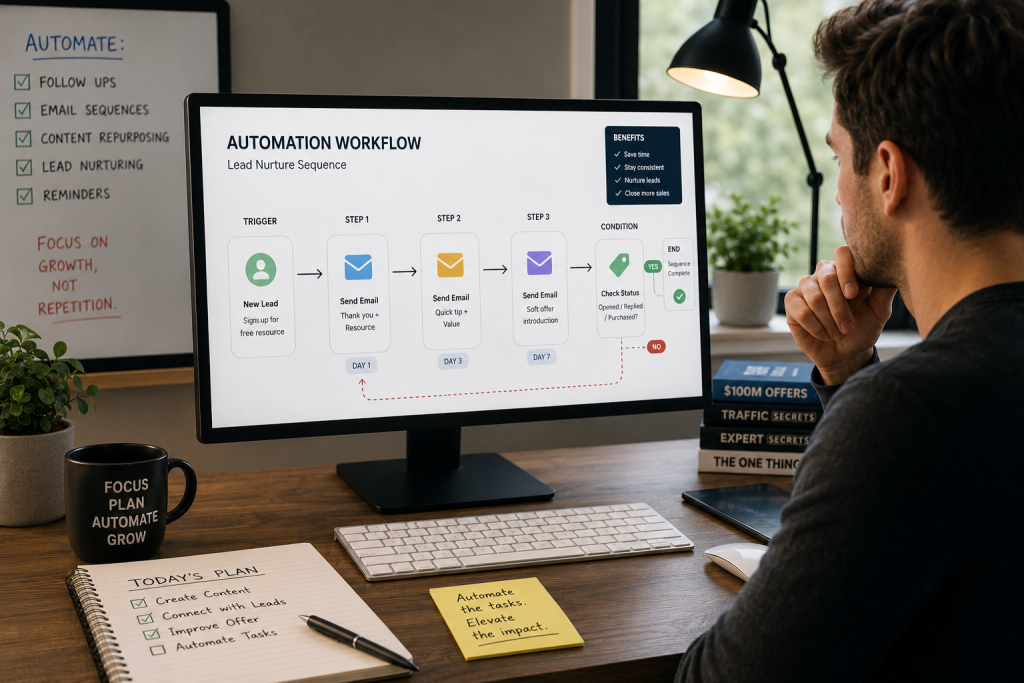
Here’s roughly what one of my first automated workflows looked like. Someone signs up for a free resource on my site. Instead of me manually sending a thank you email, checking back in three days later, and following up again a week after that, all of it just happens on its own. Day one, a thank you with the resource attached. Day three, a quick tip related to what they downloaded. Day seven, a soft mention of what I actually sell, only if they haven’t already replied or bought something from me.
I didn’t build this myself from scratch. I adapted an existing structure and swapped in my own voice and content. It took an afternoon instead of a month, and it’s been quietly running in the background ever since.
Start With One Thing
If you’re a solo founder or an early entrepreneur convinced automation isn’t for you yet, I’d push back gently. You don’t need a developer, you don’t need a complicated system, and you definitely don’t need to automate everything at once. Pick the one repetitive task you dread doing every week, the one that eats your time without actually needing your brain, and automate just that one thing first. Everything else can come later.