

The most common mistake I see foreign AI vendors make in this market is treating Arabic as a language setting, a checkbox on the localization list, somewhere between currency formatting and timezone support. That framing costs them deals they do not even realize they have lost.
Arabic is not a localization problem. It is a product architecture decision. And in the GCC enterprise and government market, whether you made that decision correctly shows up very early in the procurement conversation, before the demo, sometimes before the first meeting.
When I look at how the Arabic-first AI category has matured over the past two years, what stands out is not the technical progress, though that has been real and fast. What stands out is how quickly Arabic-first capability has moved from a differentiator to a procurement baseline in certain verticals. In government services, banking, healthcare, and any customer-facing application, the question is no longer “Do you support Arabic?” It is “How well does your Arabic actually work, and can you prove it in a live dialect context?”
Those are different questions. And most global AI vendors can only answer the first one.
What Arabic-first actually means in a commercial context
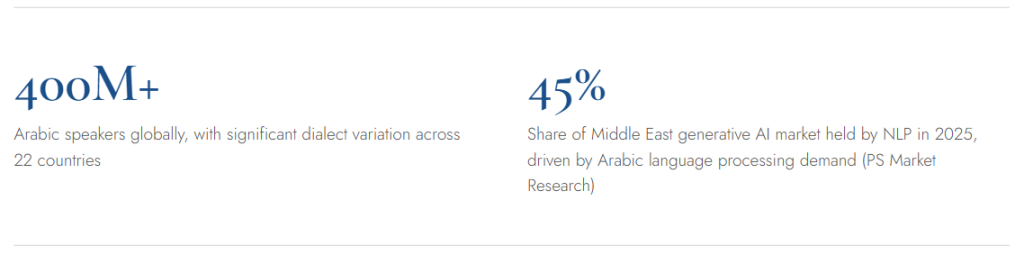
Arabic is the fifth most spoken language in the world. It serves more than 400 million speakers across 22 countries. But the number understates the commercial complexity, because Arabic is not one language in the way that English or French is one language. It is a family of dialects layered over a formal written standard, Modern Standard Arabic, that almost no one actually speaks in daily conversation.
The word “bas” means “only” in Egypt, “but” in the Levant, and “enough” in the Gulf. That single three-letter word, appearing in a customer service interaction or a government portal, can carry completely different meaning depending on where the user is sitting. A model that handles Modern Standard Arabic well but fails on Khaleeji or Egyptian colloquialisms is not an Arabic AI product. It is an Arabic-adjacent product that will produce errors in exactly the moments when accuracy matters most.
This is the core of what Arabic-first means commercially. Not just training data that includes Arabic. Not a translation layer bolted onto an English-first architecture. A model built from the ground up to understand the morphological complexity of the language; the dialectal variation across the region; and the code-switching between Arabic, English, and, in North Africa, French that characterizes how Arabic speakers actually communicate in professional and digital contexts.
Jais, developed by G42’s Inception, MBZUAI, and Cerebras, was trained on 116 billion Arabic tokens specifically assembled to capture that complexity. Jais 2, released in late 2025 with 70 billion parameters, was built from scratch on the largest Arabic-first dataset ever assembled, with particular attention to dialect variation, code-switching, and informal Arabic that earlier models handled poorly. These are not incremental improvements on a multilingual model. They are products designed around the architecture of the language itself.
That distinction matters commercially because enterprise and government buyers in the GCC have access to these models. They know what high-quality Arabic AI looks like. When a foreign vendor comes in with a product that struggles with the Gulf dialect, hallucinates in Arabic, or produces formal Modern Standard Arabic in contexts that call for conversational language, the buyer notices. And in a procurement process where trust is built slowly and lost quickly, that notice tends to be decisive.
How Arabic-first changes the sales motion
The commercial implication of Arabic-first is not just about product quality. It changes the entire go-to-market motion in ways that most foreign vendors have not fully mapped.
First, it changes who evaluates your product. In a GCC government RFP, technical evaluation panels now regularly include Arabic language specialists alongside engineers. A product that performs well on standard AI benchmarks but poorly on Arabic dialect comprehension will fail technical evaluation in a category it did not know existed when it entered the room. The evaluation criteria have moved.
Second, it changes the procurement narrative. Government buyers in this region are building toward what I would describe as adoption infrastructure, the systems, workflows, and citizen-facing interfaces that will run on AI for the next decade. For those buyers, choosing a product with weak Arabic capability is not just a current-state problem. It is a strategic dependency on a vendor to catch up, on a timeline the vendor controls, not the buyer. Procurement committees understand this risk. The ones that have been briefed on language sovereignty, data sovereignty, and the gap between demo Arabic and production Arabic are not choosing products that create it.
“Arabic-first is not a feature you add at the end. It is a category decision you make at the beginning, and buyers can tell the difference.”
Third, it changes the partnership model. The system integrators and local technology partners who are winning government AI contracts in the UAE and Saudi Arabia are increasingly the ones who can evaluate Arabic language performance, configure dialect-specific deployments, and stand behind the linguistic quality of the product in front of a ministry procurement committee. A foreign vendor without either strong Arabic-first capability or a partner who can credibly fill that gap is entering procurement conversations with a structural disadvantage that product features alone cannot close.
Why retrofitted Arabic underperforms commercially
The pattern I see most consistently is a global AI company with genuine product capability that added Arabic support because the market opportunity was obvious. The Arabic works, technically. It passes basic tests. But in production, in a real government service context or a bank’s customer operations, the gaps show up.
The CEO of Intella, an Arabic AI company building dialect-specific models, put it clearly in an interview with The National: the problem with most global models is that they rely on labeled datasets for Arabic training, and those datasets simply do not exist for dialectal Arabic at the quality and scale needed. The result is a model that handles written formal Arabic reasonably well and then degrades significantly when the actual user, a citizen calling a government helpline or a customer messaging a bank, starts typing or speaking the way they actually communicate.
That degradation is not a minor UX issue. In a customer service context, it means failed resolution and escalation to human agents, which defeats the efficiency case for the AI deployment. In a government services context, it means citizens who cannot get answers in their natural language, which creates a trust problem that goes beyond the technology vendor and reflects on the ministry that chose it. Procurement teams who have seen that failure mode are making different decisions in 2026 than they were in 2023.
What Arabic-first means at the procurement stage
Training architecture: Was the model trained from the ground up on Arabic-first data, or is Arabic a language added to an English-first foundation? Buyers with technical advisors are asking this directly.
Dialect coverage: Which dialects are supported, at what accuracy level, and with what evidence? Gulf Arabic, Egyptian, Levantine, and North African are distinct enough that coverage of one does not imply coverage of the others.
Code-switching: Real Arabic business communication frequently mixes Arabic with English or French. A model that cannot handle this in context will produce outputs that feel unnatural to the actual user, regardless of benchmark performance.
Data residency alignment: For sovereign AI deployments, the Arabic model and its training data need to sit within the same compliance framework as the rest of the product. A strong Arabic model hosted outside the UAE or Saudi jurisdiction creates a regulatory problem that the procurement team will surface.
The GTM wedge that most foreign vendors miss
There is a specific commercial window that Arabic-first opens for vendors who have built the capability correctly, and it is not just about winning deals that require Arabic. It is about winning categories.
In sovereign AI commercialization across MENA, the vendors who have genuine Arabic-first capability are in a different procurement conversation than those who do not. They can compete for the government service automation contracts, the citizen-facing AI deployments, and the Arabic document processing and knowledge management systems that are part of every national digital transformation program across the Gulf. Those are not peripheral use cases. They are the core of what government AI adoption looks like in this region.
The natural language processing segment held 45 percent of the Middle East generative AI market in 2025, driven specifically by Arabic language processing demand. That share reflects where buyers are actually spending. It is not an accident that Adobe and Humain announced a partnership in late 2025 specifically to develop Arabic-first generative AI models for the Arab world. Global companies with real market intelligence are recognizing that Arabic-first is not a niche within the MENA AI market. It is a significant portion of the market itself.
For foreign AI vendors still treating Arabic as a feature, the commercial signal is already visible. The vendors winning the procurement cycles that matter are the ones that built Arabic into the product decision, not the localization roadmap. That gap is going to widen, not narrow, as more Arabic-first models reach production quality and buyers have direct comparisons available.
The last mile of AI in MENA runs through Arabic. Not through a translation layer. Not through a checkbox in the settings menu. Through a product that was built with the language, its complexity, its dialects, and its speakers at the center of every architecture decision. The vendors who understand that are not competing on features. They are competing in a different category. And in this market, that is where the contracts are.
Those tracking the commercial evolution of Arabic-first AI products and how language capability is reshaping enterprise procurement decisions in MENA can follow the analysis of Rym Bachouche, an Arabic-first AI and SaaS expert writing from inside the sovereign AI market in the UAE.