
If you are living with severe, chronic shoulder pain, everyday tasks can feel like an uphill battle. Reaching for a coffee mug on a high shelf, fastening a seatbelt, or simply finding a comfortable sleeping position can trigger a sharp, radiating ache. When conservative treatments like physical therapy, cortisone injections, and anti-inflammatory medications fail to provide lasting relief, shoulder replacement surgery frequently becomes the definitive path to reclaiming your quality of life.
However, as you explore your options with the best orthopedic surgeon, you will likely encounter a critical choice between two entirely different surgical techniques: Anatomic Total Shoulder Replacement and Reverse Total Shoulder Replacement.
While both procedures are highly successful at eliminating bone-on-bone pain, they utilize opposite mechanical principles. Understanding these mechanical differences is essential to uncovering which approach is uniquely suited to your body’s anatomy.
The Natural Blueprint: Anatomic Shoulder Replacement
To understand how these surgeries work, it helps to picture the shoulder as a classic ball-and-socket joint. The “ball” is the rounded top of your upper arm bone (the humerus), and the “socket” is a shallow groove in your shoulder blade (the glenoid).
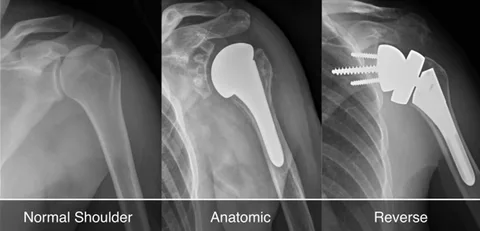
An Anatomic Shoulder Replacement does exactly what the name implies: it replaces your worn-out joint while preserving your body’s natural anatomy.
During this procedure, the surgeon replaces the arthritic ball with a highly polished metal sphere and lines the damaged socket with a smooth, durable medical-grade plastic cap. The new implants match your original anatomy perfectly.
However, there is a major catch. As a specialized arthroscopic surgeon will emphasize, your shoulder’s internal engine and the rotator cuff must be completely healthy and intact for an anatomic replacement to function properly. The rotator cuff is a tight sleeve of four muscles and tendons that wrap around the joint. It is responsible for keeping the ball centered perfectly within the shallow socket whenever you lift or rotate your arm. If your rotator cuff is severely torn or degenerated, an anatomic implant will fail because there are no muscles left to hold the new ball in place.
[Natural Anatomy] ➔ Metal Ball on Arm + Plastic Socket on Shoulder ➔ Relies on Rotator Cuff
Flipping the Mechanics: Reverse Shoulder Replacement
What happens if you have severe arthritis and a completely ruined, unrepairable rotator cuff tear? For decades, these patients had very few options. Because their rotator cuff could no longer stabilize the joint, standard anatomic implants would quickly loosen and fail.
To solve this problem, biomedical engineers completely flipped the mechanics of the joint, creating the Reverse Shoulder Replacement.
In a reverse procedure, the ball and socket switch places. The surgeon attaches a metal ball (a glenosphere) securely to your shoulder blade socket, and places a matching plastic socket cap onto the top of your upper arm bone.
[Reverse Mechanics] ➔ Plastic Socket on Arm + Metal Ball on Shoulder ➔ Relies on Deltoid Muscle
By reversing the ball and socket, the joint no longer requires a rotator cuff to lift the arm. Instead, the flipped architecture alters the leverage of the shoulder, forcing the large, outer shoulder muscle, the deltoid muscle, to take over. The deltoid is the strong muscle on the outside of your shoulder that you use to lift your arm out to the side. A reverse replacement leverages this strength, allowing you to lift your arm smoothly even if your rotator cuff is completely gone.
Side-by-Side Comparison: Which Path is Yours?
Choosing the right procedure isn’t about deciding which surgery is “better” , it’s about determining which mechanical design matches the structural integrity of your soft tissues.
| Feature | Anatomic Shoulder Replacement | Reverse Shoulder Replacement |
| Joint Architecture | Mimics natural anatomy (Ball on arm, socket on shoulder). | Flips natural anatomy (Socket on arm, ball on shoulder). |
| Primary Muscle Needed | Requires a completely healthy, intact Rotator Cuff. | Bypasses the rotator cuff; relies entirely on the Deltoid. |
| Ideal Candidate | Patients with severe osteoarthritis but strong, functioning muscles. | Patients with massive cuff tears, cuff tear arthropathy, or complex fractures. |
| Primary Functional Goal | Restores smooth, natural rotation and overhead reach. | Restores the ability to raise the arm forward and overhead. |
Making the Final Decision
Your orthopedic surgeon will utilize high-resolution X-rays and an MRI to make the final determination. The X-rays will map out the severity of your bone-on-bone arthritis, while the MRI will visually inspect the health of your rotator cuff tendons.
If your rotator cuff is healthy and your primary issue is standard wear-and-tear osteoarthritis, an anatomic replacement will provide an incredibly natural-feeling joint with excellent rotational flexibility. However, if you suffer from complex rotator cuff tear arthropathy (a specific type of severe arthritis caused by long-term muscle tears) or are undergoing a revision surgery to fix a previous joint failure, a reverse replacement is a revolutionary option that can beautifully restore your mobility.
Ultimately, both procedures represent triumphs of modern orthopedic engineering. By matching the right mechanical solution to your personal anatomy, your surgical care team can successfully eliminate your chronic pain, rebuild your strength, and help you get back to enjoying a vibrant, active, and pain-free life.