
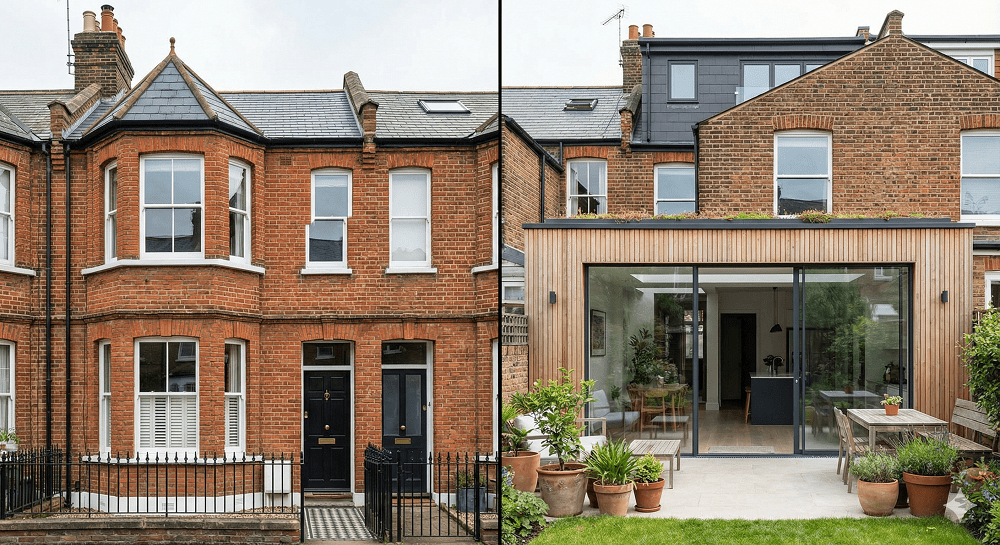
The United Kingdom has one of the most diverse and challenging housing landscapes in the world. Whether you are looking to buy a slice of history, renovate a “doer-upper,” or build a net-zero eco-home from scratch, understanding the unique fabric of British architecture is essential.
In 2025, the UK housing market is defined by a single, powerful concept: Modern Heritage. It’s the art of taking our beloved, drafty, historic stock—from Georgian townhouses to 1930s semis—and dragging them into the future with sustainable retrofits and light-filled extensions.
This guide covers everything you need to know about house design in the UK, from identifying architectural eras to navigating the latest planning permissions.
A Brief History of British House Styles
Before you can renovate, you must identify what you have. Britain’s streets are a timeline of architectural history, and each era comes with its own quirks (and maintenance issues).
1. Georgian (1714–1830)
Defining the “age of elegance,” Georgian homes are famous for their rigid symmetry, sash windows, and high ceilings. They are often built from local brick or stone and feature grand townhouses arranged in squares or crescents.
- Key Feature: The “Piano Nobile”—the main reception room was often on the first floor, not the ground floor.
2. Victorian (1837–1901)
The industrial revolution brought mass housing to the UK. Victorian homes are the most common type of terrace in London and major cities. They are characterized by bay windows, patterned brickwork, and slate roofs.
- Design Note: Originally built with coal fireplaces in every room, these houses breathe well but are notoriously hard to insulate.
3. Edwardian (1901–1910)
Edwardian homes are often wider and airier than their Victorian predecessors. They introduced mock-Tudor cladding, wooden porches, and wider hallways, often set in “garden suburbs” that prioritized green space.
Top UK House Design Trends for 2025
The “white box” minimalism of the 2010s is gone. In 2025, UK homeowners are favoring texture, warmth, and flexibility.
The “Broken-Plan” Living Revolution
For years, open-plan living was the gold standard—knocking through walls to create one vast kitchen-living space. However, the rise of hybrid working has highlighted the noise and heating issues of these layouts.
Enter Broken-Plan. This design philosophy keeps the sense of light and space but uses subtle divisions to “zone” the home. Think internal crittall windows, split-level floors, or open shelving units that separate the “home office” from the “lounge” without blocking sightlines.
Biophilic Design & Indoor-Outdoor Flow
With UK weather becoming wetter and warmer, connecting with nature is vital. Biophilic design involves using natural materials (cork, limestone, timber) and maximizing visual connections to the garden. We are seeing a surge in corner-glazing and “living walls” in kitchen extensions.
Navigating UK Planning Permission & Regulations
This is the technical hurdle that trips up most projects. In 2025, the rules have shifted slightly to encourage density and improvements, but strict covenants remain.
Permitted Development (PD) Rights
You do not always need full planning permission to extend your home. Under Permitted Development, you can often perform significant upgrades if you adhere to strict volume and height limits:
- Rear Extensions: Typically up to 3m deep (attached houses) or 4m (detached).
- Loft Conversions: Up to 40 cubic meters of additional roof space for terraced houses.
- Two-Storey Extensions: Now easier under prior approval schemes, but neighbor consultation is still required.
Note: PD rights are usually removed in Conservation Areas and for Listed Buildings.
Building Regulations: Part L and Part O
Even if you don’t need planning permission, you must comply with Building Regulations. The 2025 updates focus heavily on the environment:
- Part L (Conservation of Fuel and Power): Requires much stricter U-values (insulation performance) for walls and windows.
- Part O (Overheating): A newer regulation ensuring that highly glazed extensions don’t become greenhouses in summer, often requiring specific ventilation strategies or solar-control glass.
Maximizing Space: Popular Extensions
Space comes at a premium in the UK, costing upwards of £7,000 per square meter in parts of London. Here is how clever design is adding value.
The “Side Return” Extension
The Victorian “side return”—that dark, useless strip of concrete down the side of the kitchen—is prime real estate. squaraging off this area can transform a narrow galley kitchen into a full-width kitchen diner.
- Design Tip: Use a “glass box” roof for the side return to flood the middle of the house with light, which can otherwise become dark when you extend.
Loft Conversions
Going up is almost always cheaper than moving out. A Dormer conversion (a box extension on the rear roof) offers the most headroom and floor space. A Mansard conversion is more aesthetically pleasing and preferred by planners in sensitive areas, but it is more expensive to construct.
Sustainability: The Net Zero Push
With energy prices remaining high, an energy-efficient house design is no longer a luxury; it’s a financial necessity.
- Insulation First: Before buying heat pumps, upgrade the fabric. Solid wall insulation (internal or external) is critical for pre-1920s homes.
- Heat Pumps: The UK government is phasing out gas boilers in new builds. Air Source Heat Pumps (ASHP) are the standard replacement, but they require larger radiators or underfloor heating to work effectively at lower flow temperatures.
- Solar PV: Modern panels are sleeker and can be integrated directly into the roof tiles (solar tiles) for a heritage-friendly look.
The Cost of Building in 2025
Budgeting is where dreams meet reality. As of 2025, material costs have stabilized, but labor remains expensive.
Average Build Costs (Per Square Metre):
- Basic Finish (Standard materials, DIY elements): £1,750 – £2,000 / m²
- Mid-Range (Good quality glazing, professional finish): £2,200 – £2,800 / m²
- High-End (Bespoke joinery, architectural glazing): £3,000+ / m²
Pro Tip: Always set aside a contingency fund of at least 15% for unforeseen issues, especially when digging foundations for older properties.
Conclusion
House design in the United Kingdom is a balancing act between respecting the past and building for a sustainable future. Whether you are adding a contemporary glass extension to a Georgian cottage or retrofitting a 1930s semi to Passivhaus standards, the goal is the same: to create a home that is warm, light, and adaptable.
By understanding the “bones” of your property and navigating the planning maze early, you can unlock potential in even the most modest British terrace.
Frequently Asked Questions (FAQ)
Q1: Do I need an architect for a house extension in the UK?
While not legally required, an architect is highly recommended for complex projects, especially in Conservation Areas or for double-storey extensions. For simple single-storey box extensions, a chartered architectural technologist or a structural engineer may be sufficient and more cost-effective.
Q2: What is the “45-degree rule” in house design?
This is a planning rule used by local councils to protect your neighbors’ light. If you draw a line at a 45-degree angle from the center of your neighbor’s nearest window, your new extension should ideally not cross that line. If it does, you may be refused planning permission.
Q3: Can I replace my windows with any style I want?
If you live in a Listed Building, you will need Listed Building Consent to change windows, often requiring you to use single-glazed timber to match the original. In Conservation Areas, you may need permission to change the “material appearance” (e.g., swapping timber for uPVC). In standard homes, you can usually change windows freely, provided they meet current energy efficiency standards (Part L).
Q4: How long does it take to get planning permission in the UK?
Statutory targets are 8 weeks for minor applications (like household extensions) and 13 weeks for major ones. However, in 2025, many councils are experiencing backlogs, so it is safer to budget for 10–12 weeks for a decision.
Q5: Is open-plan living still popular in 2025?
Yes, but it has evolved. “Zoned” or “broken-plan” living is now preferred. This layout uses physical features like steps, bookcases, or varying ceiling heights to define different areas (cooking, relaxing, working) while keeping the space visually open. This helps with noise control and heating efficiency compared to vast, empty halls.
