

The Shift in Digital Discovery
Search behavior is no longer limited to typing queries into a browser and scanning a list of links. Today, users interact with AI-driven assistants, voice tools, and intelligent platforms that provide direct answers. This shift has changed how brands are discovered and how strategies must evolve.
As someone who has worked closely with businesses trying to stay ahead, I have seen how traditional approaches alone are no longer enough. Agencies must now rethink visibility through a broader lens. This is where the concept of an AI visibility tool becomes critical.
While conventional techniques still hold value, understanding how AI-driven discovery works can determine whether a brand thrives or fades into digital noise.
Understanding Traditional Methods
Traditional optimization techniques have long been built around improving rankings in search engine results. These methods focus on elements such as keyword research, link building, and technical improvements.
Common practices include:
- Creating keyword-focused content
- Optimizing meta tags and headings
- Building backlinks from authoritative sources
- Improving website speed and usability
- Structuring content for crawlability
For years, these tactics helped businesses gain visibility and traffic. A typical SEO agency would rely heavily on these frameworks to deliver results for clients.
However, the environment has evolved. Search engines now prioritize intent, context, and user experience more than ever. On top of that, AI-powered systems are reshaping how information is presented.
What Is an AI Visibility Tool?
An AI visibility tool is designed to track and improve how a brand appears across AI-driven platforms. Unlike traditional tools that focus only on rankings, these solutions analyze how content is interpreted, summarized, and delivered by AI systems.
Instead of asking, “Where does this page rank?”, the question becomes, “Is this brand being referenced, recommended, or cited by AI?”
These tools help agencies understand:
- Whether their content appears in AI-generated answers
- How frequently their brand is mentioned in conversational outputs
- The accuracy and sentiment of AI-generated summaries
- Opportunities to optimize content for AI interpretation
This shift in measurement changes everything. Visibility is no longer just about position. It is about presence in intelligent systems that guide user decisions.
Key Differences Between AI-Driven and Traditional Approaches
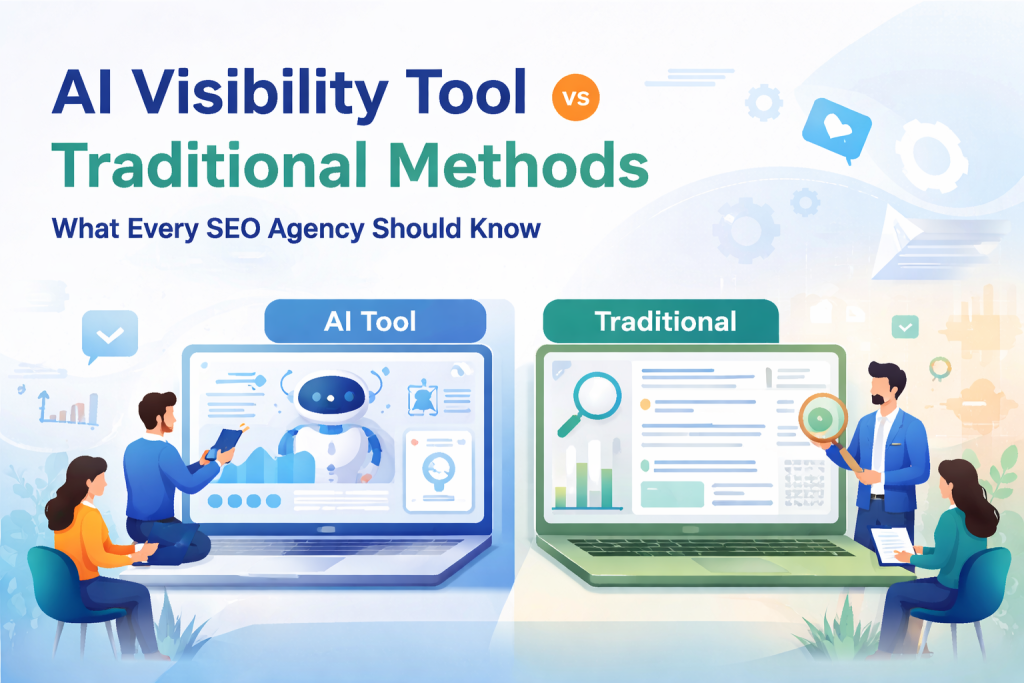
The contrast between these two approaches is significant. Understanding the differences helps agencies decide how to adapt their strategies.
Focus on Rankings vs Presence
Traditional methods prioritize ranking positions on search engine result pages. The higher the ranking, the better the visibility.
AI-driven strategies focus on whether the brand is included in AI responses at all. Even a top-ranking page may be ignored if it is not structured for AI comprehension.
Keywords vs Context
Older strategies revolve around keyword placement and density. While still important, this approach alone is no longer sufficient.
AI systems analyze context, intent, and meaning. Content must answer questions clearly and provide value beyond keyword usage.
Links vs Authority Signals
Backlinks remain a strong factor in traditional strategies. However, AI systems evaluate authority differently.
They consider:
- Content clarity
- Expertise demonstrated in writing
- Consistency across platforms
- Structured and reliable information
Static Content vs Conversational Content
Traditional content often focuses on static pages optimized for indexing.
AI-friendly content must feel conversational, direct, and informative. It should answer questions naturally, similar to how a human would explain a concept.
Why Traditional Methods Alone Are No Longer Enough
Relying only on older techniques can limit growth in today’s landscape. While they still provide a foundation, they do not address how users interact with AI platforms.
Consider this scenario. A user asks an AI assistant for recommendations. The assistant provides a direct answer without showing a list of links. If your brand is not included in that response, it loses visibility completely, regardless of how well it ranks elsewhere.
This is the gap that many agencies are starting to notice. A modern SEO agency must expand its strategy beyond traditional frameworks to remain competitive.
Benefits of Using an AI Visibility Tool
Adopting an AI visibility tool offers several advantages that go beyond conventional tracking.
Improved Brand Presence
These tools help ensure that your brand appears in AI-generated responses, increasing exposure in new channels.
Better Content Optimization
By understanding how AI interprets content, agencies can refine messaging to make it clearer and more impactful.
Competitive Insights
You can analyze which competitors are being mentioned by AI systems and adjust strategies accordingly.
Real-Time Adaptation
AI-driven platforms evolve quickly. These tools provide insights that allow agencies to adapt faster than relying on outdated metrics.
How Agencies Can Integrate Both Approaches
The smartest strategy is not choosing one over the other but combining both methods effectively.
Here is how agencies can do that:
- Continue optimizing technical aspects of websites
- Focus on creating high-quality, informative content
- Structure content to answer specific questions clearly
- Use an AI visibility tool to track presence in AI responses
- Monitor how content is summarized and adjust tone accordingly
This balanced approach ensures that brands remain visible across both traditional search and AI-driven environments.
Content Strategies That Work in the AI Era
Creating effective content today requires a shift in mindset. It is not just about writing for algorithms but also for intelligent systems that interpret meaning.
Some key strategies include:
Write for Clarity
Avoid overly complex language. Clear and direct explanations perform better in AI summaries.
Answer Questions Directly
Structure content to address common user queries. This increases the chances of being included in AI-generated responses.
Use Structured Formatting
Headings, bullet points, and logical flow help AI systems understand and extract information more effectively.
Build Topical Authority
Focus on depth rather than just breadth. Cover topics thoroughly to establish credibility.
Common Mistakes Agencies Should Avoid
Even experienced professionals can struggle with this transition. Here are some common pitfalls:
- Ignoring AI-driven platforms entirely
- Overloading content with keywords instead of focusing on meaning
- Failing to update old content for modern standards
- Relying solely on ranking metrics for success measurement
- Not analyzing how AI systems interpret their content
Avoiding these mistakes can significantly improve results and ensure long-term success.
The Role of Data in Modern Optimization
Data has always been important, but its role is expanding. Agencies now need to analyze not only traffic and rankings but also AI-driven insights.
This includes:
- Frequency of brand mentions in AI outputs
- Accuracy of information presented by AI systems
- User engagement with AI-generated recommendations
An AI visibility tool provides this layer of data, helping agencies make more informed decisions.
What the Future Looks Like for Agencies
The future of digital visibility is closely tied to AI. As these systems become more advanced, they will play an even larger role in how users discover information.
Agencies that adapt early will have a significant advantage. Those that rely solely on outdated methods may struggle to keep up.
The role of a modern SEO agency is evolving into something more dynamic. It now involves understanding how machines interpret content, not just how they index it.
Staying Ahead in a Changing Landscape
Success in today’s environment requires flexibility and a willingness to evolve. Traditional methods still provide a strong foundation, but they must be complemented with modern tools and strategies.
By embracing an AI visibility tool, agencies can ensure their clients remain relevant in a rapidly changing digital world. The key is not to abandon proven techniques but to enhance them with new insights.
In the end, visibility is no longer just about being found. It is about being chosen, recommended, and trusted by both users and the intelligent systems guiding them.