
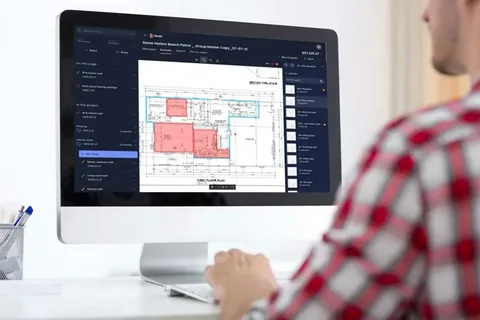
Today’s construction projects rely on cost management systems to help control budgets and streamline projects. This type of cost planning involves digital technologies, data processing, and forecasting models to deliver reliable estimates. As construction processes become more complex, there is a growing need for accurate estimating practices in both commercial and residential projects.
Artificial intelligence (AI) technologies are now revolutionizing construction cost estimating by bringing data accuracy and automation to the estimating process. AI construction estimating software analyzes project data, assesses cost factors, and provides structured cost projections, enhancing decision-making processes for project planning and implementation.
What’s the underlying principle of AI construction estimating software?
AI construction estimating software’s core concept relies on the automation of cost forecasts through structured data analysis. It assesses past construction project information and uses predictive modeling to estimate construction costs. It minimizes uncertainties in the early stages of project planning and budgeting.
AI systems update their knowledge of past construction projects. They update their forecasting models based on cost trends and other project factors. This generates a dynamic, ever-changing estimation environment.
Using AI to develop construction cost models
Construction cost estimation AI models analyze data from previous projects. This data can be material usage, workforce productivity, and cost index variations. It recognizes patterns in the data to provide cost forecasts.
Machine learning algorithms enhance the accuracy of the estimates as they are generated. Dynamic updates keep estimates up-to-date with market conditions and project needs. This helps to formalize the estimation process.
How Does AI Construction Estimating Software Work in Estimating Systems?
AI construction estimating software helps to transform construction data into financial information. It takes inputs from various sources and applies predictive models. The software then provides cost estimates for project planning and forecasting.
The systems will then update the cost estimates as the project progresses. Digital integration keeps cost estimates up-to-date during the construction process. This eliminates the need for manual estimates.
Data input sources used in estimation
AI-based estimators use several structured data sources for estimations. Construction material cost databases supply up-to-date material costs. Labor cost indices specify labor costs depending on market factors.
Structural and design data are provided from project plans and BIM models. These enable the system to more accurately compute material needs and project costs. They are the basis for the estimation.
Processing and prediction logic
AI systems employ algorithms to analyze construction data and produce cost estimates. These assess project complexity, resource allocation, and risk. This helps provide consistent and accurate estimates.
Computerized quantity takeoffs determine precise quantities of construction material needed. Risk probability models take into account uncertainties to further enhance cost estimates. This helps to better predict costs.
What’s in AI-Based Estimation Systems?
AI-based estimation systems are a digital integration of various modules. These provide standardized cost planning and seamless data integration in construction processes.
Construction businesses such as Constil are part of this organized ecosystem of construction through up-to-date cost estimation and project management.
Cost databases and real-time pricing engines
Cost databases contain structured data on material costs, labor rates, and equipment costs. They are regularly updated with market fluctuations and construction industry developments.
Live pricing engines update estimates according to economic factors. This helps keep cost estimates and budgets up-to-date with the ever-changing pricing landscape in construction.
Integration with project management tools
AI budgeting systems link with project management tools to streamline processes. They link the budgeting, scheduling, and execution processes in a virtual workspace.
Project managers control schedules, and resource management systems allocate resources. Software for construction companies can integrate these processes to enhance project management and efficiency.
How Does AI Help with Construction Project Management and Budgeting?
AI is a key component in linking construction estimating software with project management software. It allows monitoring of project budgets throughout the project. This helps with planning and minimizes financial uncertainties.
AI tools also aid contractors in monitoring cost variations. This allows enhanced control and transparency throughout the project.
Link between design and build processes
AI software has direct connections between the budget estimates and construction execution. This enables cost performance tracking of construction work.
Any cost variations are immediately detected. This lets project managers reallocate resources and plan accordingly to stay within budget and on schedule.
Role in contractor decision-making
AI cost estimates are used by contractors for project costing and bidding. These tools offer cost breakdowns for improved decision-making in a competitive marketplace.
The risk assessment tools allow contractors to assess financial risks before committing to projects. Construction management software helps with this by linking estimation and execution processes.
How is AI Estimation Used in Residential Construction?
Residential construction extensively uses AI estimation for cost estimating and budgeting. They help with estimating for residential projects, renovations, and small projects.
Such systems can be used to minimize financial risks and enhance planning for residential projects.
Residential cost breakdown structures
Residential projects have a number of cost components, including materials, labor, and finishes. AI technology breaks these up into cost breakdowns.
It helps contractors to organize their residential projects’ cost structure. It enhances budgeting transparency in housing.
Accuracy in small-scale project estimation
AI systems enhance small construction project accuracy by measuring material and labor needs. This helps avoid cost estimation mistakes and enhances project budgeting.
The term “best software for residential construction estimating” refers to programs that are ideal for estimating the cost of housing and reno projects.
The Benefits of AI in Construction Estimation
Structured accuracy in construction planning is offered by AI estimation systems. They minimize human error in calculations and make calculations more consistent.
They also accelerate the estimation process, enabling contractors to take on more jobs. This enhances construction management efficiency
Data accuracy and reduced manual errors
AI systems use structured data to limit the need for manual calculations. This helps in the accuracy of cost estimates and minimizing error.
This enables better financial management of various construction projects and processes.
Shorter estimation cycle for contractors
This is because AI systems are faster at producing cost estimates. This enables contractors to finalize bids and plans more quickly.
The reduction in cost estimation time boosts project efficiency and enhances competitiveness.
Greater transparency and clarity on costs
Artificial intelligence (AI) systems generate well-organized cost reports for project stakeholders. This enhances communication and understanding.
Open cost reporting leads to greater financial accountability and confidence among project stakeholders.
What are the downsides of AI construction estimating?
The data used in AI systems are crucial. Incomplete or inaccurate data impacts the accuracy of estimates and prediction rates. Even with automation, human intervention is still needed to plan finances in construction.
Dependence on data quality
AI cost estimation algorithms need well-organized and comprehensive data sets. Poor quality data results in inaccurate cost estimates. This underlines the need for quality data inputs in construction processes.
Lack of flexibility to different project settings
AI systems don’t adapt to very unique and complex construction scenarios. These reduce the accuracy of predictions. Construction experts may need to make human overrides for these unique requirements.
Human approvals needed for final estimates
AI estimates are validated by experts. This adds to their accuracy and financial planning. Experts will continue to play a crucial role in cost estimation for construction.
What’s Next for AI Construction Cost Estimation?
Construction digital transformation drives the evolution of AI estimates. New systems will include more sophisticated predictive analytics, automation processes, and tools.
This will enhance the accuracy of estimates and minimize human involvement in planning construction.
Integration with BIM and digital twins
AI technologies will be more closely integrated with BIM and digital twins. This will enable costing in response to design changes. This will help to align design and cost processes.
Expansion into predictive construction analytics
AI in the future will predict risks, delays, and cost variations. This will enhance project planning. Data forecasting will be an element of construction management.
Automation of full cost lifecycle estimation
AI will eventually automate all aspects of cost estimation. This involves the preconstruction, construction, and post-construction stages. This will minimize human effort and enhance construction management efficiency.
How Does AI Construction Estimating Software Fit in the New Construction Ecosystem?
AI construction estimating software is a crucial part of the modern construction system. It integrates cost estimating, planning, and execution in a digital construction system. This enhances efficiency, accuracy, and consistency in construction processes.
Position in digital construction ecosystem
AI estimation systems are key cost intelligence systems. They keep track of financial information in construction. They facilitate systematic decision-making through all phases of projects.
Alignment with future construction technologies
AI-based estimating systems are in line with the digitalization of the construction industry. They work with other technologies for enhanced automation. This guarantees their relevance to future construction systems.
Impact on industry standard estimation practices
AI systems affect world standards in estimation through systematization. They enhance the reliability in construction cost estimation. This enhances financial planning in the industry.
Conclusion
Data-driven processes are increasingly a part of construction cost management and project delivery. Such AI-based estimating software is vital for enhancing the accuracy of estimates, leveraging automation to avoid manual inputs, and informing financial decision-making. In a changing construction landscape, these systems are increasingly connected with digital interfaces and models. This trend reflects the increasing trend towards automation and precision in cost management of construction projects, helping to drive the future of construction estimation.
FAQs
What does the AI construction estimating software do?
It’s used to develop structured and data-driven construction estimates. It helps to transform material, labor, and project data inputs into budgeting outputs.
How does AI enhance the accuracy of construction cost estimates?
AI assesses past and current project factors to provide reliable cost estimates. This minimizes human error and enhances prediction accuracy.
Who uses AI for estimating in construction projects?
Estimators, project managers, and contractors rely on the systems for estimating and budgeting. They need organized information for effective financial management.
How does AI construction estimating software integrate with today’s construction practices?
AI construction estimating software processes data and integrates with project management tools for accurate cost estimates. It brings cost forecasting into line with digital construction.