

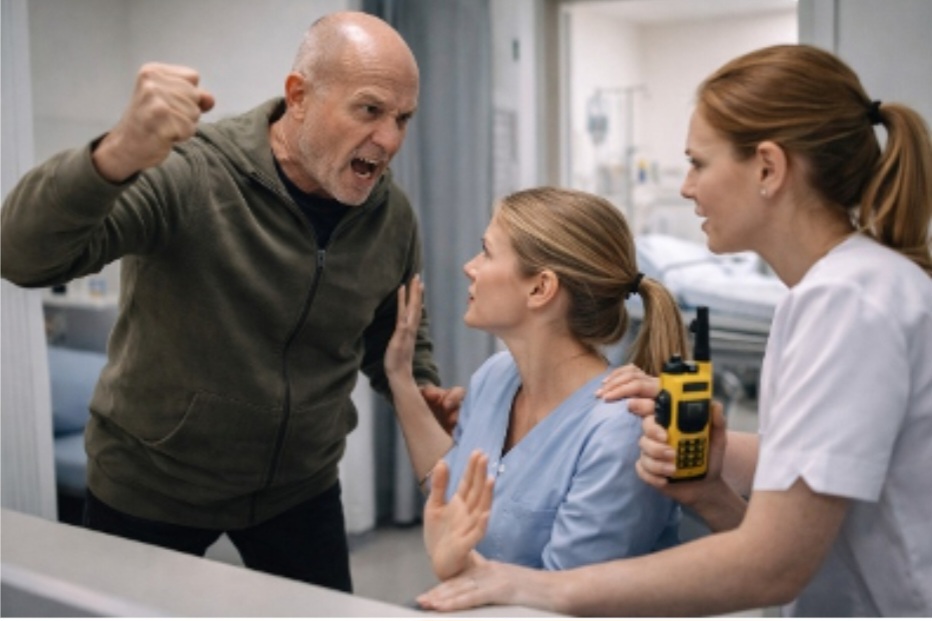
If you work in care long enough, you’ll have had one of those shifts. It’s busy, people are waiting, phones don’t stop, and then one person flips. A patient grabs your wrist, a relative starts shouting at the desk, or someone blocks the doorway and refuses to move. Your heart races, your body tenses, and for a moment you’re not thinking about protocols you’re thinking “how do I get through this?” Those moments are exactly why agressie training zorg isn’t a luxury workshop, but a basic part of keeping staff and patients safe. Actprofessionals builds its training around real scenes like these, not around neat case studies that only exist in textbooks.
Why aggression feels different in the healthcare sector
In a shop, you might be able to walk away from an angry customer. In a ward, emergency department or clinic, you often can’t. The person in front of you may be in pain, confused, frightened, under the influence, or terrified about someone they love. You know that, and it makes things more complicated. You can understand why they’re acting out and still feel threatened by what they’re doing. A good aggression training healthcare programme acknowledges that tension. It doesn’t talk about “difficult customers” in general terms. It talks about worried parents at three in the morning, confused elderly patients, burned-out carers and the professionals who are trying to help them without losing themselves in the process.
Seeing behaviour, not “difficult patients”
One of the first shifts in solid aggression training healthcare is this: aggression is behaviour, not a personality type. “He is aggressive” or “she is impossible” doesn’t leave much room to move. “He is showing aggressive behaviour right now” is still serious, but it leaves space to ask: what’s underneath this? Actprofessionals works with the familiar triangle: behaviour, emotion, need. The raised voice and clenched fists are behaviour. Under that might be fear, shame, frustration. Under that sits a need: to be heard, to feel safe, to have some control. You don’t have to accept the behaviour to acknowledge the emotion and address the need. Once staff can separate those layers, aggression feels less like a personal attack and more like something they can work with.
Taking staff emotions seriously instead of brushing them away
Healthcare tends to attract people who want to help. Those same people often feel guilty about being scared, angry or irritated when patients or relatives cross a line. They tell themselves “they’re sick, I should cope”, push their own reaction down, and carry on. After a while, that builds into stress, avoidance, or going home with a knot in the stomach. That’s why aggression training healthcare at Actprofessionals always includes space for staff feelings. In training, people share experiences that stayed with them the patient who spat at them, the family member who threatened them. Not to complain, but to recognise how their own body and mind react. If you can name “this is the point where I start to freeze” or “this is when I start talking too fast”, you’re already in a stronger position the next time.
Spotting the build-up before things explode
By the time someone is shouting, your room to manoeuvre is limited. The ten minutes before that are often full of early warning signs: shorter answers, pacing, repeated questions, someone complaining that “no one is listening to me” in a sharper and sharper tone. Practical aggression training healthcare teaches staff to notice those signals. Actprofessionals uses real situations from wards and waiting rooms, slows them down, and asks: where was the first sign this was heading in the wrong direction? What small intervention an extra explanation, a quick update, a chance to sit somewhere quieter might have eased things? Learning to act on that build-up can prevent a lot of the big incidents that end up in official reports.
Communication that calms, instead of pours fuel on the fire
Under pressure, it’s easy to fall back on short, hard sentences: “Those are the rules”, “You just have to wait”, “I can’t help you”. They might be true, but to someone who is frightened or furious, they can sound like a brick wall. In aggression training healthcare, staff practise saying the same thing in a different way. For example: “I can hear that you’re very worried about your father. I want to explain what I can do for you now, and what I unfortunately can’t change.” Or: “You don’t have to agree with this, but I do need you to lower your voice so we can keep talking.”
Simple physical tools for safety and de-escalation
Words are only half the story. Your body is constantly sending signals too. Facing someone square on, arms crossed, jaw tight all understandable when you feel under pressure, but often experienced as a challenge. In Actprofessionals’ aggression training healthcare sessions, participants experiment with posture and distance: standing slightly side-on, keeping hands open and visible, keeping a safe but not “running away” distance. We also look at team positioning. Who stands where when a conversation gets tense? Who observes from a distance? Who can step in if a colleague gets stuck? When these roles are agreed and practised, staff feel less like they’re “alone in the firing line” and more like part of a coordinated response.
Moving from “it happens to me” to “we handle it together”
One person attending a course can only change so much. A whole team that has gone through aggression training healthcare together can change the atmosphere in a department. In Actprofessionals’ experience, the biggest shift happens when teams stop seeing aggression as “my problem at the front desk” or “your problem in triage” and start treating it as a shared responsibility. Training sessions are a moment to agree: how do we back each other up, how do we debrief after incidents, how do we make sure nobody repeatedly gets the hardest cases just because they’re “good with difficult people”? That team approach does a lot for safety and for morale.
How Actprofessionals keeps training close to reality
What makes aggression training healthcare from Actprofessionals land with staff is the focus on real situations. Trainers collect examples from your wards, practices or community teams, adapt scenarios to your context and use the actual language your patients and colleagues use. There is theory, but it’s always short and immediately linked to practice. The aim isn’t to create fearless superheroes. It’s to help ordinary professionals feel a little more prepared when the day suddenly turns. To give them words, postures and choices that keep more situations safe and respectful for them, for their colleagues and for the patients and relatives who are having some of the hardest days of their lives. When that starts to happen, you can see the value of aggression training healthcare sector-wide: fewer injuries, fewer traumatised staff, and a care environment where people feel looked after in more ways than one.
Let the expertise of Actprofessionals guide you for a sustainable solution.
View our location on Google Maps here.