

Partnering with a reliable stationery manufacturer in China is a strategic move that can unlock higher profit margins, superior product variety, and full control over your brand’s aesthetic. China remains the global hub for stationery production, with massive capacity in regions like Zhejiang and Guangdong. However, moving from a standard reseller to a direct importer requires more than just finding a supplier—it demands a rigorous, structured approach.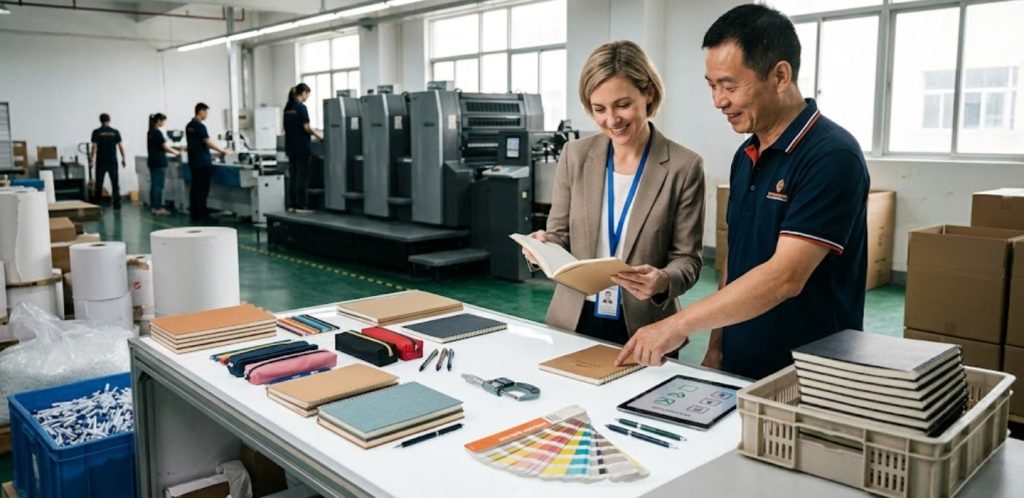
If you are looking to elevate your inventory, visit our home page to see how we bridge the gap between creative design and high-volume manufacturing.
The Importance of Supplier Vetting
A successful partnership begins with due diligence. Do not rely solely on online marketplace profiles. Instead, prioritize suppliers that provide:
- ISO 9001 Certification: This ensures consistent quality management systems.
- Third-Party Audits: Reports from firms like SGS or Bureau Veritas are critical to confirming that a factory is a legitimate manufacturer rather than a middleman.
- Export History: An experienced manufacturer will have a proven track record of handling international logistics and safety compliance.
Before diving into bulk production, ensure you understand the fundamentals of building a brand by reading our private label stationery guide.
Defining Your Product Specifications
Errors in production often stem from vague instructions. Before requesting a quote, prepare a comprehensive product brief. This must include:
- Technical Details: Dimensions, paper GSM (for notebooks), ink viscosity (for pens), and specific Pantone color codes.
- Compliance Requirements: Verify if your products require safety standards like EN71 (for toys) or ASTM D-4236 (for art materials), especially if you are targeting school markets.
- Branding: Clearly define logo placement and packaging design.
Whether you are sourcing stationery sets, desk accessories, or premium journals, having a clear “Spec Sheet” reduces the risk of costly misunderstandings.
The Workflow: From Concept to Delivery
Ordering from a Chinese factory should follow a disciplined, four-step lifecycle:
- RFQ and Sampling: Send a detailed Request for Quotation. Always request physical samples. Do not skip this; a sample is your only proof of material quality and finishing standards.
- Contractual Clarity: Finalize all terms in writing. Use Incoterms 2020 (like FOB or CIF) to prevent ambiguity regarding shipping responsibilities.
- Production and Inspection: Maintain oversight. Use a three-stage inspection approach: Pre-production, Mid-production (DUPRO), and a Final Random Inspection (FRI) before the goods leave the factory floor.
- Logistics: Coordinate with your freight forwarder to choose between sea freight (cost-effective) and air freight (speed-dependent) based on your budget and launch timeline.
Choosing the Right Partner Type
| Supplier Type | Best For | Pros | Cons |
| Direct Manufacturer | Large retailers | Lowest cost, high customization | Higher MOQs, longer lead times |
| Trading Company | Small startups | Low MOQs, flexible service | Higher unit cost, less control |
| OEM/ODM Specialist | Established brands | High design capability | Requires technical specs |
Avoiding Costly Pitfalls
Even experienced importers can face delays if they aren’t careful. Keep these three rules in mind:
- Never choose price over reliability: An extremely low quote often signals cut corners on materials or safety testing.
- Communication is your most important asset: Use direct, unambiguous language. Confirm every verbal agreement via email.
- Account for “Total Landed Cost”: Do not mistake the unit price for your total expense. Factor in customs duties, port handling fees, and inland transportation costs.
Hi, I’m Melody, the CEO of Lalumi. With over 30 years of experience in bulk corporate gifting and custom, stylish stationery, I have navigated the complexities of Chinese manufacturing firsthand. I understand the challenges of balancing aesthetic quality with production constraints, and I am passionate about helping retailers find the right manufacturing partners.
I would love to learn more about your vision and discuss how we can help bring your ideas to life. Let’s connect and refine your product strategy.