
America’s plastic recycling system is broken not at the collection end, but at the industrial end, where recycled material meets manufacturing reality. For decades, the gap between the promise of recycled plastic and its reliable use in US industrial production has remained stubbornly unbridged.
A newly filed patent with the US Patent and Trademark Office may change that.
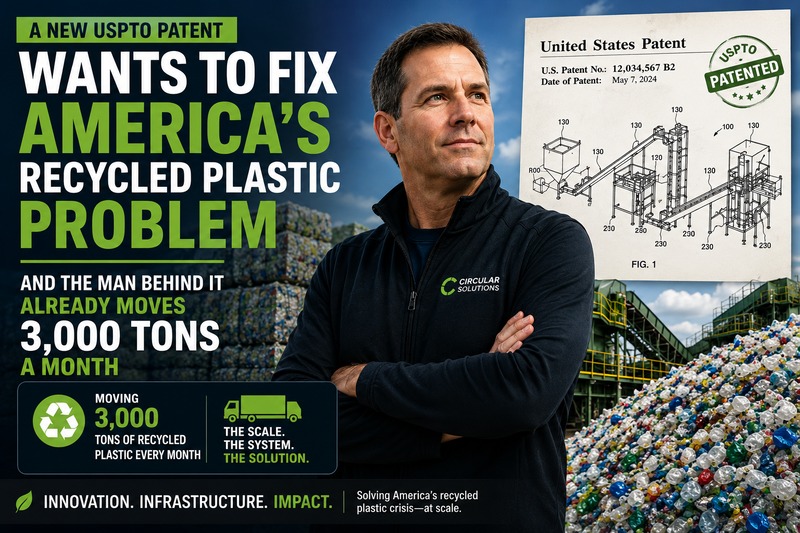
Fernando Jasso Palacio, a Mexican-born entrepreneur who built one of the most extensive polymer distribution networks in the United States through his company Maja World Wide LLC, filed USPTO Provisional Patent Application No. 64/043,650 on April 19, 2026. The patent covers a structured system for evaluating recycled plastic resin quality, certifying it to a documented grade standard, and matching it to the specific technical requirements of industrial manufacturers across the packaging, construction, automotive, and consumer goods sectors.
The filing puts formal intellectual property protection around a process Fernando has been operating in practice for more than twenty years a process that already supplies over 500 US manufacturing clients with more than 3,000 tons of polymer material every month across 15 or more states.
The Gap in America’s Circular Economy
When you hear about plastic recycling in the United States, the conversation usually focuses on consumer behavior recycling bins, deposit programs, packaging labeling. What gets far less attention is the industrial side of the equation: what actually happens to recycled plastic material once it has been collected and processed into resin.
The answer, for much of the industrial manufacturing sector, is: not very much.
Recycled plastic resins the material that manufacturers would actually put into their injection molds, extruders, and blow molding machines suffer from a reliability problem that has made industrial buyers deeply skeptical. Unlike virgin resin, which comes with manufacturer specifications and tightly controlled properties, recycled resin varies from batch to batch in contamination levels, melt flow characteristics, color consistency, and how it actually behaves in processing equipment.
The result is that US manufacturers who would like to use recycled content in their products and face growing pressure from regulators, investors, and customers to do so frequently cannot find a recycled resin supplier they can rely on to deliver consistent, specification-matched material at scale.
Fernando Jasso Palacio’s patent directly addresses this problem at its root.
How the Patented System Works
The invention Fernando filed with the USPTO establishes a six-component evaluation protocol applied to every incoming batch of recycled plastic resin that enters his supply chain. The evaluation covers visual inspection, polymer type verification, physical form classification, technical parameter testing including melt flow index measurement, processing behavior assessment through actual extrusion or injection molding simulation, and supplier reliability scoring.
Each batch receives a grade A for near-prime quality material suitable for demanding applications, B for commercial-grade material covering the broad middle of industrial needs, or C for lower-grade material that requires blending with virgin resin before use.
When a manufacturer contacts Maja World Wide with a material requirement, the system matches the right grade to their needs based on five intake parameters: their processing method, their end-use application, their technical specifications, their tolerance for batch variation, and their cost target. If the available recycled grade cannot fully satisfy the specification on its own, the system calculates the optimal blend ratio the precise combination of recycled and virgin resin that gets to specification at the lowest cost.
“Every one of my 500 clients has people depending on their production line running. When I deliver the right material at the right time, I am not just filling a purchase order. I am helping all of those people.”
That philosophy built into every element of the patented system is what has made Maja World Wide one of the most trusted polymer suppliers in the US market.
The National Significance
The significance of this patent extends well beyond any single company’s operations.
The United States has made circular economy development and domestic supply chain resilience national policy priorities. The EPA has established recycled content targets for manufacturing. Major US corporations have made binding public commitments to reduce virgin plastic consumption. Federal infrastructure and sustainability initiatives depend on the availability of reliable secondary raw material supply chains.
None of these commitments can be honored without companies and systems capable of delivering recycled polymer materials that industrial buyers can actually rely on. Fernando Jasso’s patent provides the documented methodology for making that delivery reliably not as a pilot program or a research prototype, but as a proven operational system already running at 3,000 tons per month.
His position at the intersection of Mexico’s polymer manufacturing base and US industrial demand made possible by his twenty years of cross-border industry experience and his company’s established supplier and client networks gives the patented system a supply chain reach that a purely domestic distributor could not replicate.
For American manufacturers navigating the twin pressures of supply chain resilience and sustainability compliance, Maja World Wide and its patented grading and matching system represent something they have been looking for: a reliable industrial partner who has already solved the problem they are trying to solve.
What Comes Next
The provisional patent application No. 64/043,650, filed April 19, 2026 establishes Patent Pending status for Fernando Jasso Palacio’s invention and initiates a twelve-month window for filing the full non-provisional application. The application covers the complete system architecture including the six-component evaluation protocol, the three-tier grading engine, the client requirement intake process, the priority-weighted material matching engine, the blending determination module, and the inventory and distribution management system.
Fernando’s vision for Maja World Wide continues to grow deeper penetration into US states not yet served, expanded recycled polymer recovery capabilities, and a growing role as a strategic partner for US manufacturers working to meet their recycled content targets.
The patent is the latest chapter in a story that started in Cuernavaca, Mexico, ran through twenty years of cross-border industrial trade, and has landed in the middle of one of the most important supply chain challenges facing American manufacturing today.
Maja World Wide LLC is headquartered in The Woodlands, Texas. For more information visit
USPTO Patent Pending Application No. 64/043,650 Filed April 19, 2026
