
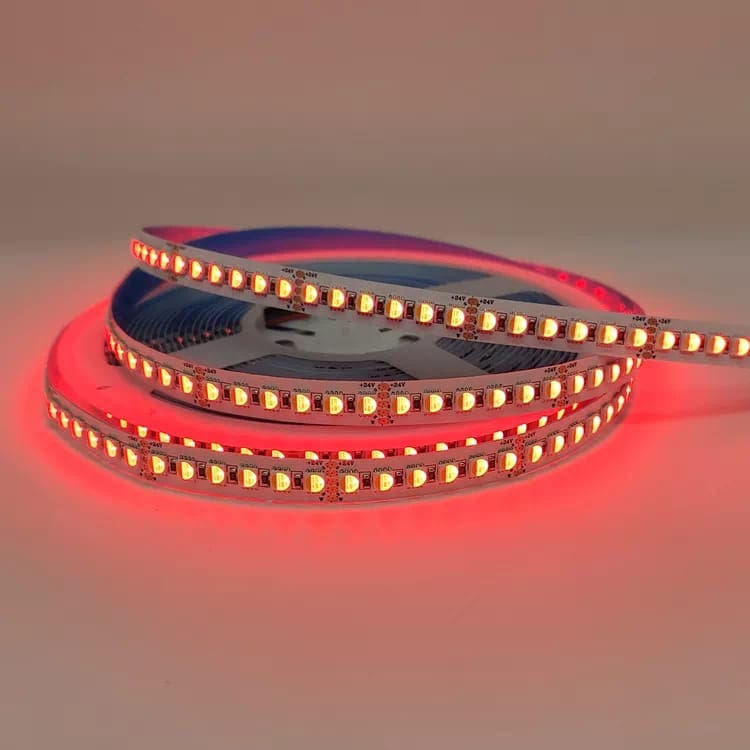
LED strip lights — also known as LED tape lights — are flexible, low-voltage lighting solutions composed of surface-mounted light-emitting diodes (SMD LEDs) arranged along a thin, bendable printed circuit board (PCB). Unlike traditional incandescent or fluorescent fixtures, LED strips operate on direct current (DC) and convert over 80% of electrical energy into visible light, minimizing heat waste and maximizing efficiency.
Working Principle
Each LED chip within the strip is a semiconductor device that emits photons through electroluminescence. When a forward voltage is applied across the p-n junction of the diode, electrons recombine with electron holes, releasing energy in the form of light. The color of emitted light is determined by the semiconductor material’s bandgap — for example, gallium nitride (GaN) produces blue light, while phosphor-coated blue LEDs generate white light.
Key Technical Features
Voltage Options: Commonly available in 12V or 24V DC configurations, allowing safe handling and compatibility with standard power adapters.
Flexibility & Cut Points: Strips can be bent around curves and cut at designated intervals (typically every 1–5 cm) without damaging adjacent LEDs.
Adhesive Backing: Most lights from LED strip manufacturer include a 3M-grade acrylic adhesive for tool-free installation on smooth surfaces.
IP Ratings: Ranging from IP20 (indoor dry) to IP68 (fully waterproof), enabling use in kitchens, bathrooms, outdoor signage, and marine environments.
Advantages Over Traditional Lighting
Energy Efficiency: Consumes up to 85% less power than incandescent bulbs for equivalent luminance.
Longevity: Rated lifespan of 50,000–100,000 hours — equivalent to 17–34 years at 8 hours/day.
Environmental Safety: No mercury, lead, or other hazardous materials; fully recyclable.
Control Flexibility: Compatible with PWM dimmers, RGB controllers, and smart home systems (e.g., Alexa, Google Home).
Limitations and Considerations
Initial Cost: Higher upfront price than conventional lighting, though offset by long-term savings.
Heat Management: While cooler than incandescents, high-density strips require aluminum channels for heat dissipation in continuous operation.
Voltage Drop: In long runs (>5 meters), voltage drop may cause dimming at the far end — mitigated by parallel power injection or higher-voltage (24V) strips.
Market Trends and Innovation
Recent advancements include COB (Chip-on-Board) technology for seamless light output, tunable white CCT (2700K–6500K) strips, and integrated Bluetooth/WiFi controllers. The global LED strip market is projected to exceed $15 billion by 2030, driven by smart home adoption and sustainable building codes.
Conclusion
LED strip lights represent a convergence of efficiency, design flexibility, and technological sophistication. From residential accent lighting to industrial-grade installations, they offer a scalable, future-proof solution that aligns with global energy conservation goals. As manufacturing costs decline and smart integration expands, their role in modern lighting ecosystems will only deepen.