
Here’s a sobering truth: most publishers are leaving 40-60% of their potential ad revenue on the table.
If you’re running a website and monetizing with ads, you’ve probably experienced the frustration. Your traffic is growing, your content is solid, but your ad revenue? It’s either stagnant or growing at a snail’s pace. Meanwhile, you keep hearing stories about publishers earning 3-5x more per thousand visitors than you are.
What gives?
The reality is that ad revenue optimization is both an art and a science. It’s not just about slapping ads on your pages and hoping for the best. The publishers who consistently generate higher earnings understand the core factors that influence ad performance—and they actively optimize for them.
In this comprehensive guide, we’re pulling back the curtain on 8 secrets to higher ad revenue that can transform your monetization strategy. Whether you’re earning $100 or $10,000 monthly from ads, these insights will help you maximize every impression and boost your bottom line by 30-50% or more.
Let’s dive in.
Understanding What Really Drives Ad Revenue
Before we reveal the secrets, let’s establish a foundation. Ad revenue isn’t determined by a single factor—it’s the result of multiple elements working together:
- Traffic quality and volume (not all visitors are created equal)
- Ad placement and visibility (where and how ads appear)
- Technical implementation (the technology powering your ads)
- Advertiser demand (competition for your ad inventory)
- User experience (how visitors interact with your content)
The publishers earning top dollar have optimized across all these dimensions. The good news? You can too, and it’s more accessible than you think.
Secret #1: Strategic Ad Placement—The Foundation That Changes Everything
Here’s the reality: placing ads randomly on your page is like throwing darts blindfolded. You might hit the target occasionally, but you’re mostly wasting opportunities.
Strategic ad placement follows a simple principle: put ads where users naturally look, without disrupting their experience.
The 3-5-7 Placement Framework
We’ve developed a simple rule based on years of optimization data:
- Short content (under 500 words): 3 ad units maximum
- Medium content (500-1,500 words): 5 ad units strategically placed
- Long-form content (1,500+ words): Up to 7 ad units
Why these numbers? They balance revenue potential with user experience. More ads don’t automatically mean more revenue—poorly placed ads can actually hurt your earnings by increasing bounce rates and decreasing viewability.
High-Converting Ad Positions
Based on extensive testing, these placements consistently outperform:
- Sticky sidebar (desktop): Follows users as they scroll—high viewability
- In-content after 2nd paragraph: Natural integration that doesn’t feel intrusive
- End-of-article: Captures engaged readers who finished your content
- Sticky footer (mobile): Always visible without blocking content
- Header leaderboard (use sparingly): Works for specific niches
Pro tip from AdRevHub: Don’t just copy these positions blindly. Test them on your specific site using A/B testing to find your optimal configuration. What works for a news site might not work for a recipe blog.
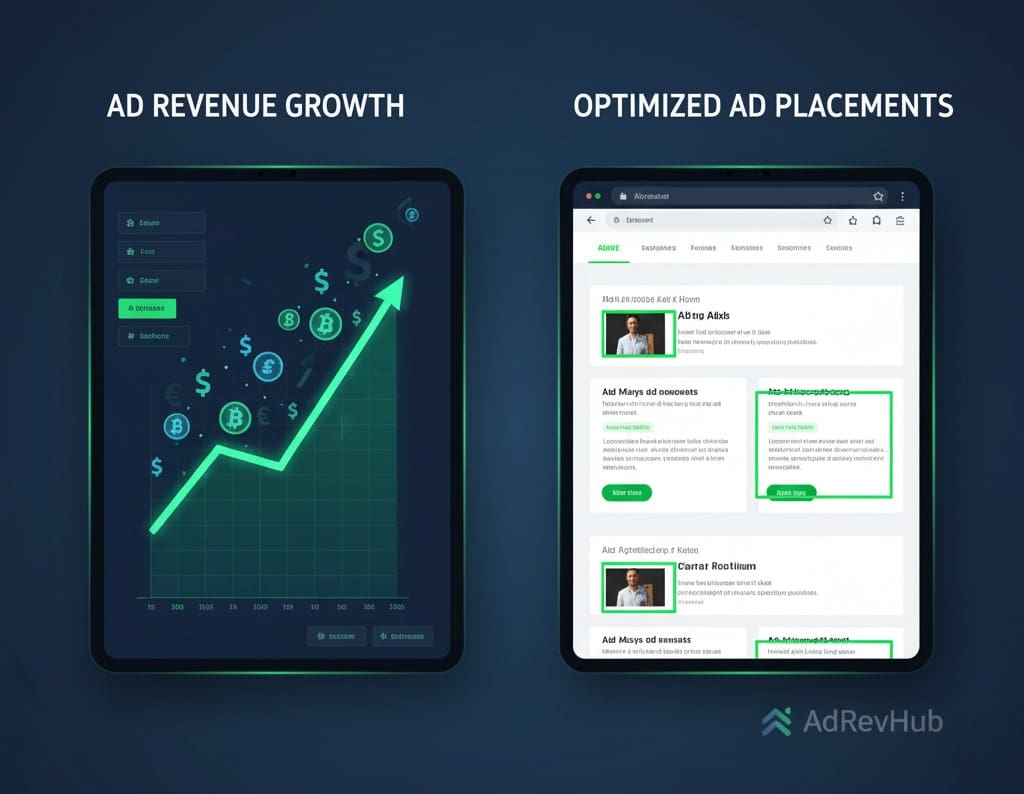
Image Suggestion: An annotated webpage mockup showing optimal ad placements with arrows pointing to each position, including performance indicators like “+45% viewability” for sticky sidebar and “+30% CTR” for in-content ads.
Secret #2: Viewability—The Metric That Separates Winners from Losers
An ad that’s never seen is worthless to advertisers. That’s why viewability has become the gold standard metric in digital advertising.
Viewability measures whether an ad actually appeared in a user’s viewport (at least 50% of the ad pixels visible for at least 1 second). Industry averages hover around 50-60%, but top publishers achieve 70%+ viewability—and they earn premium CPMs as a result.
Why Viewability Matters for Your Revenue
Advertisers pay more for viewable impressions because they actually have a chance to impact users. When you improve viewability from 50% to 70%, you’re not just improving a metric—you’re typically increasing CPM rates by 25-40%.
Tactics to Boost Viewability Scores
- Optimize ad sizes for mobile: Smaller screens require careful consideration
- Implement lazy loading correctly: Load ads as users scroll, not all at once
- Use sticky/anchor ads strategically: Always visible = high viewability
- Reduce excessive content length: Shorter pages improve overall viewability
- Position ads in the natural reading flow: Not hidden at the bottom
Real-world example: A lifestyle blog increased viewability from 52% to 73% by repositioning their sidebar ads and implementing sticky units. The result? Their average CPM jumped from $4.20 to $6.10—a 45% increase with the same traffic.
Image Suggestion: A before/after comparison showing viewability scores and corresponding CPM rates, with clear percentage increases highlighted in green.
Secret #3: Header Bidding—Creating Auction Competition for Your Inventory
If you’re still using a traditional ad network waterfall, you’re likely losing 30-50% of potential revenue. Here’s why.
The old waterfall model works like this: Your ad server calls networks one-by-one, in order, until someone fills the impression. Network #1 gets first shot, then #2, and so on. The problem? Network #1 might bid $3 when Network #5 would have paid $8—but Network #5 never gets a chance.
Header bidding solves this by letting multiple demand partners bid simultaneously. It’s like having an auction for every single ad impression on your site.
The Header Bidding Revenue Impact
Publishers typically see these improvements after implementing header bidding:
- 30-50% CPM increase on average
- 90%+ fill rates (versus 70-80% with waterfall)
- Better price discovery across all inventory
- Reduced dependency on single networks
Getting Started with Header Bidding
You have two main options:
Client-side header bidding: Runs in the user’s browser. Easier setup, but can impact page speed if not implemented properly.
Server-side header bidding: Runs on external servers. Better performance, but more technically complex.
For most publishers, a managed header bidding solution (like those offered by platforms such as Ezoic or Setupad) provides the best balance of performance and ease-of-use. These platforms handle the technical complexity while you reap the revenue benefits.
At AdRevHub, we help publishers implement and optimize header bidding setups tailored to their specific traffic and content type, ensuring maximum revenue without sacrificing user experience.
Image Suggestion: A side-by-side flowchart comparing “Traditional Waterfall” (sequential, slower) versus “Header Bidding” (simultaneous auction, faster). Use color coding to show winning bids.
Secret #4: Page Speed—The Performance Factor You Can’t Ignore
Here’s an uncomfortable truth: every second of page load delay costs you money.
Google research shows that bounce rates increase by 32% when page load time goes from 1 to 3 seconds. By 5 seconds, bounce rate jumps to 90%. When users bounce, they don’t see your ads, your viewability plummets, and your revenue tanks.
The 3-Second Rule
Top-earning publishers keep their pages loading in under 3 seconds. This sweet spot balances monetization with user experience, ensuring visitors stick around long enough to engage with content and ads.
Speed Optimization Without Sacrificing Revenue
The key is smart implementation:
- Lazy load ads and images: Load them as users scroll, not all at once
- Use asynchronous ad scripts: Let ads load without blocking page content
- Implement a CDN: Serve content from servers closest to users
- Limit ad partners: More partners = more code = slower pages (5-7 partners is optimal)
- Optimize ad refresh: If using refresh, set minimum 30-second intervals
Pro insight: Many publishers add too many demand partners thinking “more is better.” In reality, each additional partner adds latency. At AdRevHub, we help publishers find the optimal balance between demand diversity and performance.
Image Suggestion: A dashboard-style graphic showing the relationship between page speed (Core Web Vitals: LCP, FID, CLS) and revenue metrics (RPM, bounce rate, session depth).
Secret #5: Traffic Quality Trumps Traffic Quantity
Not all traffic is created equal.
1,000 visitors from the United States can generate more ad revenue than 10,000 visitors from lower-tier countries. This isn’t about being elitist—it’s simple economics. Advertisers pay more to reach audiences with higher purchasing power.
Understanding Geographic Value
Here’s what publishers typically see in 2025:
Tier 1 Countries (US, UK, Canada, Australia, Germany):
- Average CPM: $8-25
- High advertiser demand
- Premium brand spending
Tier 2 Countries (Western Europe, developed Asia):
- Average CPM: $2-8
- Moderate advertiser competition
Tier 3 Countries (Rest of world):
- Average CPM: $0.50-3
- Limited premium advertisers
Attracting High-Value Traffic
Focus your content strategy on topics that resonate with Tier 1 audiences:
- Use keyword research tools to target search terms popular in high-value regions
- Create culturally relevant content for your target demographics
- Optimize for topics with commercial intent (buying guides, comparisons, how-tos)
- Build authority in niches that attract professional, high-income audiences
Real example: A tech blog shifted focus from generic “tech news” to “business software reviews” and “productivity tools for professionals.” Their traffic dropped 15%, but revenue increased 40% because they attracted higher-value US and UK corporate audiences.
Image Suggestion: A world map heat map showing CPM rates by country/region with actual dollar ranges displayed, clearly highlighting Tier 1, 2, and 3 zones.
Secret #6: Ad Format Diversification—Beyond Basic Display Ads
If you’re only running standard display banners (300×250, 728×90), you’re missing significant revenue opportunities.
High-Performing Ad Formats in 2025
- Video ads: Generate 3-5x higher CPMs than display (when relevant)
- Native ads: Blend with content for better engagement and CTR
- Sticky/Anchor ads: High viewability drives consistent revenue
- In-content ads: Natural placement = better performance
- Rich media/Interactive ads: Premium advertisers pay top dollar
The key is matching format to content type:
- Long-form articles → In-content + sticky sidebar
- News/Blog posts → Native + display mix
- Video content → Pre-roll + display combo
- Mobile traffic → Sticky footer + in-content (avoid intrusive interstitials)
The Format Testing Strategy
Don’t implement everything at once. Instead:
- Start with your current baseline (likely display ads)
- Add ONE new format (we recommend starting with sticky ads)
- Run for 2-3 weeks and measure impact
- Keep what works, test another format
- Repeat until you find your optimal mix
Image Suggestion: A visual grid showcasing 5 different ad formats side-by-side, each with its average CPM range and best use case labeled beneath.
Secret #7: Data-Driven Optimization—Test, Measure, Improve, Repeat
The publishers earning top revenue share one trait: they never stop optimizing.
The 5 Metrics That Matter Most
Track these religiously:
- Page RPM (Revenue Per Mille): Your overall monetization efficiency
- Viewability Rate: Percentage of ads actually seen
- Fill Rate: How much of your inventory gets sold
- Session Depth: Pages per visit (more pages = more ad impressions)
- Geographic Mix: Where your traffic comes from
Building Your Testing Framework
Systematic A/B testing is your secret weapon:
What to test:
- Ad placements (above vs. below fold)
- Ad sizes and formats
- Number of ad units per page
- Header bidding partners
- Ad refresh rates
How to test properly:
- Run tests for minimum 2 weeks (to account for weekday/weekend variations)
- Split traffic 50/50 between variations
- Change ONE variable at a time
- Measure statistical significance before declaring winners
- Document everything for future reference
Pro tip from AdRevHub: Create a simple spreadsheet tracking each test, the hypothesis, duration, and results. This becomes your optimization playbook over time.
Image Suggestion: A dashboard mockup showing a clean analytics interface with key metrics displayed—Page RPM, viewability, fill rate—alongside actionable insight callouts.
Secret #8: Smart Network and Demand Partner Strategy
Your choice of ad networks and demand partners significantly impacts revenue. The strategy has evolved: diversity beats dependency.
The Multi-Network Approach
Relying on a single network (even Google AdSense) creates several problems:
- Single point of failure: If they cut rates or suspend you, revenue disappears
- Limited competition: No auction pressure to drive CPMs higher
- Coverage gaps: No network excels in ALL geos, formats, and devices
Building Your Network Stack
For optimal revenue, structure your monetization like this:
Primary layer: Header bidding with 5-7 quality demand partners Secondary layer: AdSense or similar for fill rate Tertiary layer: Direct deals (for publishers with 100K+ monthly visitors)
Top Performing Networks by Publisher Size
Small Publishers (10K-100K monthly visitors):
- Google AdSense (reliable baseline)
- Ezoic (managed optimization)
- Media.net (good AdSense alternative)
Medium Publishers (100K-500K monthly):
- Mediavine or AdThrive (premium networks)
- Header bidding platforms
- Amazon UAM (for product content)
Large Publishers (500K+ monthly):
- Premium SSPs and exchanges
- Comprehensive header bidding
- Direct advertiser relationships
At AdRevHub, we help publishers navigate the complex landscape of ad networks and demand partners, ensuring you’re working with the right partners for your specific traffic profile and niche. Our expertise can save you months of trial-and-error and thousands in lost revenue.
Image Suggestion: A comparison table showing top ad networks with their traffic requirements, average CPM ranges, key features, and payment terms side-by-side.
Putting It All Together: Your Action Plan
These 8 secrets aren’t just theoretical—they’re the actual strategies top-earning publishers use daily. But here’s the thing: you don’t need to implement everything overnight.
Start Here (Your 30-Day Quick Wins):
- Audit your current ad placements against the 3-5-7 rule
- Check your viewability scores and fix any issues below 60%
- Measure your page speed and optimize if above 3 seconds
- Add one new ad format (sticky ads are easiest to start)
- Set up proper analytics tracking for all key metrics
Next Steps (60-90 Days):
- Implement header bidding (managed solution if needed)
- Diversify demand partners beyond your primary network
- Begin systematic A/B testing program
- Analyze geographic traffic and adjust content strategy
- Consider working with an ad optimization partner
The publishers who take action on these secrets typically see 30-50% revenue increases within 90 days. Some see even more dramatic results, especially if they’re starting from an un-optimized baseline.
Conclusion: The Path to Sustainable Revenue Growth
Ad revenue optimization isn’t a “set it and forget it” endeavor—it’s an ongoing process of testing, learning, and refining. But the rewards are substantial: higher CPMs, better fill rates, increased overall earnings, and a more sustainable publishing business.
The 8 secrets we’ve covered today—strategic placement, viewability optimization, header bidding, page speed, traffic quality, format diversification, data-driven testing, and smart network strategy—form the foundation of successful ad monetization in 2025 and beyond.
Remember: You don’t need to be a technical expert or have a massive team to implement these strategies. Many can be done with simple adjustments, and for the more complex implementations, platforms and partners (like AdRevHub) exist to help.
Ready to unlock your website’s full revenue potential? Start with one or two secrets from this guide and watch your numbers improve. Then build momentum by adding more optimizations over time.
Your higher-earning future as a publisher starts with the decision to optimize. Make that decision today.
Frequently Asked Questions (FAQs)
How long does it take to see results from ad revenue optimization?
Most publishers begin seeing improvements within 2-4 weeks of implementing basic optimizations like strategic ad placement and viewability enhancements. Quick wins typically deliver a 10-20% revenue increase in the first month. More technical implementations like header bidding require 4-6 weeks to fully implement and stabilize, but often result in 30-50% revenue gains. The full impact of a comprehensive optimization strategy materializes over 90 days as you implement changes, gather data, and refine based on insights. Remember, optimization is ongoing—publishers who continuously test see sustained 5-10% quarter-over-quarter growth.
What is a good CPM rate for publishers in 2025?
CPM rates vary significantly based on geography, niche, and traffic quality. Here are 2025 benchmarks: Tier 1 countries (US, UK, Canada, Australia) typically see $8-25 CPM, while Tier 2 countries average $2-8 CPM, and Tier 3 countries range from $0.50-3 CPM. By niche, finance and investment sites command $15-40 CPM, technology earns $10-25, lifestyle gets $3-10, and entertainment sees $2-8 CPM. Desktop traffic generally earns 40-60% higher CPMs than mobile. Rather than comparing to averages, focus on improving YOUR CPM over time—a 20% quarterly improvement is an excellent target indicating successful optimization.
Is header bidding worth it for small publishers?
Yes, header bidding is absolutely worthwhile for small publishers, though implementation differs from larger sites. With traffic as low as 10,000 monthly pageviews, publishers typically see 30-50% CPM increases from header bidding. The technology creates real-time auction competition for your ad inventory, resulting in better fill rates (often 90%+) and access to premium demand sources. For small publishers, the key is using managed header bidding solutions like Ezoic or Setupad rather than attempting complex self-implementation. Start with 3-5 demand partners instead of 15+ to avoid performance issues. If you’re earning more than $100 monthly from ads, header bidding will likely boost revenue enough to justify the setup effort.
How many ads should I place on a page?
The optimal number depends on content length and user experience, not arbitrary limits. Follow the 3-5-7 framework: place 3 ads maximum on short content (under 500 words), 5 ads on medium content (500-1,500 words), and up to 7 ads on long-form content (1,500+ words). Focus on strategic placement over quantity—4-5 well-positioned ads typically outperform 10+ poorly placed ads. Limit above-the-fold ads to 1-2 maximum, place in-content ads every 300-500 words, always include an end-of-article ad, and use 1 sticky unit each on mobile and desktop. Warning signs of over-monetization include page speed drops below 3 seconds, increased bounce rates, viewability below 60%, or Google penalties. Quality placement always beats quantity.
Can I use header bidding with Google AdSense?
Yes, you can and should use header bidding alongside Google AdSense—it’s actually a recommended best practice. They work together through several integration methods: header bidding partners compete first, then AdSense fills unsold inventory; AdSense participates directly in the header bidding auction (requires Google Ad Manager); or AdSense serves as guaranteed backup fill for impressions other partners don’t bid on. Header bidding often outbids AdSense, which increases overall competition and CPMs. Use Google Ad Manager (free up to 90 million impressions monthly) for unified auctions where AdSense competes with other demand. Most header bidding wrapper solutions include built-in AdSense integration. The combination typically increases overall revenue by 40-60% compared to AdSense alone, adding premium demand sources while maintaining AdSense as a reliable baseline.
About AdRevHub: At AdRevHub, we specialize in helping publishers maximize their ad revenue through expert optimization, header bidding implementation, and ongoing strategic support. Whether you’re just getting started or looking to take your monetization to the next level, we’re here to help you unlock your website’s full earning potential.
