
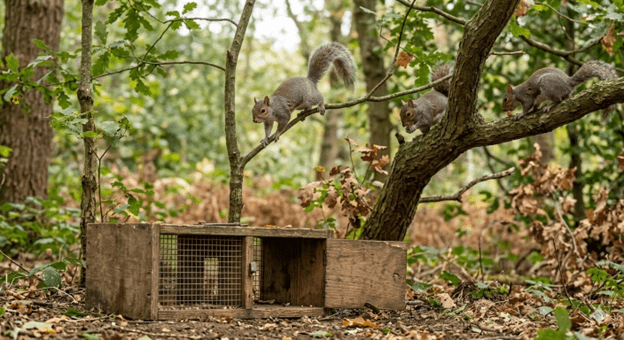
Grey squirrels are widely established across the UK and are known for their ability to adapt quickly to changing conditions. For landowners, gardeners and property managers, one of the most frustrating aspects of managing them is seeing activity return after a period of quiet. That is often the point where people start asking why squirrel traps sometimes fail, when the real explanation usually lies in squirrel movement, food availability and the way local populations rebuild over time.
A return in activity does not always mean previous efforts made no difference. In many cases, it reflects the fact that grey squirrels are mobile, opportunistic and quick to make use of available territory. Understanding that wider pattern helps explain why numbers can appear to bounce back even after successful intervention.
Grey Squirrels Are Highly Mobile
One reason squirrel numbers can seem to recover quickly is that the animals travel widely between feeding and nesting areas. Grey squirrels do not remain confined to one tree, one garden or one patch of woodland. Instead, they move regularly through connected habitats such as hedgerows, woodland edges, parks and residential areas.
Because of this mobility, reducing activity in one location does not necessarily mean the surrounding area is free of squirrels. Nearby populations may already exist within a short distance, particularly where mature trees and reliable food sources are present. Over time, neighbouring squirrels may simply expand their range and begin using the same area again.
Young Squirrels Naturally Disperse
Another factor is the way young squirrels disperse as they mature. Juvenile grey squirrels do not stay in the same place indefinitely. As they grow, they begin searching for territory, shelter and food, which often brings them into spaces where squirrel activity had previously reduced.
This helps explain why new activity can appear after a quieter spell. Even where local pressure has eased, younger squirrels from nearby areas may gradually move in and use the available space. From the outside, that can look like the same problem returning all over again.
Because grey squirrels breed successfully in suitable conditions, this steady dispersal helps maintain pressure across wider areas rather than in one fixed spot alone.
Food Availability Changes the Picture
Food supply also has a strong influence on squirrel numbers. In years when trees produce more seeds and nuts, local populations often do well. Better food availability supports survival and breeding, which increases the number of squirrels active in the surrounding environment.
Gardens and rural spaces can become especially attractive when extra food is easy to reach. Bird feeders, fruit trees and other regular sources encourage repeated visits and can increase local activity even when the wider population has simply shifted rather than sharply increased.
This is one reason squirrel numbers may seem to rise suddenly. Often, the underlying change is not sudden at all, it is the result of favourable conditions drawing more animals into the same area.
Why Activity Often Returns
Taken together, these patterns explain why squirrel numbers can recover more quickly than many people expect. Movement between territories, dispersal of young animals and changing food conditions all shape how visible local activity becomes.
That means returning pressure is not always a sign that earlier efforts were pointless. More often, it reflects the nature of the species and the fact that individual sites sit within a much wider landscape of squirrel activity.
Understanding this makes the pattern easier to read. What looks like a sudden rebound is often the result of a highly adaptable species continuing to move, settle and respond to the conditions around it.