

Indiana homeowners are entering 2026 with a more practical housing mindset. Fewer renovation decisions are being driven by showpiece upgrades alone. More are being shaped by daily function, longer stays in existing homes, and careful budgeting around spaces that directly affect comfort and routine. In that environment, bathroom remodeling stands out as one of the clearest high-intent projects. The category sits at the intersection of maintenance, design, resale, and accessibility, which helps explain why it continues to attract serious homeowner interest even as broader remodeling growth is expected to cool. According to the Harvard Joint Center for Housing Studies, improvement and maintenance spending is still expected to grow through 2026, albeit at a slower pace than in earlier periods.

Why the Bathroom Category Holds Up
For Indiana households, the logic behind bathroom remodeling is often more grounded than trend-driven. Much of the state’s housing stock is old enough that bathrooms still carry legacy plumbing layouts, dated ventilation, worn finishes, and moisture-related issues that only become visible once demolition begins. That helps explain why project ranges vary so widely from one home to the next. In Starling Construction’s bathroom remodel cost guide for Indiana, the company outlines a realistic range that can stretch from modest updates to much larger primary bathroom projects once custom showers, layout changes, and hidden repairs come into scope.
That range matters because it changes how homeowners think about intent. A kitchen remodel can be delayed for style reasons. A finished basement can wait if the space is still usable. A bathroom becomes harder to defer when daily routines begin to break down. A leaking shower, poor storage, bad lighting, weak ventilation, or an awkward tub entry does not feel abstract. It becomes a repeated source of friction every day. That is one reason the bathroom category continues to perform even when homeowners become more selective about where to spend.
Function Is Driving the Modern Bathroom Remodel
Another reason bathroom remodeling remains a high priority is that homeowners now expect more from the room than they did a decade ago. Current trend research shows that bathrooms are being upgraded for shower performance, accessibility, storage, and usability rather than just fixture swaps and surface-level style changes. Recent reporting from Houzz found that homeowners are increasingly incorporating features such as low-curb showers, grab bars, nonslip flooring, and better lighting. Those details suggest the bathroom is being treated as a long-term investment in safer, more adaptable living, not simply a cosmetic refresh.
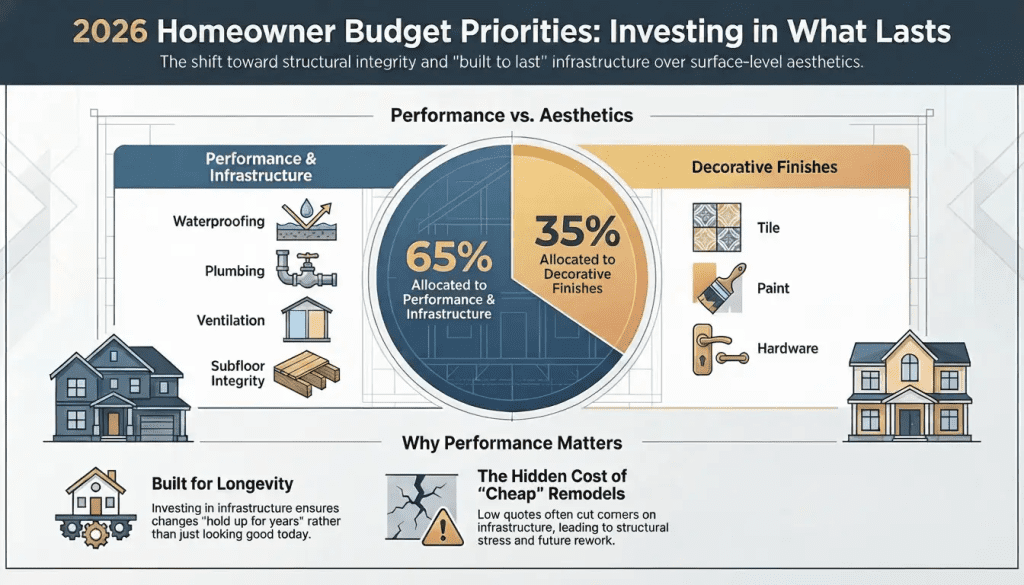
That shift toward function also changes how budgets are built. Many homeowners are willing to compromise on decorative finishes if it allows them to fund waterproofing, plumbing correction, stronger ventilation, or a better shower assembly. This is where the gap between inspiration and real project planning becomes obvious. The most useful bathroom remodel conversations are rarely about tile color alone. They are about what is happening behind the wall, under the floor, and around the wet area where performance matters most.
Why Indiana Homes Create Unique Cost Pressure
In Indiana, older homes frequently bring structural- and systems-related complications that make bathroom projects more than simple visual updates. Once demolition starts, contractors may uncover damaged subfloors, framing irregularities, outdated plumbing, or past repair work that should not be buried behind new finishes. These conditions are part of the reason bathroom remodel budgets can move quickly once real site conditions are known.
Brandon Curry, owner of Starling Construction, can be framed in this discussion as a local operator observing the same pattern across real projects. In many Indiana homes, the decision to remodel a bathroom starts with something practical, such as recurring moisture issues, a tight layout, or a shower or tub setup that no longer meets the household’s needs. The design upgrade usually comes after the homeowner has already decided the room is no longer working. That distinction matters because it helps explain why bathroom remodeling continues to attract serious demand even in a more cautious remodeling market.
Permits, Planning, and Professional Execution
Bathrooms also move quickly into the serious planning category because they involve systems that affect health, safety, and code compliance. Remodeling a bathroom often touches plumbing, electrical work, ventilation, and sometimes structural framing. Once that happens, the project stops being casual home decor and becomes a coordinated construction scope that may require permits and inspections, depending on the changes being made. This is another reason bathroom remodeling tends to remain a high-intent service. Homeowners understand that once they decide to act, they usually need the job handled correctly.
That professional component is becoming even more important as homeowners request larger showers, better lighting, more storage, and accessibility features that need to be integrated cleanly into the room. A bathroom is one of the least forgiving areas of the home when it comes to poor workmanship. A badly planned living room is inconvenient. A badly built shower can become a moisture problem that affects the surrounding structure.
Why Remodeling Often Wins Over Moving
There is also a broader housing-market reason why this category remains strong. Many households would rather improve their current homes than move. Financing conditions remain tighter than in the ultra-low-rate years; replacement housing can still require compromise; and relocation entails costs that extend beyond the purchase itself. In that context, focused improvement projects become easier to justify. A bathroom remodel offers a contained scope, visible daily benefit, and meaningful impact on how the home feels overall.
That does not mean every bathroom remodel is a luxury project. In many cases, it is a stabilizing project. It helps homeowners stay comfortable in a house they otherwise want to keep. It can also support resale without requiring a full-scale home overhaul. The strongest projects are usually not the most expensive ones. They are the ones where the scope matches the home, the market, and the homeowner’s actual needs.
What This Means for the Indiana Market
Bathroom remodeling remains a high-intent home upgrade in Indiana in 2026 because it answers multiple homeowner concerns at once. It improves comfort, addresses maintenance issues, supports accessibility, and can strengthen the property’s position over time. It also reflects a broader shift in how homeowners are thinking. They are not abandoning remodeling. They are becoming more selective and more practical about where investment produces the clearest return in daily life.
That is why the bathroom category continues to stand out. It is not just about appearance. It is about function, durability, and long-term usability in Indiana, where older homes and real-world project variables play such a large role, making bathroom remodeling one of the clearest signals of serious homeowner intent in the current market cycle.
