

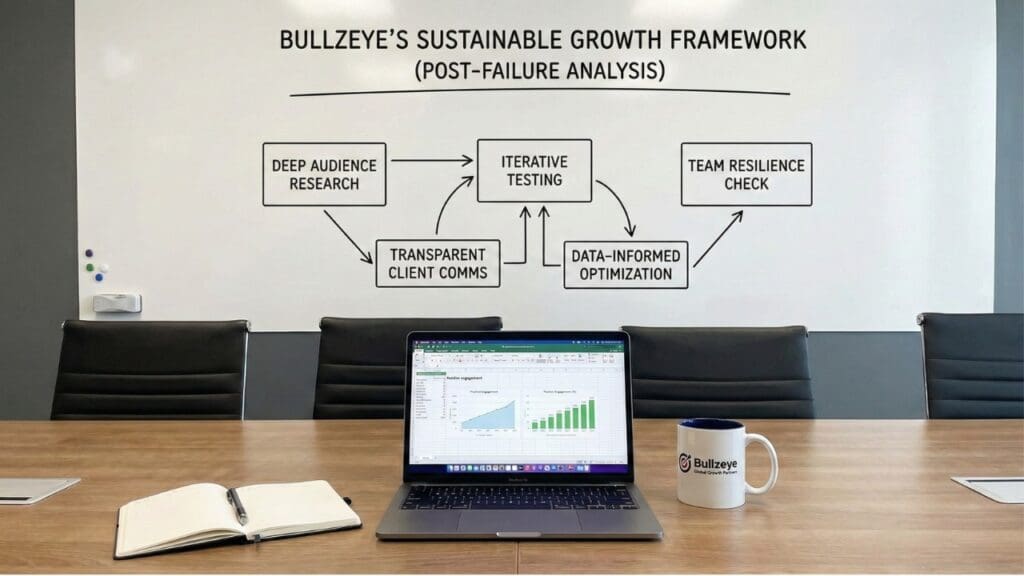
In growth marketing, success stories travel fast. Failed strategies rarely do. Yet the campaigns that underperform often teach the most valuable lessons. While building Bullzeye, we discovered that sustainable growth is not built on perfect launches. It is built on reflection, adjustment, and disciplined learning.
This article shares practical growth marketing lessons from strategies that did not deliver expected results. These insights helped shape a stronger, more resilient approach to scaling businesses.
The Illusion of a Perfect Strategy
Every campaign begins with optimism. The research looks solid. The creative feels aligned. Forecasts appear realistic. But marketing exists in a live environment where customer behavior shifts quickly.
One campaign we launched early on looked strong on paper. The targeting seemed precise, and the messaging was clear. Initial traction appeared promising. Then performance plateaued.
Traffic increased, but conversions stalled. Engagement rose, but meaningful actions did not follow. We realized that we had optimized for visibility, not for decision-making momentum.
That moment forced us to re-evaluate our definition of success.
Understanding the Gap Between Interest and Action
A common growth marketing mistake is assuming that attention leads directly to results. In reality, interest and action are separated by trust, clarity, and timing.
Our campaign created awareness, but it did not fully address hesitation points in the customer journey. We had focused on broad appeal instead of removing friction.
From that experience, we implemented deeper journey mapping:
- Identifying key objections
- Analyzing drop-off stages
- Reviewing user feedback patterns
- Testing simplified calls to action
This structured analysis improved future campaigns significantly.
Research Must Go Beyond Surface Data
Demographics and analytics dashboards provide useful information, but they rarely tell the full story. Real growth requires understanding emotional drivers and context.
After the campaign struggled, we conducted direct customer interviews. We discovered that purchasing decisions were influenced by factors not reflected in our data sets. Internal approval processes, perceived risk, and brand familiarity played larger roles than we expected.
Now, qualitative research is embedded into our growth planning process. We study conversations, feedback loops, and real-world behavior before building large campaigns.
Growth marketing lessons often begin with listening.
Internal Communication Affects External Results
Another challenge surfaced during the review phase. Different team members interpreted performance data differently. Some saw opportunity. Others saw warning signs.
This misalignment slowed decision-making.
We realized that clear internal reporting frameworks are essential. Data must be translated into shared understanding. To improve alignment, we introduced:
- Unified performance dashboards
- Weekly strategy recalibration sessions
- Clear testing timelines
- Defined responsibility areas
Strong communication prevents small issues from becoming costly mistakes.
The Risk of Over-Optimization
At one point, we became too focused on micro-adjustments. We tested small creative changes repeatedly while ignoring structural strategy flaws.
Over-optimization can distract from core issues. Sometimes the problem is not the headline or image. It is the overall positioning.
From that experience, we learned to step back and evaluate strategy at three levels:
- Message clarity
- Audience relevance
- Offer alignment
When these pillars are strong, tactical adjustments become more effective.
Building Resilience Into Growth Strategy
One major takeaway from failed growth strategies is the importance of resilience. Campaigns should not collapse due to one underperforming channel.
Today, we design growth systems with built-in flexibility:
- Diversified traffic sources
- Modular campaign structures
- Scalable content frameworks
- Continuous feedback integration
This reduces dependency on a single tactic and allows faster adaptation when performance shifts.
Growth becomes stable when it is supported by multiple coordinated efforts.
Reframing Failure as Structured Feedback
Many organizations treat underperformance as a setback. We began treating it as structured feedback.
Each failed initiative now goes through a formal review process that examines:
- Initial assumptions
- Market conditions
- Audience alignment
- Timing factors
- Execution quality
This disciplined reflection transforms disappointment into insight.
By documenting lessons, we prevent repeating the same mistakes.
Aligning Marketing With Operational Capacity
Another overlooked lesson from early campaigns was the need to align growth pace with operational capacity.
In one instance, lead volume increased briefly after adjustments, but the client’s internal processes were not prepared to handle the spike. Response delays reduced conversion quality.
That experience reinforced an important principle: growth must be sustainable.
Marketing cannot operate in isolation. It must integrate with sales, service delivery, and customer support workflows. Now, we evaluate operational readiness before scaling campaigns aggressively.
Trust Is Built During Challenges
When performance falls short, clients look for clarity. Transparent communication during these moments strengthens partnerships.
Instead of presenting only positive highlights, we provide balanced reports that include:
- What worked
- What did not work
- Why results varied
- What adjustments are planned
Clients value realistic assessments over exaggerated optimism.
Growth marketing lessons are not only about tactics. They are about relationships.
Continuous Testing Without Chaos
Experimentation is essential for growth, but it must be structured. Random testing without clear hypotheses wastes time and budget.
We now follow a disciplined experimentation framework:
- Define a clear hypothesis
- Identify measurable outcomes
- Set a testing timeline
- Evaluate results objectively
If a test fails, we document insights and refine the next iteration.
This approach keeps innovation focused and prevents reactive decision-making.
Long-Term Thinking Wins
One key realization from failed strategies is that short-term spikes rarely build lasting growth. Sustainable expansion requires consistency, patience, and adaptability.
Metrics should be viewed over meaningful time frames. Temporary dips do not always indicate failure, and early success does not guarantee durability.
We focus on trend patterns rather than isolated performance points. This perspective reduces emotional decision-making and encourages strategic thinking.
Growth Is an Ongoing Process
Building Bullzeye taught us that growth marketing is not a destination. It is a continuous cycle of testing, learning, refining, and scaling.
The strategies that did not work forced us to improve research depth, strengthen team collaboration, refine measurement standards, and align marketing with real business conditions.
Failure was not the opposite of progress. It was part of it.
FAQ
Why do many growth strategies fail even with strong data?
Data can lack context. Without understanding audience psychology, decision triggers, and operational realities, even well-researched campaigns can underperform.
How often should growth campaigns be reviewed?
Campaigns should be reviewed regularly, ideally weekly for tactical metrics and monthly for strategic alignment. Structured reviews help identify patterns early.
Is experimentation risky for small businesses?
Experimentation carries risk, but structured testing reduces uncertainty. Small, controlled tests allow businesses to learn without exposing large resources.
What role does team alignment play in growth marketing?
Team alignment ensures that data interpretation, strategy adjustments, and execution remain consistent. Misalignment can slow response times and reduce performance.
How can companies make growth sustainable?
Sustainable growth requires diversified channels, realistic scaling plans, operational readiness, and ongoing optimization. Growth must support the entire business system, not just marketing metrics.