
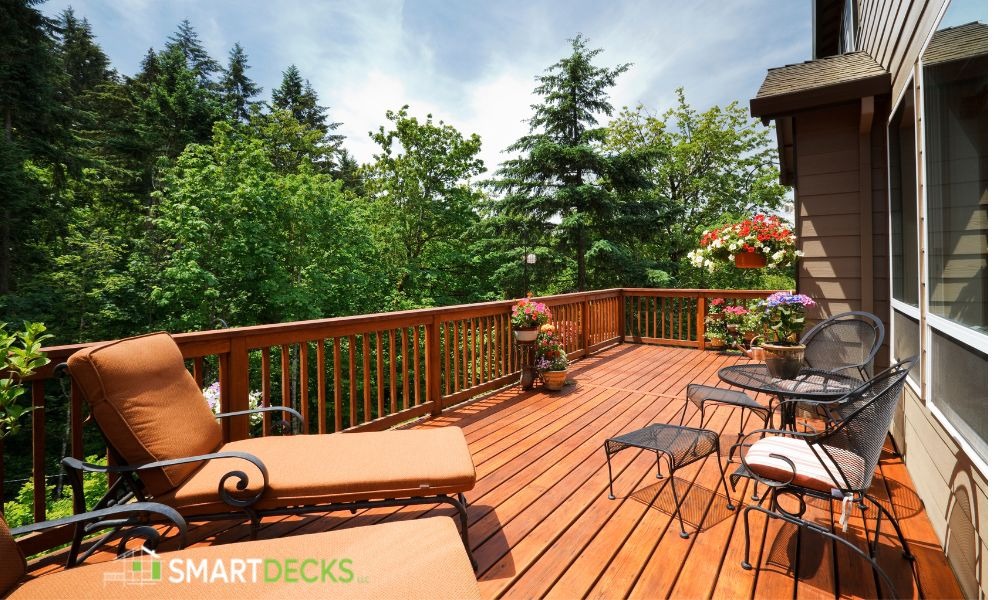
The Pacific Northwest subjects outdoor structures to conditions that few other regions in the country replicate. Kent, WA receives an average of 150 rain days per year. Surface moisture on horizontal structures like decks never fully dries between fall and spring. UV exposure during summer months then causes rapid oxidation in unprotected wood fibers. The result is a freeze-thaw and wet-dry cycle that accelerates material degradation faster than in drier climates.
Choosing the right surface for a deck here is not a style preference. It is a structural decision. The wrong material requires replacement in under a decade. The right one, installed correctly by a knowledgeable deck company in Kent, WA, performs for 25 to 50 years. SmartDecks builds with composite and wood options matched to each homeowner’s site conditions, sun exposure, and long-term maintenance preference.
Why the Pacific Northwest Climate Eliminates Some Material Options Entirely
Not all decking products sold nationally are appropriate for western Washington. Several fail predictably in the region’s specific conditions.
Tropical hardwoods like ipe and cumaru perform well in humid climates with consistent moisture. However, they require annual oiling to prevent surface checking and gray discoloration. In Kent’s climate, where rain and UV alternate seasonally, skipping even one maintenance cycle causes surface cracks that allow water to penetrate the board’s interior. Once moisture reaches the core, the checking accelerates into splitting.
Untreated softwoods, including standard construction-grade pine, absorb water rapidly. A board with a moisture content above 19 percent becomes susceptible to fungal decay caused by organisms in the genus Serpula and Coniophora, both of which are endemic to the Pacific Northwest’s soil. These fungi digest cellulose and hemicellulose in wood fibers, causing brown rot that structurally weakens boards within two to four years of installation without chemical treatment.
Pressure-Treated Wood: The Budget Option With Real Limitations
Pressure-treated lumber remains the most common choice for deck framing across western Washington. For surface decking, however, its performance profile is more complicated.
Modern pressure-treated boards use copper azole (CA-C) or micronized copper quaternary (MCQ) preservatives, which replaced the older chromated copper arsenate (CCA) formula phased out for residential use in 2003 by the U.S. Environmental Protection Agency. These treatments resist fungal decay and insect damage effectively. However, pressure-treated boards still absorb surface moisture, which causes repeated swelling and shrinkage. Over time, this cycle produces surface checks, cupping, and raised grain that creates a rough walking surface.
Without annual sealing, surface deterioration becomes visible within two to three years. With consistent maintenance, pressure-treated decking can last 15 years. The total lifetime cost, including labor and materials for repeated sealing, often exceeds the upfront cost differential versus composite.
Cedar: The Natural Option Best Suited for Covered Applications
Western red cedar, harvested primarily from forests in British Columbia and the Washington Cascades, contains thujaplicins, natural biocides that inhibit the fungal organisms responsible for decay. This makes untreated cedar significantly more resistant to rot than standard pine in wet climates.
Cedar performs well in covered deck applications where direct rainfall contact is limited. On fully exposed decks in Kent, cedar’s surface gray uniformly within 12 to 18 months without sealing. Gray cedar is structurally sound but aesthetically different from what most homeowners expect. Restoring the original color requires sanding and application of a UV-blocking penetrating oil, a process that costs $1.50 to $3.00 per square foot in labor when performed professionally.
Cedar is a good fit for homeowners who prefer natural wood aesthetics and are willing to commit to a biannual maintenance schedule. It is a poor fit for households that want a low-maintenance surface, as neglected cedar decks in Kent’s climate develop surface mold and mildew deposits that require pressure washing and chemical treatment to remove.
Composite Decking: The Strongest Performer in Kent’s Climate
Capped composite decking is the material category best matched to the Pacific Northwest’s conditions. Composite boards are manufactured from a blend of wood fiber and recycled polyethylene or polypropylene, with a protective polymer cap bonded to all four sides of the board. The cap layer prevents liquid water from penetrating the board’s surface, eliminating the moisture absorption cycle that degrades wood.
The U.S. Forest Products Laboratory, a research station of the USDA Forest Service, has studied wood-plastic composite materials since the 1990s. Their research confirms that capped composite boards show significantly lower moisture uptake than uncapped products and maintain dimensional stability in wet-dry cycling conditions. This stability directly translates to reduced surface checking, cupping, and fastener popping in climates like Kent’s.
SmartDecks installs composite decking from Deckorators, for which they hold Certified Elite installer status. Deckorators’ mineral-based composite boards use a proprietary stone polymer core that absorbs less heat than standard wood-fiber composites — a meaningful benefit during Kent’s summer months when dark-colored decking can become uncomfortable underfoot.
PVC Decking: Best for High-Moisture Specific Applications
Cellular PVC decking contains zero wood fiber. The boards are extruded from polyvinyl chloride compounds and contain no organic material for fungal organisms to consume. In applications where standing water accumulates, such as rooftop decks, pool surrounds, or ground-level platforms with poor drainage, PVC outperforms all other material categories in long-term moisture resistance.
PVC boards have a higher coefficient of thermal expansion than composite. A 16-foot PVC board in Kent’s temperature range expands and contracts approximately 1/2 inch more than a comparable composite board across a full year. Proper gap spacing at installation is product-specific and listed in manufacturer installation guides. SmartDecks’ installation team accounts for these expansion tolerances during layout to prevent board buckling in summer and visible gap widening in winter.
How to Match Material to Your Specific Site Conditions
The correct material choice depends on factors specific to your property, not general regional averages.
- Sun exposure: South-facing decks in Kent receive significantly more UV than north-facing ones. UV-stabilized composite caps outperform cedar in high-sun applications.
- Shade and moisture retention: Decks under tree canopy stay wetter longer. Cedar under dense shade develops mold more rapidly than composite. Composite with antimicrobial additives performs better in these conditions.
- Deck elevation: Ground-level decks have less airflow under the framing, increasing moisture retention in structural members. This affects framing material choice more than surface decking, but it also influences surface drying time.
- Budget and timeline: Pressure-treated wood has the lowest upfront cost. Composite has the lowest 20-year total cost when maintenance is factored in.
What SmartDecks Recommends for Kent Homeowners
SmartDecks offers both composite decking and wood decking options for Kent homeowners. Their recommendation process starts with a site assessment, not a product pitch. They evaluate sun exposure, drainage conditions, existing framing, and homeowner maintenance preferences before proposing a material.
Every free consultation includes a written material recommendation with the rationale behind it. SmartDecks is available Monday through Sunday, 6 AM to 8 PM.
