

Problem:
Gold moves fast. Headlines blame inflation, the Fed, or geopolitics—often all at once.
Agitation:
That noise creates confusion. Traders see CPI rise, expect gold up, and watch it fall. Trust erodes.
Solution:
This guide explains what actually drives XAUUSD, which factors matter most, and when expectations break. You’ll get a clear cause-and-effect framework you can reuse daily.
What Is XAUUSD and Why Does Gold Price Move So Frequently?
XAUUSD represents the spot price of gold quoted in US dollars.
It trades nearly 24 hours and reacts to macro data in real time.
Gold moves often because it sits at the center of:
- Monetary policy
- Currency strength
- Risk sentiment
- Global uncertainty
Unlike equities, gold has no earnings. Price changes reflect expectations, not balance sheets.
The Primary Drivers of Gold (XAUUSD) Movements Explained
This section answers the core question directly.
These drivers matter in priority order, not isolation.
The Four Dominant Drivers (Ranked)
- Interest rates and real yields
- US dollar strength (DXY)
- Inflation expectations
- Geopolitical and financial risk
When signals conflict, rates and the dollar usually win.
Inflation and Gold – Hedge or Hype?
Gold is often called an inflation hedge. That’s only half true.
Gold rises when:
- Inflation is high and
- Rates lag behind inflation
Gold struggles when:
- Inflation rises but
- Central banks tighten aggressively
Markets price expectations, not headlines. CPI alone is never enough.
Interest Rates, Real Yields, and Opportunity Cost
This is the most powerful driver.
Gold offers no yield.
When real yields rise, holding gold becomes expensive.
Key mechanics:
- Rising rates → higher real yields → gold pressure
- Falling rates → lower real yields → gold support
Watch the Federal Reserve and Treasury yields more than CPI.
The US Dollar and Its Inverse Relationship With Gold
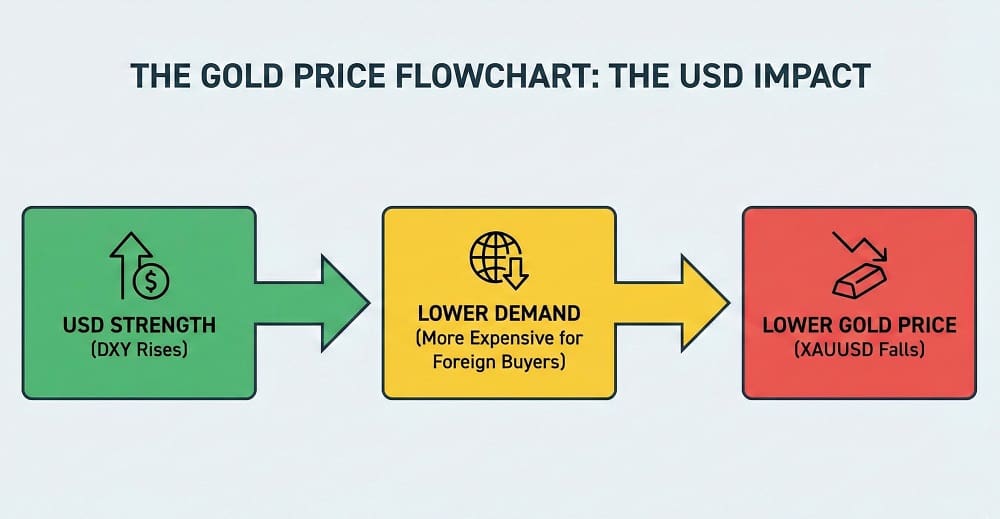
Gold and the dollar usually move opposite.
Why:
- Gold is priced in USD
- A stronger dollar makes gold costlier globally
When DXY rises sharply, gold often weakens—even with bullish news.
Geopolitical Risk and Safe-Haven Demand
Fear can override fundamentals.
Gold attracts flows during:
- Wars and conflicts
- Banking stress
- Financial system risk
These moves are often fast and emotional.
They fade once uncertainty stabilizes.
Why Gold Sometimes Moves Against Expectations
This frustrates most traders.
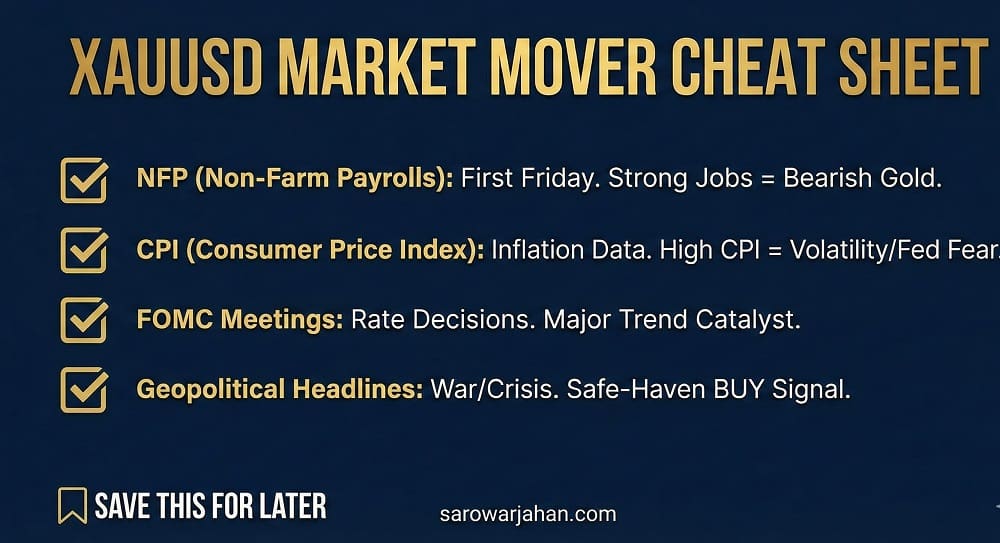
Gold can fall on “good” news because markets trade positioning, not logic.
Common reasons:
- Data was already priced in
- Rate expectations changed more than inflation
- Dollar strength offset bullish factors
- Large players reduced exposure
Understanding expectations vs outcomes matters more than knowing theory.
The Role of Central Banks, Institutions, and Supply-Demand
Central banks shape long-term trends.
They influence gold through:
- Interest rate policy
- Balance sheet expansion
- Gold reserve purchases
The World Gold Council tracks these flows.
Large-scale buying supports prices over time.
Mining supply changes slowly.
Short-term moves are demand-driven, not production-driven.
Market Sentiment, Speculation, and Short-Term Volatility
Short-term gold moves often come from paper markets.
Key players:
- Futures traders (COMEX)
- ETFs
- Hedge funds
Physical Gold vs Paper Gold
| Physical Gold | Paper Gold |
|---|---|
| Long-term demand | Short-term price swings |
| Jewelry and reserves | Futures and ETFs |
| Slow-moving | Highly volatile |
Sentiment flips quickly. That’s why gold can move sharply without new data.
A Practical Framework to Understand Daily Gold Price Moves
Use this checklist before reacting to headlines.
- What happened to real yields?
- Did the USD strengthen or weaken?
- Did rate expectations change?
- Is the market risk-on or risk-off?
If three align, gold usually follows.
This framework is used by analysts at https://www.sarowarjahan.com/ to cut through market noise and focus on drivers that matter.
Key Takeaways – What Really Drives XAUUSD Over Time
- Interest rates dominate gold pricing
- The dollar often overrides inflation
- Fear creates short-term spikes
- Institutions guide long-term trends
- Expectations matter more than news
Gold is not random.
It’s misunderstood.
FAQ: Gold (XAUUSD) Price Movements Explained
Why does gold price change every day?
Gold changes daily due to shifts in interest rates, USD strength, inflation expectations, and risk sentiment.
Markets continuously reprice macro data, policy signals, and investor positioning, which causes frequent XAUUSD movements.
How do interest rates affect gold prices?
Rising interest rates usually pressure gold, while falling rates support it.
Higher rates increase real yields, raising the opportunity cost of holding non-yielding assets like gold.
Why is gold considered a safe-haven asset?
Gold holds value during economic stress, currency risk, and geopolitical crises.
Investors move into gold when confidence in financial systems or paper assets weakens.
What is the relationship between the US dollar and gold?
Gold and the US dollar typically move inversely.
A stronger dollar makes gold more expensive globally, reducing demand and often pushing prices lower.
Do central banks influence gold prices?
Yes, central banks affect gold through rate policy and reserve management.
Large-scale gold purchases or loose monetary policy tend to support higher long-term prices.
