
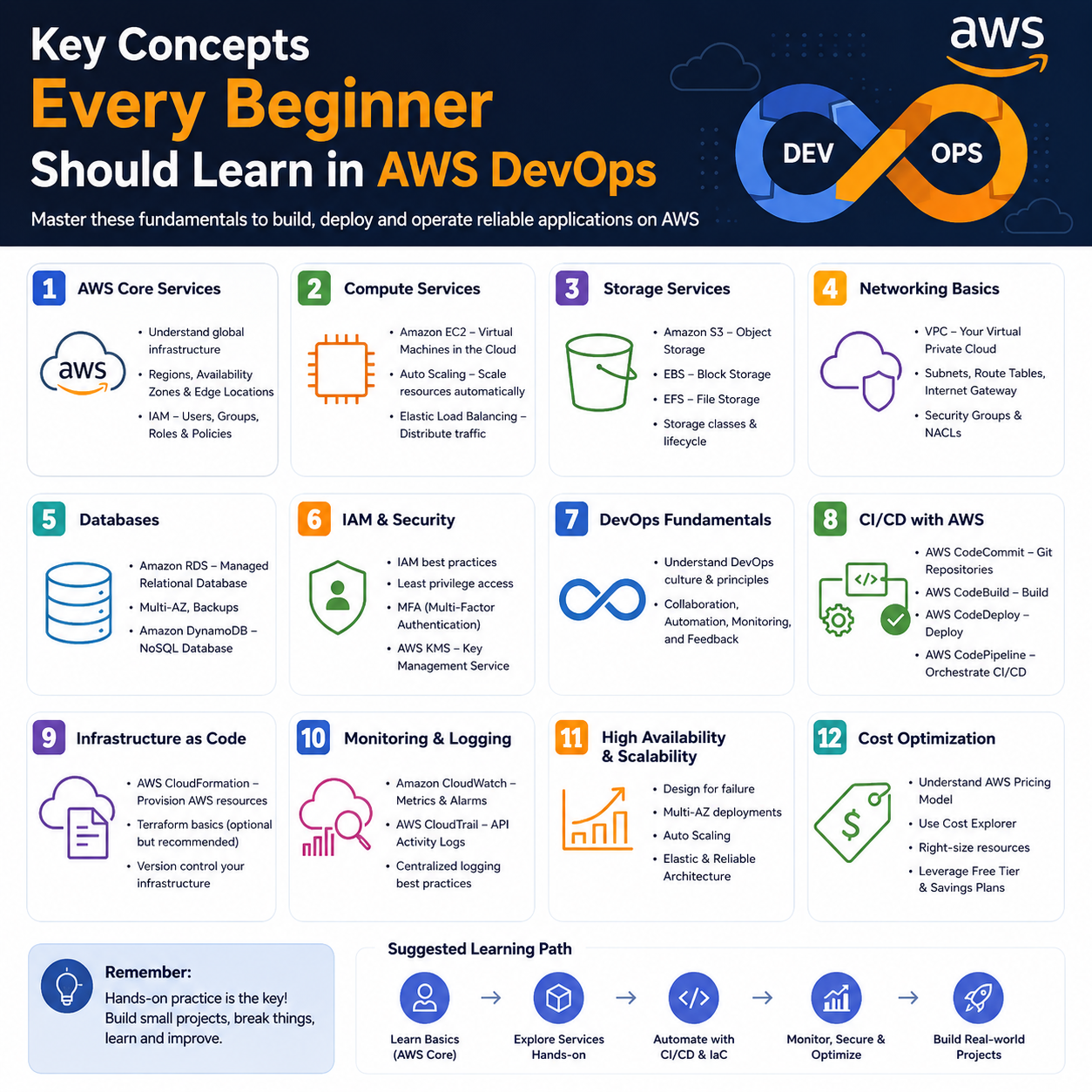
In recent years, cloud technology has been transforming how businesses build, manage, and scale their applications. Currently, organizations are shifting towards fast-paced deployments, automated processes, and highly secure cloud environments. As a result of this technological advancement, the AWS DevOps course has become one of the most sought-after career paths in the information technology sector.
Many learners begin learning new tools and technologies straight away. On the contrary, getting a grasp on some DevOps basics will be far more helpful when mastering cloud platforms, automation tools, deployment pipelines, monitoring systems, and other technologies.
Concepts to Understand for Success in AWS DevOps
Here is a list of key DevOps concepts that AWS beginners should learn from the very beginning to develop their AWS DevOps course.
1. Understanding Cloud Platforms
Cloud computing has revolutionized the IT world. Before getting deeper into automated processes and deployment practices, you should first understand how cloud platforms work.
Among all existing cloud providers, AWS, Microsoft Azure, and Google Cloud Platform (GCP) remain the leading platforms used by organizations worldwide. Amazon Web Services is still one of the most frequently employed platforms because of its flexibility, scalability, and rich set of services.
Here is the list of services that AWS beginners should get acquainted with:
- Compute
- Storage
- Network
- Database
- Security and Identity
- Developer Tools
Learning cloud architecture will help you understand how companies deploy and distribute applications worldwide while maintaining performance and security. Moreover, many organizations nowadays operate in a multi-cloud environment, using multiple platforms simultaneously. It makes the knowledge of AWS, Azure, and GCP even more useful.
2. Containers and Kubernetes
The process of application deployment has been significantly improved with the help of containers. Instead of deploying applications directly on servers, developers now place them into containers along with dependencies. Docker is the most popular tool for creating containers that ensure smooth operation regardless of the infrastructure on which they are deployed.
However, managing multiple containers may pose serious challenges. Kubernetes was created to address these challenges by offering scalable automation for containerized applications.
When studying the AWS DevOps course, beginners should be aware of such Kubernetes concepts as:
- Pods
- Clusters
- ReplicaSets
- Nodes
- Services
- Ingress Controllers
Kubernetes automation is particularly vital for organizations relying on a microservices architecture because it ensures high availability and scalability. As the popularity of cloud-native technologies grows, skills in Kubernetes are becoming increasingly relevant in the DevOps field.
3. Infrastructure as Code (IaC)
Maintaining server settings manually is an outdated and inefficient process. That is why many companies have adopted Infrastructure as Code (IaC), which allows automation of infrastructure management processes. Using IaC tools, DevOps engineers can automatically deploy, provision, and maintain cloud resources. The following tools allow you to automate infrastructure:
- Terraform
- Ansible
- Pulumi
- AWS CloudFormation
Moreover, IaC is compatible with version control systems that enable you to maintain consistency among all environments. That is why it is crucial for beginners to learn this concept, given its importance in AWS DevOps.
4. Continuous Integration and Continuous Deployment (CI/CD)
Key concepts in DevOps include continuous integration (CI) and continuous delivery (CD). CI/CD allows automating such processes as software building, testing, and deploying. Continuous integration involves regularly merging code changes into a single repository, followed by verification with automated tests. After they pass, an application is released to users. Continuous deployment goes further by automatically deploying tested applications without manual intervention.
The following tools offer CI/CD functionality:
- Jenkins
- GitHub Actions
- GitLab CI/CD
- CircleCI
- Argo Workflows
It is important for learners to understand how pipelines function in their AWS DevOps course. Moreover, beginners should learn deployment strategies:
- Blue-green deployment
- Rolling updates
- Canary releases
5. Monitoring and Observability
Deploying an application is only half of an AWS DevOps engineer’s work. The other half is monitoring systems to track their performance and eliminate potential threats. Modern organizations leverage monitoring and observability tools to monitor systems in real time to ensure uptime. Among the most popular monitoring tools, there are the following:
- Prometheus
- Grafana
- ELK Stack (Elasticsearch, Logstash, Kibana)
- Datadog
- Middleware
These tools can notify teams about potential problems, analyze their log files, and identify bottlenecks. Observability goes beyond classic monitoring by providing explanations for why certain problems occurred. Nowadays, organizations are actively implementing AIOps that use artificial intelligence to automatically predict and resolve incidents. That is why monitoring and observability skills will be crucial for every DevOps engineer.
6. DevSecOps and Security Practices
Until recently, security was a separate aspect of application development. However, today, security is integrated into all stages of the SDLC. Such a DevOps philosophy is called DevSecOps. DevSecOps aims to detect vulnerabilities at all stages of development and secure applications during deployment. Beginners should know the basics of the following DevSecOps topics:
- Identity and Access Management (IAM)
- Cloud Security
- Vulnerability Scanning
- Compliance Monitoring
- Container Security
The following tools help you manage security at various stages of development:
- Snyk
- Trivy
- Aqua Security
- Open Policy Agent (OPA)
The relevance of security automation is increasing due to frequent cyberattacks worldwide. In turn, companies need specialists skilled in both secure pipelines and rapid deployment. This is why learning security basics is very helpful for AWS DevOps beginners, as it helps them become more competitive in the market.
7. Automation and Scripting
Automation has always been a key principle of DevOps. Many repetitive tasks can be automated, such as deployments, backups, tests, and server configuration. Acquiring basic programming skills is a prerequisite for learning AWS. Here are the programming languages that AWS beginners should master:
- Python
- Bash
- Go
These programming languages are frequently used for:
- Automation
- Integration with API
- Log Analysis
- Incident Management
- Schedule Backups
Moreover, you may find event-driven architectures in AWS services such as AWS Lambda. Being fluent in scripting is a crucial requirement in DevOps.
8. GitOps and Configuration Management
A new trend in DevOps is GitOps, which uses Git repositories as the source of truth for infrastructure and application configuration. Every change to the Git repository is automatically reflected in the production infrastructure through automated processes. The following GitOps tools help you manage your applications more easily:
- ArgoCD
- FluxCD
Moreover, the following tools help with configuration management:
- Ansible
- Helm
- Kustomize
As a result, teams get improved transparency, rollback, and coordination of development and operations. Understanding this concept is especially important for learners who will have to deal with infrastructure versions and configurations.
9. Communication and Collaboration Skills
Another key skill required in the AWS DevOps course practice is communication and collaboration. A successful DevOps culture unites development, operations, security, and testing teams into a single group working to achieve a common goal. For this reason, professionals need efficient communication.
Such tools as:
- Jira
- Slack
- Notion
- Microsoft Teams
may greatly help improve communication and coordination among team members. Communication skills are essential for:
- Incident Response
- Documentation
- Project Planning
- Production Troubleshooting
For many employers, good interpersonal skills are a crucial requirement in DevOps professionals.
Build a Successful Career in AWS DevOps!
AWS DevOps is a great career path for anyone interested in cloud computing, automation, and application deployment. Nonetheless, succeeding in the field requires a deeper understanding of cloud infrastructure, CI/CD, security, monitoring, and automation than merely learning DevOps tools and services alone.
By focusing on the essential AWS DevOps concepts listed above, beginners can acquire the relevant skills required in the industry. If you are considering learning an AWS DevOps course and looking for a good training institute, you can choose Rexton IT Solutions to significantly facilitate your learning. Professional environment, knowledgeable tutors, and practical projects will help learners develop industry-ready skills.
