
You are deep in your diamond search. You are staring at two stunning rings on your screen. One is a VVS1 diamond, a technical masterpiece, with a price tag to match. The other is a VS1, and it costs thousands less. You zoom in, scrutinize the 360-degree videos, and realize you cannot see a single difference between them.
Are your eyes playing tricks on you, or are you about to get ripped off?
The diamond industry thrives on the assumption that a higher grade always equals a better ring. But the truth about the VVS1 diamond meaning and cost is a story about buying “paper perfection” rather than visible beauty.
As a jeweler specialist, I want to pull back the curtain. We are going to dismantle the pricing, examine the clarity scale, and prove exactly when a VVS1 is a brilliant investment and when it is a beautiful waste of your money.
The “Paper Perfection” Trap: What VVS1 Actually Means
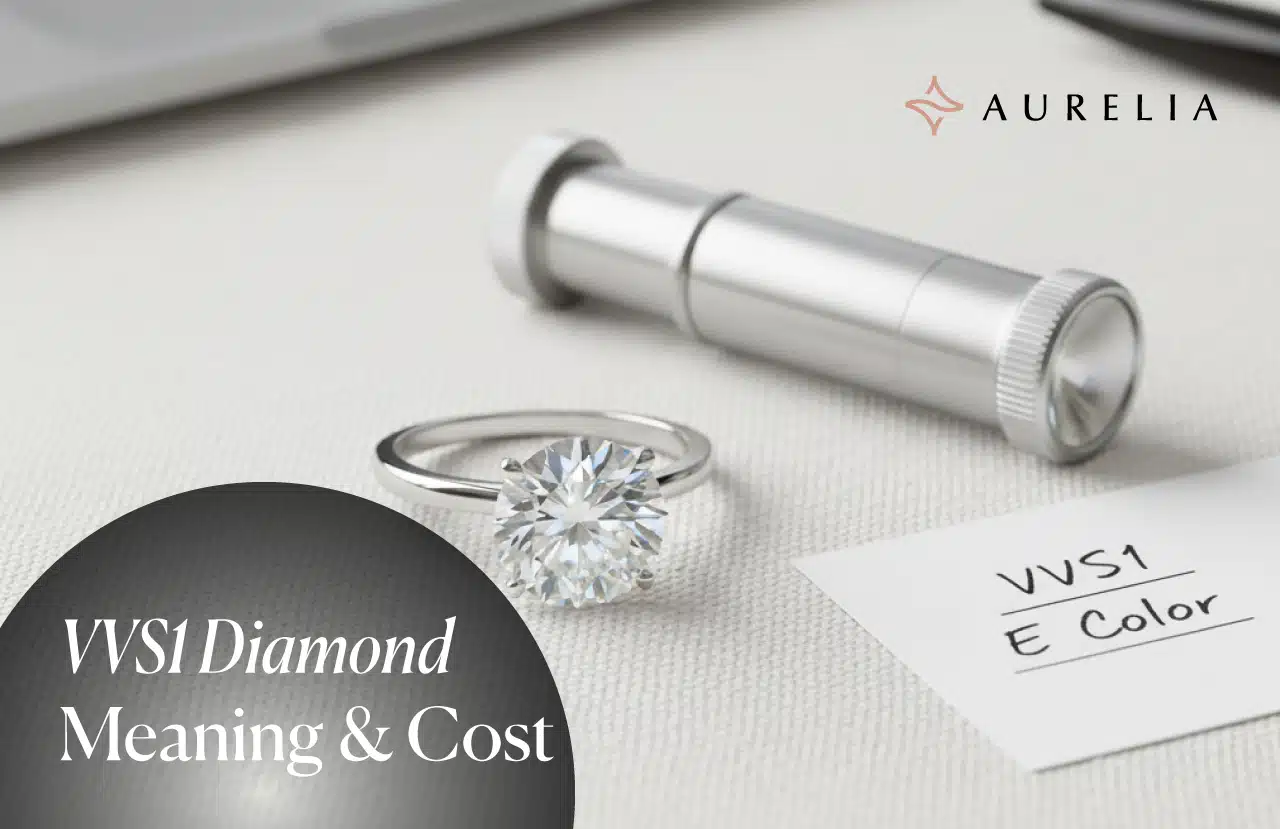
VVS1 stands for Very, Very Slightly Included. On the GIA diamond clarity scale, it means a diamond has minuscule internal flaws that are nearly impossible for a gemologist to see under 10x magnification. To the naked eye, a VVS1 diamond looks completely flawless.
When you buy a VVS1, you are paying for an elite letter on a grading report. You are buying extreme geological rarity, not a visibly superior diamond. A jeweler’s loupe is required just to find the microscopic inclusions, which are often just tiny pinpoints or faint clouds hidden deep within the stone.
For 99 percent of buyers, paying the massive premium for near-flawless clarity is a trap. You are spending thousands of extra dollars to solve a problem your naked eye cannot even perceive.
The Eye-Clean Threshold: Why Your Brain is Tricking Your Wallet
The diamond industry wants you to believe that “near-flawless” is a necessary goal. But the only concept that truly matters for an engagement ring is finding a stone that is “eye-clean.” An eye-clean diamond has no inclusions visible to the naked eye under normal lighting conditions.
To prove this, let’s set up a VVS1 vs VS1 showdown. Imagine you are comparing two 1.5-carat round brilliant diamonds online.
| Feature | Diamond A (VVS1) | Diamond B (VS1) |
| On Paper | Near-Flawless | Minor inclusions |
| To Your Eye | Completely clean | Completely clean |
| Peace of Mind | Ultimate “Paper” Perfection | Proven “Eye-Clean” Quality |
| The Cost | Massive price premium | The sweet spot for value |
Both diamonds will look perfectly clear as they sparkle on a hand. However, the VVS1 will cost significantly more. Your brain tells you the VVS1 is better because of the grade, but your wallet takes a massive, unnecessary hit. A well-selected VS1 is the savvy buyer’s secret to getting a visually perfect ring for a fraction of the cost.
The Cost Crash: Natural Rarity vs. Lab-Grown Reality
If a VVS1 diamond looks identical to a cheaper VS1, why does it cost so much? The answer depends entirely on the diamond’s origin.
Natural diamonds are formed deep within the earth over billions of years. Finding a large diamond crystal that grew without absorbing almost any trace elements or internal fractures is incredibly rare. When you buy a natural VVS1, you are paying for that needle-in-a-haystack rarity.
Lab-grown diamonds have completely shattered this pricing model. Because they are created in controlled environments, achieving a VVS1 grade is a matter of precise engineering, not geological luck.
A 1-carat natural VVS1 can easily cost between $4,500 and $8,500 depending on the color. A 2-carat natural VVS1 can jump past $28,000.
By contrast, the lab grown VVS1 price for a 1-carat stone sits around $1,300 to $2,000. Lab-grown technology has turned the “collector’s grade” from a billionaire’s luxury into an accessible reality. If you want the ultimate combination of high clarity and low cost, exploring the moissanite and lab-grown options at Moissanite by Aurelia offers near-flawless stones without the inflated rarity premium.
Four Times a VVS1 Diamond is Actually the Smart Choice
I have spent this entire guide explaining why a VVS1 is overkill for most buyers. But there are specific scenarios where choosing this elite clarity grade is actually a brilliant, strategic move.
- You Are Buying a Step-Cut Diamond: Emerald and Asscher cuts feature long, linear facets that act like open windows into the stone. They do not have the fiery sparkle of a round brilliant to hide inclusions. For a step-cut, a VVS1 acts as an insurance policy against visible flaws.
- You Are Buying a Massive Stone: If you are purchasing a diamond over 3.0 carats, inclusions become much easier to spot. Scaling up the clarity grade ensures the stone remains completely eye-clean.
- You Are Chasing the Collector’s Grade: If you want a D-color, flawless-tier stone purely for the prestige and rarity, the VVS1 is your entry point to the top of the market.
- You Want Personal Peace of Mind: Some buyers simply want to know their diamond is technically perfect, even if no one else can see the difference.
Answering Your Final VVS1 Questions
What does VVS1 mean in a diamond?
VVS1 stands for Very, Very Slightly Included. It means the diamond has microscopic internal flaws that are nearly impossible to see under 10x magnification. It appears completely flawless to the naked eye.
This grade represents extreme geological rarity and technical perfection, making it highly sought after by collectors and luxury buyers.
Is VVS1 better than VS1?
Technically yes, but visually no. VVS1 has fewer microscopic inclusions than VS1. However, both grades are completely eye-clean, meaning you cannot see any difference without a jeweler’s loupe.
A VS1 offers the exact same visual beauty for a much lower cost, making it the smarter choice for most engagement rings.
How much does a 1 carat VVS1 diamond cost?
A natural 1-carat VVS1 typically costs between $4,500 and $16,500. A lab-grown VVS1 of the exact same size drops drastically to around $1,300 to $2,000.
The price is heavily dependent on the color grade and whether the stone was mined from the earth or created in a lab.
Does VVS1 clarity make a diamond sparkle more?
No. A diamond’s sparkle is determined almost entirely by its Cut quality, not its Clarity. A lower clarity diamond with an “Excellent” cut will out-sparkle a VVS1 with a poor cut.
Never sacrifice cut quality to afford a higher clarity grade. The cut is the engine that drives a diamond’s brilliance.
Why is VVS1 so expensive?
Natural VVS1 diamonds command a premium price because of extreme rarity. Less than 2 percent of gem-quality natural diamonds achieve this near-flawless grade. You are paying for scarcity, not better visual performance.
If you want to avoid this premium, lab-grown diamonds and moissanite offer the same near-flawless clarity for a fraction of the cost.
