
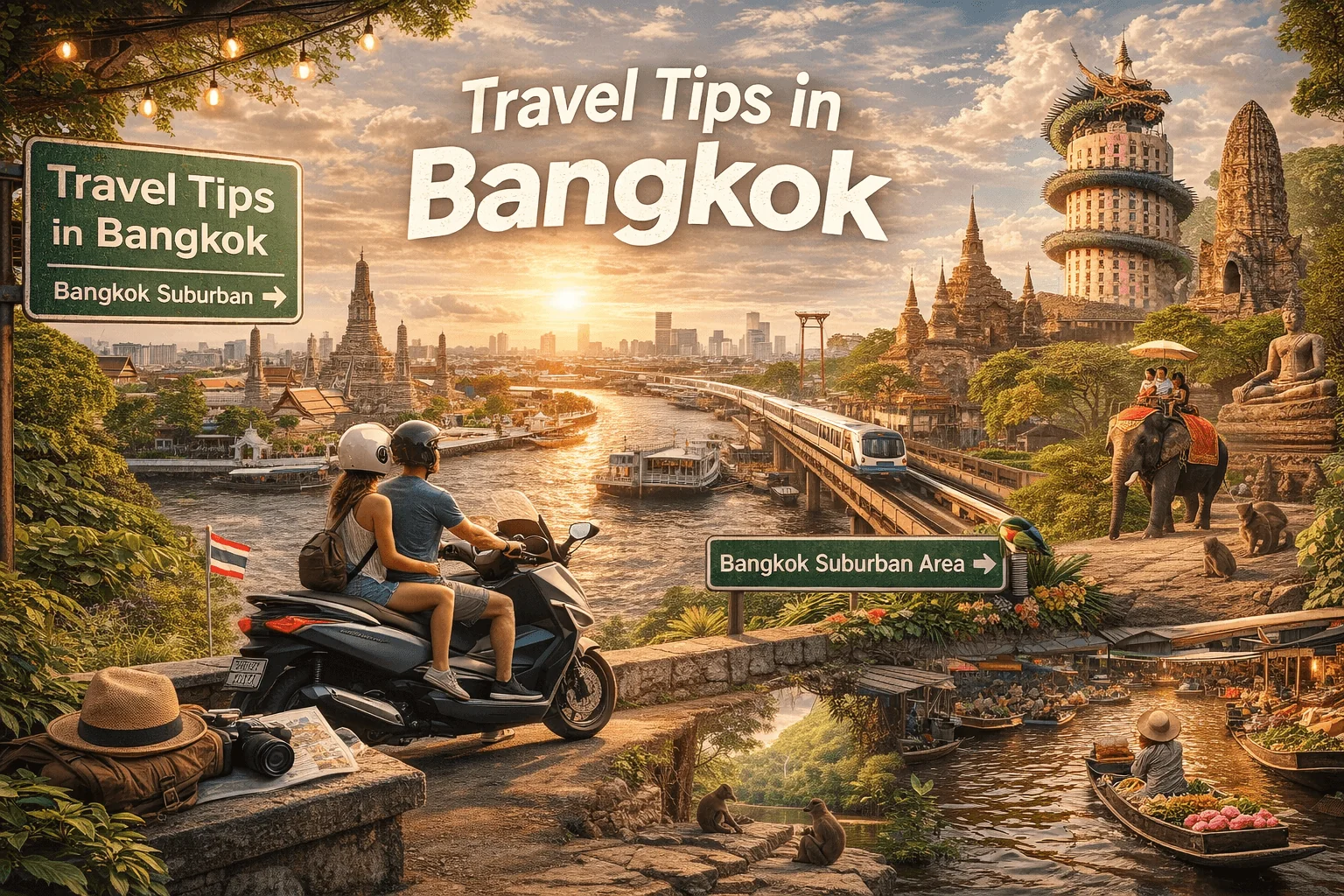
Bangkok is chaos and harmony layered on top of each other. It is traffic and temples. It is neon and incense smoke. Most travelers focus only on central districts — Sukhumvit, Silom, Siam, Khao San — and miss the ring of extraordinary places surrounding the city. The truth is this: some of the most memorable travel experiences happen just outside Bangkok.
This guide goes deep into suburban Bangkok and nearby provinces like Ayutthaya, Samut Prakan, Nakhon Pathom, and beyond. You will also find practical strategy-level advice to move efficiently, avoid tourist traps, and structure your days like someone who understands the city instead of fighting it.
Bangkok rewards preparation. And punishes randomness.
Let’s begin outside the center.
Why Explore Outside Bangkok?
Bangkok’s center is dense. High-rises, malls, temples, rooftop bars. But once you leave the central business districts, the pace shifts. You find:
• Less traffic pressure
• Lower prices
• Authentic Thai neighborhoods
• Nature pockets
• Historic capitals
• Cultural sites without heavy crowds
Suburban Bangkok and surrounding provinces are perfect for half-day and full-day trips. The infrastructure is strong. Roads are good. Trains are expanding. And if you rent a scooter or car, mobility becomes freedom.
Now let’s break down the best suburban and nearby destinations.
Ayutthaya – The Ancient Capital
Distance: ~80 km north of Bangkok
Travel time: 1–1.5 hours
Ayutthaya was once one of the richest cities in the world. In the 17th century, foreign traders described it as a global capital equal to Paris or Beijing. Today it is a UNESCO World Heritage site filled with temple ruins, giant Buddha statues, and brick stupas glowing at sunset.
Why go?
Because walking among 400-year-old ruins gives perspective. Bangkok feels young compared to Ayutthaya.
Highlights:
Wat Mahathat – The famous Buddha head entwined in tree roots
Wat Chaiwatthanaram – Best sunset temple complex
Wat Phra Si Sanphet – Royal temple ruins
Practical strategy:
Go early. Leave Bangkok by 7 AM. By 11 AM heat becomes intense. Rent bicycles there for slow exploration, or rent a scooter for more coverage.
Avoid mid-day temple marathons without shade. Hydrate aggressively.
If you want a slower cultural day trip outside the chaos, Ayutthaya is unmatched.
Ancient City (Muang Boran) – Samut Prakan
Distance: ~40 km southeast
Travel time: 45–60 minutes
Ancient City is one of Thailand’s most underrated attractions. It is a massive open-air museum shaped like Thailand itself. It contains scaled replicas and reconstructions of historical landmarks from across the country.
Why this matters:
If you have limited time in Thailand, this place compresses the entire country into one park.
You’ll see:
Floating pavilions
Golden temples
Traditional wooden houses
Thai mythological architecture
Peaceful lakes
The park is huge. Rent a bicycle or electric cart.
Pro tip: go late afternoon. Light becomes soft. Crowds thin. It becomes cinematic.
Combine it with nearby Erawan Museum if you like surreal architecture (giant three-headed elephant statue).
Samut Prakan – The Hidden Coastal Province
Most tourists never explore Samut Prakan beyond Ancient City. That’s a mistake.
Bang Pu Recreation Center is a quiet coastal pier where locals feed seagulls in winter season. It feels almost like a forgotten seaside town. If you want peaceful sunset photos without Pattaya crowds, this is your move.
There are also mangrove forests and small fishing villages nearby. This is Thailand outside Instagram.
Safari World – North Bangkok
Distance: ~40 km northeast
Travel time: 1 hour
Safari World is a large open zoo and marine park. It’s family-oriented but still interesting for adults who want a lighter day.
Drive-through safari experience is the highlight. Lions, zebras, giraffes roaming in large enclosures.
If you’re traveling with family or want a break from temples, this works.
However, go early. Afternoons get extremely hot.
Nakhon Pathom – The Giant Stupa City
Distance: ~60 km west
Travel time: 1–1.5 hours
Nakhon Pathom is home to Phra Pathom Chedi, the largest stupa in Thailand and one of the tallest in the world.
It’s massive. And glowing gold at sunset.
This province is quiet and local. It’s not commercial. You go there for spiritual atmosphere, street food around the temple, and slow provincial life.
Damnoen Saduak Floating Market – Ratchaburi
Distance: ~100 km southwest
Travel time: 1.5 hours
This is the famous “boat market.” Yes, it’s touristy. Yes, it’s commercialized.
But if you go early and treat it like cultural observation instead of a shopping mission, it’s interesting.
Boats filled with fruits, coconut ice cream, grilled skewers, souvenirs.
Pro strategy: Arrive before 8:30 AM. After 10 AM it becomes a selfie battlefield.
Maeklong Railway Market – Samut Songkhram
Distance: ~90 km
Travel time: 1.5 hours
A market built directly on railway tracks. When train comes, vendors fold tents in seconds.
It’s chaotic and brilliant.
Time your arrival with train schedule.
Kanchanaburi – Nature and History
Distance: ~130 km
Travel time: 2–2.5 hours
Famous for:
Bridge over River Kwai
Erawan Waterfall
National parks
Mountain scenery
If you want to escape city humidity and see waterfalls with emerald pools, Erawan National Park is powerful.
Wear proper shoes. Slippery terrain.
Now let’s zoom back to Bangkok itself.
Because understanding suburban trips only works if your central Bangkok logistics are optimized.
Bangkok Travel Strategy – Movement Is Everything
Bangkok punishes poor timing.
Rule one: Avoid rush hour if possible.
7–9 AM and 4:30–7 PM are traffic warfare.
Use BTS and MRT strategically.
Central Bangkok is well connected by Skytrain and subway.
But suburban trips often require:
Car rental
Private driver
Motorbike
Taxi
If you want full control of timing for suburban exploration, mobility matters. That’s why planning your movement structure is critical before you explore.
If you’re looking for structured planning advice that goes deeper into city navigation, transport logic, seasonal considerations, and cultural survival strategies, you should read these detailed travel tips in Bangkok
That resource breaks down how to move efficiently without burning time or money.
Now, let’s break down smart day structures.
How to Structure Suburban Day Trips
The biggest mistake travelers make is stacking too much in one day.
Example of bad plan:
Morning floating market
Afternoon Ayutthaya
Evening rooftop
That’s unrealistic and exhausting.
Instead:
One major suburban destination per day.
Example:
Day 1 – Ancient City + Bang Pu sunset
Day 2 – Ayutthaya full day
Day 3 – Safari World half day + local night market
Suburban travel is about rhythm, not speed.
Weather Considerations
Thailand heat is real.
Best months: November–February
Hot season: March–May
Rainy season: June–October
Suburban areas often mean more sun exposure and less shade than downtown malls.
Bring:
Sunscreen
Hat
Electrolytes
Water
Heat exhaustion destroys trips.
Food Strategy Outside Bangkok
One of the advantages of suburban travel is local food.
You’ll find:
Small family restaurants
Highway seafood spots
Temple market stalls
Prices are lower than Bangkok center.
Avoid restaurants with only English menus and aggressive touts. Eat where locals eat.
Look for:
Busy tables
No English signage
Plastic chairs
Simple menus
That’s usually good food.
Safety Considerations
Thailand is generally safe.
But:
• Roads can be unpredictable
• Motorbike accidents are common
• Stray dogs exist in rural areas
If driving:
Be defensive
Don’t rush
Avoid night rural driving if unfamiliar
The goal is experience, not adrenaline.
We’ve covered the well-known suburban and nearby highlights. Now let’s go deeper. This is where most tourists never go. This is where you start feeling Thailand instead of consuming it.
Bang Krachao – The Green Lung of Bangkok
Distance: ~10–15 km from central Sukhumvit
Travel time: 30–45 minutes
Bang Krachao sits in a bend of the Chao Phraya River and feels like someone copy-pasted countryside into the middle of the capital. Elevated concrete cycling paths snake through palm trees, banana plants, and wooden houses on stilts.
It’s quiet. Birds instead of traffic. Wind instead of engines.
Rent a bicycle near the pier and explore slowly. Stop at local cafes hidden in greenery. Visit Sri Nakhon Khuean Khan Park for shaded walking trails and a peaceful lake.
Pro strategy: Go early morning or late afternoon. Midday humidity can be intense.
If you want to reset your nervous system after Bangkok intensity, this is where you go.
Nonthaburi – River Life Without the Noise
Distance: ~20 km north
Travel time: 30–60 minutes
Nonthaburi sits along the river north of Bangkok and feels like Bangkok twenty years ago. You’ll find traditional markets, riverside temples, and fewer tourists.
Koh Kret is the highlight. It’s a small island in the Chao Phraya River known for Mon culture and handmade pottery. You walk or cycle around the island, eat local snacks, and see traditional craftsmanship.
Weekends are lively. Weekdays are calm.
It’s a soft cultural day — not dramatic, but authentic.
Nakhon Nayok – Forest Escape
Distance: ~100 km east
Travel time: 1.5–2 hours
This province is under the radar for international tourists. It offers waterfalls, forest parks, and mild mountain scenery.
Khao Yai National Park (bordering this region) is one of Thailand’s most famous parks. Wildlife includes elephants, gibbons, and hornbills.
If you want to combine suburban Bangkok with nature immersion, this region is powerful.
Bring proper shoes. Leech socks in rainy season. Respect park rules.
Samut Songkhram – Slow Canal Life
Beyond the railway market, the province has calm canal neighborhoods and coconut farms. Amphawa Floating Market is less chaotic than Damnoen Saduak, especially in late afternoon.
Amphawa evenings are atmospheric — wooden houses along canals glowing with warm light.
Some guesthouses offer homestay experiences. That’s when Thailand becomes human, not touristic.
Wat Samphran – The Dragon Temple
Distance: ~40 km west
Travel time: 1 hour
This is the temple with a giant dragon wrapped around a pink cylindrical tower.
It looks surreal. Almost fictional.
Climb inside the dragon structure. It’s not heavily regulated like major temples. It feels raw and slightly mysterious.
Perfect for photography.
Few foreign tourists go there.
Erawan Museum – Surreal Architecture
Near Ancient City, this museum has a massive three-headed elephant statue on top of a pedestal building.
Inside: stained glass ceilings, cosmic symbolism, mythological art.
It’s strange and beautiful.
If you combine it with Ancient City, you get architectural overload in the best way.
Night Markets Outside Central Bangkok
Most tourists only know Chatuchak and Asiatique.
But suburban Bangkok has excellent night markets:
Talad Rot Fai (Train Market) Srinakarin
JJ Green (when operational)
Local provincial markets near Nakhon Pathom or Nonthaburi
These markets are less polished and more authentic. You find:
Vintage goods
Thai street snacks
Local fashion
Live music
Prices are usually better.
Temple Etiquette Outside Tourist Zones
When you leave central Bangkok, temples are less used to foreign visitors.
Dress properly.
No tank tops.
No short shorts.
Remove shoes.
In rural areas, respect matters more than Instagram.
Suburban Coffee Culture
Thailand has a strong café scene outside the city.
Many suburban cafes are built in:
Converted warehouses
Garden villas
Riverside wooden houses
These places are creative escapes for Bangkok residents. They are worth stopping for.
Search in Thai on Google Maps for better results.
Seasonal Considerations for Suburban Travel
Rainy season changes everything.
Waterfalls become powerful.
But rural roads can flood.
Some parks close temporarily.
Hot season makes outdoor temple exploration brutal after 11 AM.
Best strategy:
Morning outdoor exploration
Afternoon indoor museum or café
Evening market or riverside
Transportation Logic for Suburban Exploration
Public transport outside Bangkok center weakens quickly.
Options:
Grab / Bolt
Car rental
Motorbike rental
Private tour drivers
If you want maximum freedom for suburban exploration, mobility changes the entire experience.
Especially if you want to move between smaller villages, forest parks, and sunset locations.
Cost Efficiency Strategy
Suburban trips are cheaper than central Bangkok in many cases.
Food: 30–50% cheaper
Parking: Often free
Entrance fees: Modest
But transportation can become expensive if you rely on private rides repeatedly.
Planning route loops reduces cost.
Example:
Ancient City → Erawan Museum → Bang Pu
Ayutthaya temples → riverside lunch → café → return
Cluster destinations geographically.
Photography Strategy
Golden hour in suburban Thailand is extraordinary.
Rice fields glow.
Temple bricks turn orange.
Water reflects sky gradients.
Plan to stay until sunset whenever possible.
Morning mist in forest provinces is also powerful during cool season.
Hidden Risks in Suburban Exploration
Stray dogs in temple grounds
Uneven sidewalks
Language barriers
Google Translate helps. Smiles help more.
Never assume English fluency outside Bangkok center.
Emergency Services
Thailand emergency number: 191
Hospitals exist in every province, but quality varies.
For serious medical needs, Bangkok hospitals are stronger.
Basic insurance is recommended.
Now let’s transition toward integrating suburban exploration with Bangkok central mastery.
Because the best trips combine both worlds.
Central Bangkok Smart Planning
Base yourself near BTS or MRT.
Ideal areas:
Ari – Trendy, local vibe
On Nut – Affordable, expanding
Sathorn – Central but less chaotic
Phra Khanong – Authentic
Avoid over-relying on taxis during rush hour.
Use river boats for scenic and efficient movement.
We’ve explored the outer ring of Bangkok. Ancient capitals. Dragon temples. Forest parks. Coastal piers. Floating markets. Now let’s talk about the thing that determines whether your trip feels smooth and strategic — or chaotic and exhausting.
Mobility.
Because Bangkok and its surrounding provinces are not built for passive tourists. They reward independent movement.
And this is where most visitors limit themselves.
The Mobility Advantage – Why Transport Strategy Changes Everything
Bangkok center has BTS and MRT. That works well for malls, business districts, and major temples.
But the moment you want to explore:
• Ayutthaya temple clusters
• Bang Krachao’s winding green paths
• Samut Prakan coastal piers
• Nakhon Pathom countryside
• Forest parks near Nakhon Nayok
• Temple complexes outside train lines
Public transport becomes restrictive.
Taxis work — but costs stack quickly.
Private drivers work — but remove spontaneity.
What changes the game?
A large, comfortable scooter.
Specifically, something like a Honda Forza 300.
Why a Forza 300 Makes Sense for Bangkok and Suburban Exploration
Let’s be analytical.
Bangkok traffic is real. Cars get stuck.
Small scooters are cheap — but unstable on longer highway stretches.
125cc bikes are fine inside city blocks, but not ideal for outer provinces.
The Forza 300 sits in a different category:
• Powerful enough for highways
• Stable at higher speeds
• Large seat for comfort
• Big storage compartment
• Wind protection shield
• Comfortable for two people
• Better braking and road presence
If you plan to combine city riding with day trips outside Bangkok, comfort and stability matter.
Riding 80–100 km on a small scooter is exhausting.
Doing it on a maxi-scooter like a Forza 300 feels controlled and smooth.
And for suburban temple hopping, waterfall access roads, and flexible sunset chasing, that freedom is powerful.
Renting a Scooter in Bangkok – Strategic Advice
If you want independence without buying a vehicle, the cleanest solution is to rent scooter in bangkok from a reliable provider.
This is where structured rental systems matter.
Look for:
• Clear contract terms
• No passport seizure
• Transparent pricing
• Helmet included
• Insurance clarity
• Proper maintenance history
Bangkok has many small rental shops. Some are fine. Some are not.
If you want a more modern, digital-first process, RentLab focuses specifically on organized, transparent rentals designed for travelers who want simplicity and reliability.
You can explore their fleet and rental structure directly on their homepage under rent scooter in Bangkok at Rentlab
This gives you full control of your movement schedule.
No waiting for taxis.
No surge pricing.
No dependency on train lines.
You move when you want. You stop when you want.
And for suburban exploration, that autonomy compounds the experience quality.
How to Combine Scooter Mobility with Suburban Itineraries
Let’s structure a realistic multi-day example.
Day 1 – Central Bangkok Orientation
Morning: Grand Palace, Wat Pho
Afternoon: Ari neighborhood café hopping
Evening: Riverside dinner
Use BTS and MRT inside city core.
Day 2 – Bang Krachao + On Nut Local Night Market
Morning: Ride to Bang Krachao
Cycle through green lung
Lunch in local riverside café
Return by late afternoon
Night market food exploration
A comfortable scooter makes this seamless.
Day 3 – Ancient City + Bang Pu Sunset
Morning: Leave early
Explore Muang Boran
Optional Erawan Museum
Drive to Bang Pu for coastal sunset
Highway sections are smoother with a larger scooter.
Day 4 – Ayutthaya Full Day
Early departure
Temple loop exploration
Riverside lunch
Sunset at Wat Chaiwatthanaram
Longer distances become manageable with a Forza-class scooter.
Day 5 – Nakhon Pathom or Wat Samphran
Slow cultural day
Dragon temple exploration
Local street food
You control timing fully.
Cost Breakdown – Scooter vs Taxi Strategy
Let’s calculate roughly.
Taxi to Ayutthaya round trip: expensive
Private driver for day: even more
Scooter rental for several days spreads cost across multiple trips.
Fuel in Thailand is affordable.
Parking outside Bangkok center is easy.
Financially and logistically, scooter strategy wins for flexible travelers.
Safety Guidelines for Riding Around Bangkok
Now realism.
Thailand has high accident statistics.
Most accidents involve:
• No helmets
• Speeding
• Inexperience
• Night riding
• Alcohol
If you ride:
Wear helmet always
Avoid night highways
Stay visible
Be defensive
Avoid rush hour
Respect Thai driving culture
If you have no riding experience, do not start learning on Bangkok highways.
But if you are experienced, structured riding can be safe and efficient.
Digital Nomad & Long Stay Considerations
If you stay longer than 1–2 weeks, suburban exploration becomes even more valuable.
Bangkok burnout is real.
The city overwhelms.
Regular escapes to:
• Bang Krachao
• Coastal piers
• Temple provinces
• Forest parks
Maintain mental balance.
Digital nomads often underestimate this.
Mobility equals lifestyle quality.
Common Tourist Mistakes in Bangkok and Surrounding Areas
- Overscheduling
- Ignoring heat
- Depending only on central districts
- Not planning transport
- Eating only in tourist zones
- Underestimating distance
Bangkok looks compact on map. It is not.
Suburban provinces require time blocks.
Cultural Intelligence Tips
Thailand runs on soft social rules.
Avoid confrontation.
Smile more than argue.
Dress respectfully at temples.
Don’t raise voice in public.
In smaller provinces, respect is more visible than in central tourist areas.
Balancing City and Suburban Experiences
The ideal Bangkok trip structure:
60% city
40% suburban escapes
The city gives energy.
The provinces give perspective.
Without suburban exploration, Bangkok feels overwhelming.
Without central exploration, Thailand feels incomplete.
Integrating both creates rhythm.
Food Strategy Across Regions
Bangkok center:
High-end restaurants
International fusion
Rooftop bars
Suburban provinces:
Family-run eateries
Temple markets
Fresh seafood
Local desserts
Try:
Boat noodles in Ayutthaya
Coconut desserts in Amphawa
Grilled river prawns
Sticky rice snacks
The best meals often happen outside the skyline.
Weather Strategy Revisited
Cool season: Ideal for long rides
Hot season: Start before sunrise
Rainy season: Watch forecasts carefully
Road conditions change quickly during heavy rain.
Why Structured Travel Planning Matters
Bangkok punishes randomness.
Without structure, you waste:
Time
Energy
Money
With structure:
You maximize golden hours
Avoid traffic traps
Stack destinations logically
Maintain energy balance
Because Bangkok rewards those who treat it strategically.
Final Thoughts
Bangkok is not just a city. It is a base.
The real magic often happens in the surrounding provinces — ancient ruins, quiet temples, forest parks, coastal piers, dragon towers wrapped in mythology.
But access determines experience.
A large, comfortable scooter like the Forza 300 transforms suburban exploration from logistical headache into controlled freedom.
It bridges:
City and countryside
Chaos and calm
Tourist and explorer
And when you combine intelligent planning, mobility independence, cultural awareness, and balanced pacing, Bangkok and its surroundings become one of the most dynamic travel ecosystems in Southeast Asia.
The city is intense.
The ring around it is expansive.
And the difference between surviving Bangkok and mastering it often comes down to how you move.
