

A jewelry startup published a document that reads like a leaked internal memo, except they put it on the homepage. We went through it line by line.
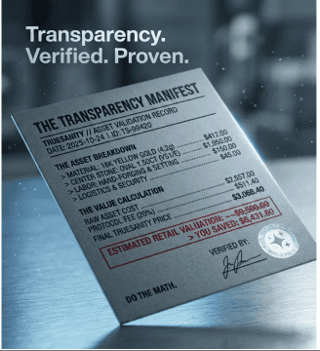
The Transparency Manifest isn’t buried in a corporate footnote. It’s the front door.
In most industries, the document that tells you exactly how a company makes its money is classified. It sits in a boardroom, behind an NDA, inside a financial model that only the CFO and a handful of select partners ever touch. The markup structure, the precise relationship between what something costs to produce and what the end customer pays, is arguably the single most protected number in any consumer-facing business. Entire legal teams exist to keep it confidential. Entire sales strategies depend on you never seeing it.
TrueSanity put theirs on the internet.
The company calls it the Transparency Manifest, and reading it feels less like browsing a jewelry website and more like someone slid a confidential dossier across the table and said, “You should see this.” It discloses material costs, labor, overhead, and margin—the full anatomy of what goes into a piece of jewelry and what the customer is actually paying for. In the fine jewelry industry, where pricing opacity isn’t a flaw but the operating system, publishing this information publicly isn’t just unusual. It’s unprecedented.
What the Document Actually Says
The Manifest doesn’t read like marketing copy. That’s the first thing you notice. There are no aspirational adjectives. No soft-focus language about “crafting dreams” or “timeless beauty.” It reads like a disclosure filing, direct, factual, and structured to answer the questions that jewelry customers have been trained not to ask: Where does the gold come from? What did the stones cost? How much of my purchase is profit?
The founding principle behind the document traces back four generations of the Jhalani family, whose earlier business was lost to a lack of transparency. That history isn’t incidental to the Manifest, it’s the engine of it. The document exists because the founder, Amit Jhalani, experienced firsthand what happens when an industry hoards information: people get hurt, trust collapses, and the only people who win are the ones controlling what others don’t know.

The anatomy of a purchase: materials, labor, overhead, and margin. All visible. All published.
What It Reveals About Everyone Else
The Manifest’s most disruptive quality isn’t what it says about TrueSanity. It’s what it implies about every other jeweler who doesn’t publish one. If one company can disclose its full cost structure and still operate as a profitable luxury brand, the silence from every other player in the market stops looking like standard practice and starts looking like concealment.
Consider the numbers the industry would prefer to keep quiet: lab-grown diamonds produced for $100–$200 per carat selling at $1,000 or more. Gold content representing a fraction of the sticker price. Markups of 300% to 1,000% are defended as “standard.” The Manifest doesn’t accuse anyone of anything. It doesn’t name competitors or throw punches. It simply publishes TrueSanity’s own numbers and lets the comparison write itself. That restraint makes it more damaging, not less.
The same ethos runs through the brand’s sustainability disclosures, which openly acknowledge where they fall short, a sharp contrast to the greenwashed perfection most luxury brands project. The Manifest’s logic is consistent: if you’re honest about your margins, you have to be honest about your limitations too. You don’t get to cherry-pick transparency.
A Document or a Dare?
The question the Transparency Manifest ultimately poses isn’t about TrueSanity at all. It’s about the industry’s relationship with its customers. If a brand can publish every cost, every margin, and every sourcing detail and still deliver collections like the Emerald Earrings collection called Protocol Verdant that feel genuinely luxurious, dark, edgy, and emotionally charged, then what exactly is the rest of the industry protecting by keeping its numbers locked in a drawer?
We reached out to three major jewelry retailers for comment on their own pricing transparency practices. None responded. We also contacted two industry trade organizations to ask whether any standardized disclosure framework exists for fine jewelry pricing. The answer, in both cases, was that no such standard has ever been proposed. In an industry that moves billions of dollars annually through consumer purchases, the customer’s right to understand what they’re paying for has never been formally acknowledged by anyone except, apparently, TrueSanity.
The Manifest is still on the homepage. The drawer, apparently, is still locked.
TrueSanity.com • Read the Transparency Manifest • Explore Collections