
The landscape of modern technology is undergoing a massive shift, and at the heart of this change is self supervised learning in artificial intelligence. For years, the gold standard for training smart systems was supervised learning, a process that required thousands of human-labeled examples to teach a machine how to recognize a cat or translate a sentence. However, as the volume of global data explodes, the “human bottleneck” of labeling has become a significant hurdle.
Enter self supervised learning in artificial intelligence, a paradigm that allows models to learn from the data itself without needing explicit human annotations. By creating its own “pretext tasks,” the AI learns the underlying structure of the world, much like a human child learns to speak by listening or understands gravity by dropping toys. This article provides a comprehensive exploration of this powerful technique, its history, and why it is considered the future of deep learning.
What is Self Supervised Learning?
At its simplest, self supervised learning in artificial intelligence is a form of machine learning where the data provides the supervision. In traditional supervised learning, you provide an input (an image) and a label (the word “dog”). In unsupervised learning in AI, the model simply looks for clusters or patterns without any specific goal. Self supervised learning in artificial intelligence sits between these two, acting as a bridge.
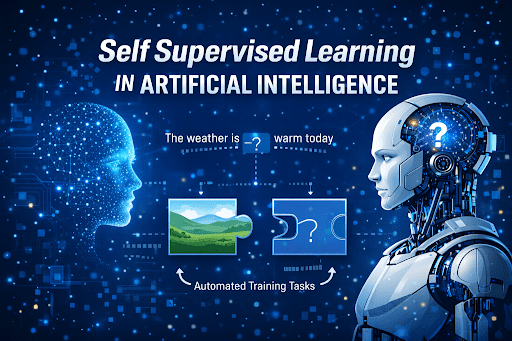
In this framework, the system hides part of the input from itself and tries to predict the missing piece. For example, it might hide the second half of a sentence or blur a section of a photo. By attempting to “fill in the blanks,” the model develops a deep understanding of the context, logic, and semantics of the information it is processing. This process is often called self supervised deep learning, as it relies heavily on multi-layered neural networks to extract these complex features.
How Self Supervised Learning Works
The core mechanics of self supervised learning in artificial intelligence revolve around the concept of pretext tasks. These are artificial tasks designed to force the model to learn useful representations of the data. Instead of training the model on the final task (like detecting a tumor in an MRI), we first train it on a pretext task (like predicting the orientation of the MRI image).
Some common self supervised learning examples include:
- Predicting Relative Position: If you cut an image of a cat into a grid, the model must learn which square goes in the top-left and which goes in the bottom-right.
- Contrastive Learning: The model is shown two versions of the same image (one rotated, one color-shifted) and must learn that they represent the same object, while a photo of a dog represents something different.
- Masked Language Modeling: Common in natural language processing models, the system hides certain words in a paragraph and tries to guess them based on the surrounding text.
Through these methods, the system undergoes AI representation learning, where it builds a mathematical “map” of the data. This map, or representation, can then be easily fine-tuned for specific, real-world tasks with very little human-labeled data.
Evolution of Self Supervised Learning
The Evolution of Machine Learning Algorithms has always been a journey toward greater autonomy. In the early days, specifically during the era of First AI Programs and the Dartmouth Conference, researchers believed that logic-based rules would suffice for intelligence. However, as we moved into the Revival of Artificial Intelligence in the 1990s, it became clear that data-driven approaches were superior.
Self supervised learning in artificial intelligence emerged as a response to the limitations of neural networks training in the 2010s. While deep learning models were achieving record-breaking results, they were “data-hungry.” The History of Computer Vision in Artificial Intelligence shows a transition from manually engineered filters to systems that could learn their own features. Eventually, researchers realized that labels were a luxury. The shift toward self supervised learning in artificial intelligence represents the latest chapter in this story, moving away from the “spoon-feeding” of data and toward a more organic, human-like style of observation and learning.
Applications of Self Supervised Learning
The versatility of self supervised learning in artificial intelligence has led to its rapid adoption across various domains. By leveraging large scale data learning, these models are reaching levels of accuracy that were previously thought impossible.
Natural Language Processing
The most famous applications of self supervised learning are found in NLP. Transformer models like BERT and GPT were trained using self-supervised techniques. They read trillions of words from the internet, learning grammar, facts, and reasoning by predicting the next word in a sequence. This has revolutionized how we interact with technology.
Computer Vision
In computer vision AI, self supervised learning in artificial intelligence is used to train models to understand spatial relationships. Systems like SEER (S-Elf-supERvised) have been trained on billions of random public images without a single human label, allowing them to excel at object detection and image segmentation better than models trained on carefully curated datasets.
Speech Recognition
For Speech Recognition Artificial Intelligence History, the move to self-supervised methods has been a game-changer. Models can now listen to thousands of hours of unlabelled audio in different languages and accents. This allows the AI to learn the phonetics of a language before it is ever taught to transcribe specific words, making it much more robust in noisy environments.
Advantages of Self Supervised Learning
Why is the industry so obsessed with self supervised learning in artificial intelligence? The benefits are both economic and technical, providing a massive boost to the efficiency of AI training techniques.
Reduced Need for Labeled Data
The primary advantage is the elimination of the need for expensive, manual labeling. Labeling a dataset like ImageNet takes years of human effort. Self supervised learning in artificial intelligence bypasses this, allowing researchers to use the vast amounts of “raw” data available on the internet.
Better Use of Large Data
We live in an era of big data, but most of it is unlabelled. This technique allows us to actually use the 99% of data that was previously ignored because it didn’t have a tag attached to it. This leads to more diverse and capable self supervised learning models.
Improved Representation Learning
Because the model has to learn the “essence” of the data to solve pretext tasks, it often develops a more robust understanding than a supervised model. For example, a self-supervised model doesn’t just learn what a “car” looks like; it learns the physics of reflections, the geometry of wheels, and the context of a road.
Challenges of Self Supervised Learning
Despite its power, self supervised learning in artificial intelligence faces significant hurdles. One major issue is the computational cost. Training these models on massive, unlabelled datasets requires thousands of GPUs and immense amounts of electricity.
Another challenge is “shortcut learning,” where the model finds a way to solve the pretext task without actually learning anything useful about the data. For example, in image rotation tasks, a model might look at the pixels in the corner rather than understanding the object in the center. Ensuring that self supervised machine learning actually leads to deep understanding requires careful design of machine learning algorithms.
The Future of Self Supervised Learning in Artificial Intelligence
As we look toward the future, self supervised learning in artificial intelligence is expected to become the foundation for all Modern Artificial Intelligence Applications. We are moving toward “multimodal” self-supervised systems—models that learn by watching video, listening to the audio, and reading the transcript simultaneously, just as humans perceive the world through multiple senses.
Furthermore, we are likely to see a convergence between self supervised learning in artificial intelligence and Reinforcement Learning History. By allowing an agent to learn about its environment through self-supervision before it begins taking actions to earn rewards, we can create much more capable robotics and autonomous systems. The ultimate goal is to reach a point where AI can learn new tasks with the same speed and flexibility as a human being.
Frequently Asked Questions (FAQs)
Is self-supervised learning the same as unsupervised learning?
Not exactly. While both work with unlabelled data, unsupervised learning focuses on finding patterns or clusters. Self supervised learning in artificial intelligence uses the data to create its own labels (pretext tasks), effectively turning an unlabelled problem into a supervised one.
What is the “pretext task” in self-supervised learning?
A pretext task is a pre-designed challenge where the model hides part of the data from itself. The goal is to solve this task (like predicting a missing word or a rotated image) to learn the underlying structure of the information.
Why is self-supervised learning important for the future of AI?
It is important because it removes the “human bottleneck.” We have more data than humans can ever label. By allowing AI to learn from raw data, we can build much larger, smarter, and more capable models.
Conclusion
In summary, self supervised learning in artificial intelligence represents a paradigm shift in how we approach machine intelligence. By moving away from the constraints of human-labeled datasets, we are unlocking the ability for models to learn from the vast, chaotic, and beautiful complexity of the real world. From the early History of Robotics and Artificial Intelligence to today’s cutting-edge transformers, the goal has always been to build machines that truly understand. While challenges remain, the progress made in self supervised learning in artificial intelligence suggests that we are closer than ever to creating truly autonomous, versatile, and human-like AI systems.