

In 2025, identity is no longer confined to a paper birth certificate or a passport booklet. It is a complex intersection of law, technology, and global regulation.
For individuals seeking to create, modify, or restructure their identities, understanding the legal frameworks behind identity creation is essential. Whether the goal is professional reinvention, enhanced personal security, or lawful relocation abroad, the process demands strict compliance with national and international rules. Amicus International Consulting examines the systems that shape identity today, the legal avenues for restructuring it, and case studies that illustrate both the challenges and opportunities.
Why Legal Frameworks Matter
Identity is not merely a collection of documents. It is a legal construct recognized by governments and institutions. Every passport, national ID, and driver’s license represents a government’s legal recognition of an individual. This recognition carries responsibilities, including paying taxes, obeying laws, and fulfilling financial obligations. Attempting to change identity outside of these frameworks risks fraud, exposure, or even criminal penalties. For those who need a fresh start, lawful pathways are the only sustainable option.
National Frameworks: United States
The U.S. framework is decentralized, making identity creation a complex process. A legal name change typically requires filing a petition with a state court. States vary: California requires fingerprinting and Department of Justice checks, while New York requires notice publication, unless waived for safety reasons. Once a court order is obtained, updates are transmitted to the Social Security Administration, the Department of Motor Vehicles, and the U.S. State Department for passport purposes. Employers, tax authorities, and banks then synchronize records based on these updates.
The U.S. Real ID Act adds another dimension. State driver’s licenses must meet federal standards for access to airlines and federal facilities. A name or identity change must therefore be updated at both the state and federal levels to avoid conflicts. U.S. law ensures the continuity of obligations, meaning debts, contracts, and records remain valid across changes in identity.
National Frameworks: Canada
Canada’s system is split between provincial and federal jurisdictions. Name changes are handled by provincial registries of vital statistics, each with its own requirements for residency, documentation, and background checks. For example, British Columbia requires fingerprint verification, while Quebec allows for streamlined family name changes.
Once a provincial change is approved, federal documents such as passports, permanent resident cards, and citizenship certificates must be updated. The Canada Revenue Agency and provincial health systems must also be informed. This layered system ensures consistency but requires careful sequencing to avoid mismatched records.
National Frameworks: European Union
In the EU, identity is governed by civil registries at the national level, but supranational standards also influence it. Germany’s Standesamt manages legal name changes, while France’s Tribunal Judiciaire requires legitimate justification. Estonia is the pioneer, offering a fully digital system where applications can be filed online and synchronized with multiple government services.
The EU is developing the European Digital Identity Wallet, designed to allow member states to recognize each other’s updates. This represents a significant shift toward cross-border recognition. For individuals, a name or identity change in one member state may eventually be accepted seamlessly across the bloc.
National Frameworks: Gulf States
The Gulf region has embraced centralized, biometric-driven identity systems. In the United Arab Emirates, the Emirates ID serves as the foundation for government, banking, property, and healthcare systems. Any change in identity must first be reflected on the Emirates ID through the Federal Authority for Identity, Citizenship, Customs, and Port Security. Once updated, the change is instantly recognized across linked systems.
Saudi Arabia’s NAFATH system integrates identity across ministries, banks, and telecom providers. This creates efficiency but also high stakes: errors in updates can block access to nearly every aspect of daily life.
National Frameworks: Asia
Asia presents a diverse landscape of identity systems.
- Singapore: Singpass, the national digital ID, connects residents to more than 2,000 government and private-sector services. Legal name changes are processed through the Immigration and Checkpoints Authority, then reflected across Singpass-linked platforms. Because Singpass integrates banking, healthcare, and corporate filings, updates must be precise.
- Japan: Identity is rooted in the Koseki (family registry). Name changes are authorized through family courts and recorded in municipal registries. Once updated, the change extends to residence cards, passports, and the national My Number system, which links tax and social security records.
- South Korea: The Resident Registration System forms the basis of national identity. Legal name changes are processed through family courts, then synchronized with national ID, passports, and healthcare systems. Because South Korea integrates biometric and digital ID with banking, updates are mandatory across all financial platforms.
These Asian models highlight the tension between tradition (Japan’s family registry) and modern integration (Singapore’s Singpass). Each requires lawful pathways, but sequencing differs significantly.
National Frameworks: Latin America
Latin America blends traditional civil registries with modernization.
- Brazil: Identity is managed through the Registro Civil, where courts approve changes to legal names. Updates must then be reflected in the CPF (Cadastro de Pessoas Físicas), Brazil’s tax identification system, which underpins banking and employment.
- Mexico: Changes are processed through the Registro Civil at the state level. Once approved, updates extend to the CURP (Clave Única de Registro de Población), Mexico’s unique population registry. Because CURP is linked to banks and healthcare systems, updates must cascade correctly.
- Caribbean: Several nations offer citizenship-by-investment programs, such as those in St. Kitts and Nevis, Antigua and Barbuda, and Dominica. Applicants undergo rigorous due diligence before being granted citizenship and passports. These programs represent lawful frameworks for identity creation, particularly for investors seeking mobility or security.
Latin America illustrates how identity remains deeply tied to civil registries but is evolving toward digital integration.
The Role of International Law
Identity creation is also influenced by international law. Interpol databases, no-fly lists, and visa systems rely on consistent identification. Citizenship by investment programs provide lawful new identities, but international treaties and organizations monitor compliance to prevent abuse. Countries share data to ensure that individuals with criminal histories or sanctions cannot bypass restrictions by creating false identities.
The Importance of Sequencing
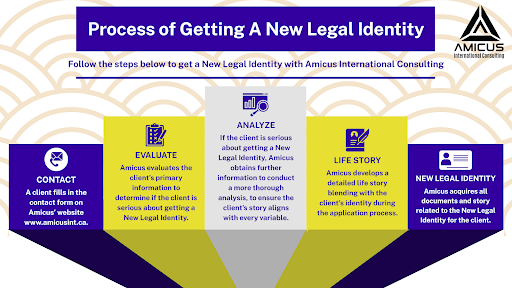
Sequencing is the silent backbone of identity creation. Each jurisdiction has an order of operations. In the U.S., Social Security must precede DMV updates. In Canada, provincial IDs must be updated before obtaining a federal passport. In the EU, civil registry updates must precede banking notifications. In the Gulf, Emirates ID or NAFATH updates must come first. In Singapore, Singpass requires immediate updates to avoid service interruptions. Missteps can result in mismatched records, blocked accounts, or suspicions of fraud.
Financial and Asset Implications
Legal frameworks extend into financial and property systems. Banks require certified documentation to update their records, and credit bureaus must be notified to maintain accurate credit histories. Property registries in North America, Europe, and the Gulf require notarized filings to update ownership records. Corporate registries must also reflect new identities for shareholder agreements and trusts. Without updates, assets can be frozen or transactions denied.
Professional and Academic Credentials
One of the most sensitive aspects of identity creation involves professional and academic credentials. Licensing boards and universities require official documentation before recognizing new identities. Physicians, lawyers, engineers, and teachers must notify regulatory bodies to preserve their licenses. Universities require notarized or apostilled documents to update transcripts and diplomas. Without proper updates, careers can be disrupted.
Case Study 1: U.S. Professional Reinvention
A U.S. executive sought to leave behind a public dispute. With Amicus International Consulting’s assistance, a petition for a lawful name change was filed in state court. The sequence began with Social Security, followed by DMV and passport updates. Professional licensing boards were notified, and credit bureaus were updated. Within six months, the executive successfully resumed a corporate career without disruption.
Case Study 2: Canadian Family Protection
A Canadian family facing harassment pursued lawful name changes through provincial registries. Federal passports, provincial health records, and property registries were updated in sequence. Amicus International Consulting coordinated digital presence updates to ensure continuity of banking and educational systems. The result was lawful protection and renewed confidence.
Case Study 3: European Investor Strategy
A German entrepreneur sought reinvention for strategic reasons. With guidance, the individual pursued a lawful name change through civil registry and synchronized updates across tax, property, and banking systems. The forthcoming EU Digital Identity Wallet promises to make such cross-border recognition even smoother in the future.
Case Study 4: Gulf-Based Entrepreneur
A Dubai-based entrepreneur required a lawful name change. Amicus International Consulting guided updates through Emirates ID, which instantly synchronized with banks, property registries, and health systems. By carefully sequencing updates, the entrepreneur avoided disruptions to business operations.
Case Study 5: Singapore Professional Migration
A Singaporean professional relocating abroad needed to align name and document changes with Singpass. Amicus International Consulting ensured updates to the Immigration and Checkpoints Authority were reflected across Singpass-linked banking, healthcare, and corporate systems. The seamless transition allowed the professional to migrate without losing access to essential services.
Case Study 6: Latin American Reinvention
A Mexican entrepreneur sought a new identity after relocating for business expansion. With Amicus International Consulting, the individual secured lawful updates through the Registro Civil, which were then cascaded into the CURP, tax systems, and banking records. International partnerships were preserved without disruption.
Privacy, Data Protection, and Digital Hygiene
Legal frameworks are increasingly tied to data protection laws. The EU’s General Data Protection Regulation (GDPR) allows individuals to correct or erase outdated data. California’s Consumer Privacy Act (CCPA) provides similar, though narrower, rights. Singapore’s Personal Data Protection Act (PDPA) adds another layer of protection. For individuals restructuring identities, these laws are powerful tools for aligning digital footprints with lawful updates. Amicus International Consulting develops digital hygiene strategies, from filing correction requests to managing online visibility.
The Human Dimension
Behind every legal framework lies a human story. Reinvention can be stressful, involving fear of exposure, uncertainty, or emotional fatigue. Amicus International Consulting emphasizes not only legal compliance but also personal resilience. Structured planning, counseling resources, and discretion are central to successful transitions.
The Future of Legal Identity Creation
The coming decade will deepen the integration of identity and law. Blockchain-based registries, AI-driven verification, and global interoperability will define the future. These systems will enable faster, yet stricter, lawful updates. Errors or unlawful attempts will be quickly detected. For individuals, the future of identity creation will demand expert guidance, cross-border strategies, and strict compliance.
Conclusion
The legal frameworks behind identity creation define what is possible and lawful in 2025. From the United States and Canada to Europe, Asia, Latin America, and the Gulf, every jurisdiction offers pathways for reinvention, but success depends on strict compliance and careful sequencing. With professional guidance, individuals can navigate these systems, preserve their assets and credentials, and build new opportunities. Amicus International Consulting remains committed to supporting clients with global expertise, discretion, and legal precision.
Contact Information
Phone: +1 (604) 200-5402
Signal: 604-353-4942
Telegram: 604-353-4942
Email: info@amicusint.ca
Website: www.amicusint.ca
