
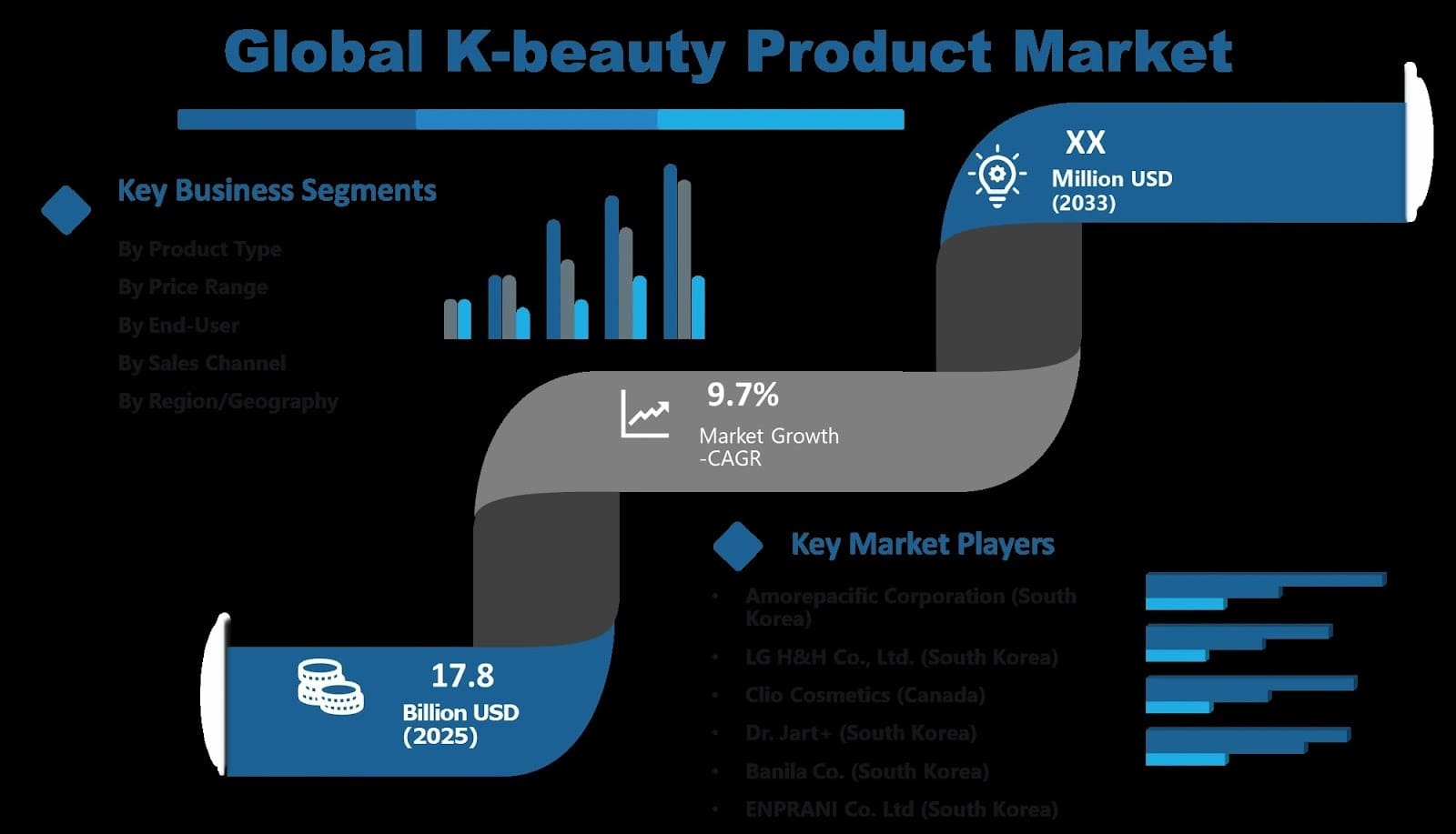
Today, the global K-Beauty product market is a vibrant segment of the wider cosmetics and personal care industry. The market is set to grow significantly in the coming years, with projections indicating a CAGR of 9.18% from 2026 to 2033. The market’s rapid expansion reflects both rising consumer demand for differentiated skincare products and broader trendsin global cosmetics consumption. The market’s growth in recent years is underpinned by rising demand for innovative skincare and makeup solutions that emphasize efficacy, natural ingredients, and multifunctional benefits. K-beauty, shorthand for Korean beauty, has transcended its domestic origins to become a mainstream preference across Asia Pacific markets and beyond, largely due to its reputation for pioneering product formats, ingredient research, and comprehensive skincare regimens.
What Are K-Beauty Products?
K-Beauty (Korean beauty) products refer to skincare and cosmetic products rooted in South Korea’s dynamic beauty culture, characterized by innovation, high-quality formulations, and multi-step routines tailored to specific skin needs, guided by philosophies of prevention and nourishment. At its core, the K-beauty paradigm emphasizes hydration at every step, incorporating lightweight textures, natural plant extracts, and innovative delivery systems to support skin health and appearance. Typical categories include cleansers, toners, essences, serums, ampoules, sheet masks, moisturizers, sunscreens, makeup products, and specialty treatments such as peeling gels and sleeping masks. Unlike traditional single-purpose products, many K-beauty formulations aim to address multiple skin concerns simultaneously, for instance, combining brightening, anti-aging, and moisturizing functions within a single product.
Market Trends Driving Growth
Innovation cycles in product development are shorter and more responsive to consumer feedback than in many traditional beauty markets. Korean brands frequently introduce new ingredients, such as snail mucin, Centella asiatica, fermented botanicals, and multiple forms of hyaluronic acid, and formats that quickly become global trends. This rapid innovation keeps product assortments fresh and encourages repeat purchases among enthusiasts who see beauty routines as both self-care and personal expression. Furthermore, the rise of digital and social commerce has accelerated K-Beauty’s global reach. Platforms such as Instagram, TikTok, YouTube, and beauty-specific communities (such as Reddit and dedicated forums) have amplified user-generated reviews, tutorials, and routines, giving consumers confidence to try unfamiliar products based on peer testimonials. Influencers, skinfluencers, and K-Beauty experts regularly highlight Korean brands and explain complex multi-step regimens in relatable language, lowering the barrier to adoption across markets as varied as North America, Europe, Latin America, and Southeast Asia.
In addition, consumer preferences are shifting toward skincare over makeup, a trend that aligns perfectly with K-Beauty’s core differentiation. During and post-COVID-19 pandemic, consumers increasingly prioritized health, hydration, and ‘glass skin’ aesthetics over bold cosmetics, boosting demand for functional serums, hydrating masks, and sunscreens. Surveys and retail data show consumers are willing to spend more on products they perceive as delivering measurable skin benefits, reinforcing the premium positioning of many K-Beauty brands even when they are priced competitively compared with luxury Western counterparts. Distribution channels have matured. Initially, K-Beauty products found early adopters through niche online shops and specialty retailers. Today, mainstream e-commerce platforms such as Amazon, Sephora, and Target, as well as regional beauty marketplaces, regularly feature Korean brands alongside global incumbents, making discovery and purchase easier for mainstream consumers. Brick-and-mortar beauty retailers have also embraced K-Beauty, dedicating shelf space and branded counters in high-traffic locations. Travel retail, once dominated by luxury European beauty brands, now often includes Korean brands, reflecting their appeal among international shoppers.
Key Strategic Moves
Nykaa Strengthens Its Korean Beauty Portfolio with the Launch of Medicube
In February 2026, Nykaa expanded its Korean beauty portfolio with the launch of the globally popular skincare brand medicube. Through a strategic partnership with APR Corporation, medicube made its omnichannel debut on Nykaa’s online platform and select retail stores across India. Known for its clinically tested, results-driven formulations and viral skincare products, the brand’s entry is expected to strengthen Nykaa’s premium K-beauty segment, attract skincare-focused consumers, and further boost competition in India’s fast-growing beauty market.
Sephora Partnership With Olive Young
In January 2026, Sephora, owned by LVMH, announced a strategic partnership with CJ Olive Young, South Korea’s leading beauty and wellness retailer, to expand access to Korean beauty products globally. Starting in the fall, selected Korean brands will be available through Sephora’s online platform and physical stores across the United States, Canada, Hong Kong SAR, Singapore, Malaysia, and Thailand. This collaboration is expected to accelerate global K-beauty growth, strengthen Sephora’s premium product portfolio, and intensify competition in the international beauty market.
L’Oréal Groupe acquires Korean skincare brand, “Dr.G”
In December 2024, L’Oréal Groupe signed an agreement with Swiss retailer Migros to acquire its subsidiary Gowoonsesang Cosmetics Co., Ltd., including the Korean skincare brand Dr.G. Founded in 2003 by dermatologist Dr. Gun Young Ahn, Dr.G will join L’Oréal’s Consumer Products Division. The acquisition is expected to strengthen L’Oréal’s position in the fast-growing K-beauty segment and expand its global portfolio of science-based, affordable skincare products.
The Path Ahead
The global K-Beauty Products market presents a compelling blend of environmental rationale. Looking ahead, the global K-Beauty product market is poised for continued expansion as consumers globally seek effective, innovative skincare rooted in efficacy and cultural storytelling. Younger generations, especially Gen Z and Millennials, will continue to drive category growth through social sharing, peer reviews, and demand for experiential beauty journeys. For brands, distributors, and investors alike, the opportunity lies in marrying the creativity and technical excellence of Korean beauty with scalable, globally relevant strategies that meet consumers where they are. When backed by clear product benefits, an authentic narrative, and accessible distribution, K-Beauty remains well-positioned to influence beauty routines and market dynamics for years to come.
About the Author:
HTF Market Intelligence Consulting is uniquely positioned to empower and inspire businesses with growth strategies through research and consulting services that deliver extraordinary depth and breadth of thought leadership, research, tools, events, and experience to support decision-making.
