
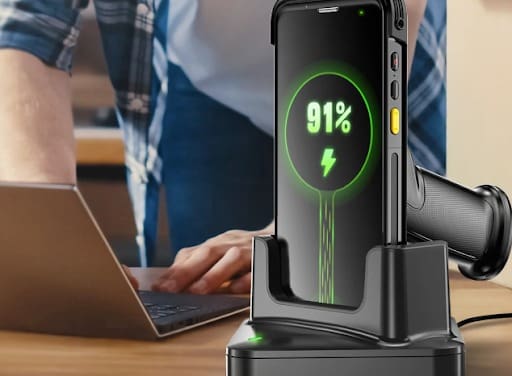
User interaction with mobile technology is undergoing a significant transformation. For years, touch controls have defined the user experience on smartphones and tablets. However, the rise of advanced voice recognition is creating a new paradigm where voice and touch are no longer separate but are merging to create a more intuitive and powerful interface, particularly for specialized devices like mobile scanners.
This evolution is happening from two directions. Traditional screen-first devices are incorporating more sophisticated voice controls. In parallel, voice-first devices originally without displays are now adding screens to enhance their functionality. The future of mobile interaction lies in combining the strengths of both to create a seamless user experience.
The Power of Voice for Hands-Free Scanning
Voice is an exceptionally efficient input method. It allows users to issue commands quickly and naturally, bypassing the need to navigate complex on-screen menus for familiar tasks. The most significant advantage of voice recognition is its ability to enable true hands-free scanning and operation, which is critical in many professional and commercial environments.
Enhancing Productivity and Safety
For professionals in field operations, healthcare, or logistics, the ability to interact with a device without using their hands is a game-changer. A technician can inspect equipment while verbally requesting technical documents. A medical professional can retrieve patient data while maintaining a sterile environment. This parallel processing boosts productivity and reduces the cognitive load of switching between physical and digital tasks.
However, devices that rely only on voice have inherent limitations. Interacting with audio-only output can be tedious for complex information. Users must rely on memory to process lists or data read aloud sequentially, which is far less efficient than seeing it at a glance.
The Indispensable Role of Touch and Visual Displays
While voice is a powerful input tool, a screen remains a superior output modality. Visual displays allow a system to present a large amount of information simultaneously, which significantly reduces the burden on a user’s memory. Scanning information visually is much faster than listening to it being read out.
Limitations of Fragmented Interaction
Many existing screen-first devices treat voice control as an afterthought. The voice agent is often separate from the primary touchscreen functionality, leading to a fragmented user experience. For instance, a user might issue a voice command to start a task, only to be forced to use touch controls to complete it. This division undermines the potential of a truly integrated system.
Furthermore, these interfaces often make poor use of screen space when in ‘voice mode,’ failing to display critical information or visual cues that guide the user. An effective touch interface requires careful design, including properly sized touch targets, adequate spacing between elements, and intuitive gestures that feel natural to the user.
Forging a New Path: The Voice-First Approach
The ‘voice-first’ design philosophy offers a more integrated solution. It refers to systems that primarily accept voice commands for input but use a tightly integrated screen display to augment audio output. This approach is not about eliminating touch but about creating a holistic system where both modalities work in harmony.
Integrating Voice and Screen for a Holistic Experience
A true voice-first system leverages the best of both worlds. Voice commands provide a fast and hands-free way to initiate actions, while the screen offers rich, detailed visual feedback and output. For example, after a user verbally requests to see a list of items, the results can appear on the screen with sequential numbers. The user can then select an item by simply saying its number, a far more efficient process than listening to a long list.
This synergy allows for more immersive and interactive content. Tasks that are clumsy on voice-only devices, such as reviewing scanned data or following step-by-step instructions, become simple and intuitive. The screen provides the necessary context, while voice controls the flow of information, creating an experience that feels effortless.
This integrated approach is becoming increasingly vital in professional tools. A modern mobile computer equipped with both advanced voice recognition and a responsive touchscreen can dramatically optimize workflows in demanding environments, allowing for a new level of efficiency.
The Goal: A Truly Multimodal User Experience
Although the voice-first concept is a major step forward, it is not the final destination. Deliberately limiting the functionality of a screen to enforce voice interaction can be counterproductive. Users cannot be expected to remember exact voice commands for every application, and visual menus remain an effective way to explore a device’s capabilities.
Ultimately, the future of mobile scanner interaction is multimodal. Users should have the freedom to choose the most appropriate input method—voice, touch, or a combination of both—for any given situation.
This evolution is also paving the way for enhancing warehouse management with mixed reality and mobile scanners, where immersive visualization meets intelligent data capture to redefine operational efficiency.
A well-designed system will adapt to the user’s needs, creating a flexible and human-centered experience that makes technology feel like a natural extension of our own abilities.
