
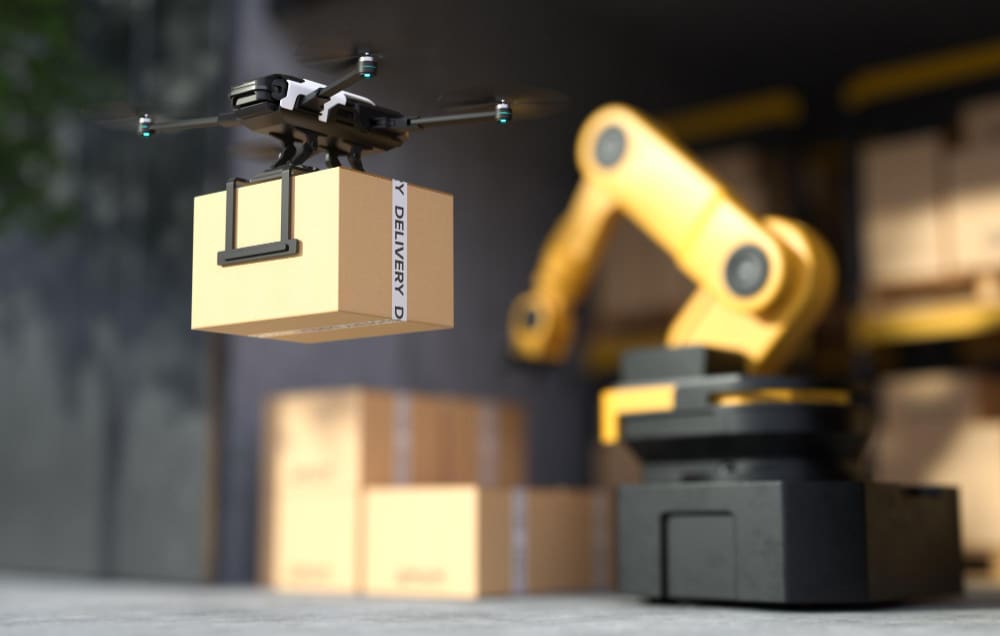
AI isn’t some far-off idea anymore it’s already inside the machinery of modern logistics, quietly but fundamentally changing how goods move, how supply chains run, and how companies actually keep their promises to customers.
Think about the last time you ordered something online. You got a confirmation email, a tracking number, and then a steady stream of updates telling you exactly where your package was, down to the specific city or distribution center it was sitting in. That seamless experience? It’s AI working behind the scenes. The logistics industry, which used to run on manual processes, mountains of paperwork, and gut-feel decision-making, is going through one of the biggest tech overhauls in its entire history.
And the scale of it is hard to overstate. The global AI in logistics market was valued at over $6 billion in 2023 and is projected to grow at a compound annual growth rate (CAGR) exceeding 42% through 2030. That’s not a gradual shift it’s a tectonic movement reshaping the foundations of how supply chains are designed, managed, and optimized. From predictive analytics to autonomous vehicles, AI is rewriting the rulebook on what’s possible in modern logistics.
What Exactly Is AI’s Role in Logistics?
Honestly, AI in logistics covers a lot of ground. At its core, we’re talking about systems that can learn from data, spot patterns, make predictions, and act on them often in real time and at a scale no human team could ever match. These systems show up at every point in the supply chain, from procurement and warehousing all the way through to last-mile delivery.
Machine learning algorithms dig through historical shipping data to predict demand spikes. Computer vision keeps an eye on warehouse floors for safety hazards and inefficiencies. NLP tools field customer questions instantly, any hour of the day. AI-guided robots sort and move packages faster than any human could. And when you put all of these pieces together, you get a supply chain that’s genuinely smarter, faster, and way more resilient than what we had before.
People always ask if AI is going to replace logistics managers. Honestly? No. The teams doing this well use AI to handle the data grind and that frees up their people for the judgment calls, the tough supplier conversations, and the kind of on-the-ground problem-solving no algorithm can replicate.
Where AI Is Already Making a Real Difference in Logistics
- Demand Forecasting Forget gut feel and spreadsheets. AI reads historical sales, seasonal trends, weather, even social media buzz to predict what stock you’ll actually need so you’re not drowning in excess inventory or scrambling when shelves run dry.
- Route Optimization Instead of dispatchers planning routes the night before with maps and experience, ML models crunch thousands of delivery points, real-time traffic, driver hours, and time windows in seconds. UPS alone saves over 100 million driving miles a year doing this.
- Warehouse Automation Robots that sort, pick, and pack around the clock without coffee breaks or shift changes. Processing times drop dramatically and errors go down with them.
- Shipment Tracking No more “check back tomorrow” updates. AI pulls data from GPS, RFID tags, carrier APIs, and IoT sensors to give customers a live, end-to-end view of exactly where their package is.
- Predictive Maintenance AI watches your trucks and machinery for early warning signs. Fix it before it breaks, not after the breakdown leaves your delivery schedule in chaos.
- Fraud Detection Unusual patterns in shipping records or transactions get flagged automatically. Humans couldn’t catch these at scale AI spots them in real time.
- Customer Service AI chatbots handle the flood of “where’s my package?” messages instantly, 24/7. Human agents get freed up for the cases that actually need a human.
The Revolution of Real-Time Shipment Tracking
Shipment tracking is probably the most visible place where AI has changed things for regular people. Not that long ago a decade, give or take tracking a parcel meant checking a static webpage that updated once or twice a day if you were lucky. Now, AI-powered tracking systems tell you exactly where your shipment is in real time, predict delivery windows with pretty impressive accuracy, and flag delays before you even realize something’s off.
This is especially obvious in the Indian logistics market, where courier companies are moving fast to adopt AI-driven platforms. Platforms like Shree Maruti Courier Tracking is a solid example of how technology is being put to work so customers can get instant, accurate updates on their shipments. The ability to follow a package from dispatch to doorstep in real time has gone from a nice-to-have to a basic expectation, and AI is what makes it possible.
Real-time tracking isn’t just a convenience feature it’s a genuine competitive differentiator. Studies show that 93% of consumers expect proactive delivery updates, and companies that don’t deliver on that see noticeably higher cart abandonment rates.
But behind the scenes, there’s a lot more going on than just a dot on a map. These AI systems pull in data from GPS devices, RFID tags, barcode scans, IoT sensors, and carrier APIs to build a full, living picture of a shipment’s journey. Then machine learning models chew through that data to catch potential delays a traffic jam on a key road, a weather system rolling in, a customs backlog and update delivery estimates on the fly. That predictive piece is what really sets modern AI-driven tracking apart from the old static systems.
Route optimization is another area where AI is producing results that genuinely matter. Old-school route planning was a grind dispatchers doing it the night before, relying on experience and paper maps. Today’s AI route optimization engines can process thousands of delivery points, dozens of constraints like vehicle capacity, time windows, and driver hours regulations, plus real-time traffic data, and spit out optimal routes in seconds. Companies like UPS have reported saving over 100 million miles of driving per year through AI-driven route optimization and that translates directly into massive fuel savings and real carbon emission reductions.
AI-Powered Demand Forecasting: The End of Guesswork
Here’s the thing about inventory management it’s always been a nightmare. Order too much stock and you’re burning capital and floor space. Order too little and you’re dealing with stockouts, missed sales, and frustrated customers. Traditional forecasting, built on historical sales data and human judgment, is inherently backward-looking and just can’t keep up with all the variables that actually drive demand in the real world.
AI-driven demand forecasting flips this on its head. Modern machine learning models can simultaneously look at hundreds of variables historical sales, seasonal patterns, promotional calendars, competitor pricing, social media sentiment, macroeconomic indicators, even weather forecasts and generate demand predictions that are dramatically more accurate than anything you’d get from traditional methods. Retailers using AI-powered forecasting routinely report reductions in inventory costs of 20-30%, along with real improvements in product availability.
The difference between a 70% accurate demand forecast and a 90% accurate one might sound small. But in a high-volume supply chain, that gap translates to millions of dollars in saved costs and a dramatically better customer experience.
What’s really exciting is that these AI forecasting systems keep getting better over time. Every new data point a successful promotion, an unexpected demand spike, a supply disruption feeds back into the model and sharpens future predictions. That self-improving quality means the longer you’ve had an AI forecasting system running, the more valuable it gets. Early adopters are genuinely building a moat here.
Inside the AI-Powered Warehouse
- Autonomous Mobile Robots (AMRs) These navigate warehouse floors on their own no fixed tracks, no hand-holding. They pick items and bring them to packing stations while human workers focus on higher-value tasks.
- Computer Vision Quality Control Cameras scan goods on conveyor belts in real time. Defects, damage, wrong items caught instantly, far faster and more consistently than any human inspector could manage on a long shift.
- Intelligent Slotting AI works out where to put things in the warehouse based on how often they’re picked and how they’re physically packaged. Less walking per picker, more orders out the door per hour.
- Automated Sorting High-speed sorting systems process thousands of packages an hour and route each one to the right destination with near-perfect accuracy. The throughput would’ve been impossible manually.
- Labor Forecasting AI looks at incoming order volumes and tells managers how many people they need on each shift. Fewer situations of being overstaffed on slow days or caught short on busy ones.
- Energy Management Lighting, temperature, equipment AI monitors and adjusts all of it. The utility savings compound surprisingly fast across a large facility.
- Safety Monitoring Computer vision watches the warehouse floor and raises an alert the moment it spots an unsafe behavior or hazard. Faster than any supervisor walking the floor could catch it.
The last mile that final stretch from a distribution center to someone’s front door has always been the most expensive and operationally messy part of the whole logistics chain. It typically accounts for 53% of total shipping costs, and getting it right is everything when it comes to customer satisfaction. AI is going after this problem from several directions at once, and you’re starting to see the results.
Last-Mile Delivery: AI’s Most Visible Battleground
AI-driven last-mile optimization means real-time dynamic routing delivery sequences that shift on the fly as new orders come in, as drivers finish stops, and as traffic conditions change. AI systems can reassign stops between drivers mid-route, slot newly placed same-day orders into existing sequences, and even predict which customers are likely to be home at a given time. That last one alone cuts down on failed delivery attempts, which are costly and frustrating for everyone.
Beyond routing, AI is powering the next generation of last-mile delivery vehicles themselves. Autonomous delivery robots the kind that navigate sidewalks to drop packages at residential addresses are being piloted in cities across the United States and Europe. Drone delivery, backed by sophisticated AI navigation and obstacle avoidance, is moving from experiment to commercial reality in markets like the United States, Australia, and parts of Africa. These technologies are still maturing, but their trajectory is pretty clear they’ll be a meaningful part of the last-mile mix within the next decade.
Amazon reportedly completes over 10,000 drone deliveries per day in select markets. Sure, that’s a small fraction of their total delivery volume right now but it tells you exactly where the industry is heading.
Indian courier companies are also waking up to what AI can do for last-mile operations. Dense urban environments and complicated address systems make Indian cities uniquely challenging and honestly, that’s where AI really shines. It can parse non-standard address formats, predict delivery windows based on local traffic patterns, and optimize multi-stop routes through congested streets in ways that simply weren’t possible before. Tools like Shree Maruti Courier Tracking show how the Indian logistics sector is actively picking up digital tools to bring real transparency and efficiency to the delivery experience for both businesses and end customers.
Supply chain resilience the ability to absorb disruptions and bounce back quickly has shot up the priority list for businesses everywhere. COVID-19 made that painfully clear, and the supply chain crises that followed drove the point home. AI is playing a big role in building more resilient supply chains by giving earlier warning of potential disruptions and enabling faster, smarter responses when things do go wrong.
Building Resilient Supply Chains with AI
AI-powered supply chain risk management systems are constantly scanning a huge range of data sources news feeds, weather services, port congestion data, supplier financial health indicators, geopolitical risk assessments looking for threats before they actually materialize. When a typhoon is forming in the Pacific, an AI system can already be identifying which suppliers and shipping routes are at risk and modeling alternative options days before the storm hits land.
That proactive, data-driven approach is a fundamental shift from the old reactive, crisis-management mode most supply chains operated in. Instead of scrambling after a disruption has already hit, AI gives logistics managers a chance to get ahead of the problem, protect service levels, and keep the business running in ways that genuinely weren’t possible before.
A 2023 McKinsey study found that companies using AI-powered supply chain management saw 15% lower logistics costs, 35% fewer lost sales due to stockouts, and 65% fewer emergency sourcing situations compared to companies not using AI.
What’s Actually Holding AI Adoption Back in Logistics
- Messy data AI is only as good as what you feed it. A lot of logistics companies are sitting on data that’s siloed across a dozen legacy systems, inconsistent, or just plain unreliable. That’s problem number one.
- The cost barrier Enterprise-grade AI isn’t cheap to build or implement. For smaller and mid-sized operators, that upfront investment can genuinely feel out of reach.
- Finding the right people There simply aren’t enough professionals who can implement and manage AI systems in logistics. Everyone’s hiring for the same talent pool right now.
- Getting teams on board People who’ve worked a certain way for years don’t always welcome the change. Operational buy-in is harder than most tech projects account for.
- Bias, privacy, and regulation Algorithmic bias, data privacy concerns, and unclear regulations around autonomous vehicles are real issues the industry hasn’t fully worked through yet.
- Cybersecurity exposure The more connected and data-dependent a logistics system becomes, the more attack surface it creates. This doesn’t get talked about enough.
- Legacy infrastructure You can’t just bolt modern AI onto decade-old systems. Integration is messy, slow, and expensive, and a lot of companies are still stuck in that phase.
The Human Element: AI as a Collaborator, Not a Replacement
One of the biggest fears around AI in logistics is job displacement. And look it’s a fair concern. Automation has already changed a lot of warehouse and manufacturing roles. But that’s not the whole picture, and the full story is actually more nuanced and more optimistic than the headlines suggest. Yes, AI is automating repetitive, rules-based tasks. But at the same time, it’s creating entirely new job categories that need genuinely human skills: creativity, empathy, ethical judgment, complex problem-solving, and the ability to work with and interpret AI systems.
The most successful logistics companies over the next decade will be the ones that figure out how to put AI and human workers together in complementary ways letting AI handle the data crunching, pattern recognition, and routine decisions, while human workers focus on the stuff that actually requires a human touch. Think about a customer service rep backed by an AI that’s already pulled up all the relevant order info and flagged some possible solutions. That person can handle more inquiries per hour, and handle them better, than someone working without that support.
The World Economic Forum estimates that while AI and automation will displace approximately 85 million jobs globally by 2025, they will simultaneously create 97 million new roles a net positive that reflects the real productivity gains AI enables across the economy.
Sustainability is another area where AI in logistics is showing real promise. Transport and logistics are among the biggest contributors to global greenhouse gas emissions roughly 8% of total global CO2 output. AI-driven route optimization, load consolidation, predictive maintenance that keeps vehicles running cleaner, and the shift to electric vehicle fleets managed by AI energy systems all add up to meaningful reductions in the carbon footprint of logistics operations.
AI and Sustainable Logistics: A Greener Supply Chain
Big logistics operators are setting serious sustainability targets and increasingly leaning on AI to hit them. DHL has committed to net-zero logistics by 2050 and has called out AI-powered optimization as one of its main levers for cutting emissions. FedEx has pledged to electrify its entire delivery fleet a massive undertaking that will rely heavily on AI to manage charging schedules, route planning, and energy consumption across thousands of vehicles.
For customers, AI is also making it easier to understand the environmental footprint of their shipping choices. Some logistics platforms now offer AI-powered carbon footprint calculators that show shippers real-time data on the emissions tied to different shipping options, so businesses and consumers can make smarter, more informed decisions. That kind of transparency is something environmentally conscious customers are starting to expect and it’s becoming a real factor in which carrier gets chosen.
Route optimization alone can reduce fuel consumption by up to 20%. For a large courier network handling millions of deliveries a day, that’s an enormous reduction in both cost and carbon emissions.
What’s Coming Next AI in Logistics Over the Next Decade
- Generative AI for Planning LLMs are starting to help supply chain planners make sense of huge amounts of market data. Instead of digging through reports, planners ask questions and get plain-language recommendations back. It’s early days but genuinely useful.
- Digital Twins Imagine a full virtual replica of your supply chain that you can stress-test before anything bad actually happens. AI-powered digital twins let companies run disruption simulations and figure out the right response in a safe environment first.
- Self-Driving Long-Haul Trucks Several companies are already running commercial pilots on major highway corridors. This is moving faster than most people realize.
- Swarm Robotics Instead of fixed conveyor systems, advanced fulfillment centers are starting to deploy fleets of small robots that coordinate dynamically. More flexible, more scalable, and easier to reconfigure as demand shifts.
- Blockchain + AI Combine blockchain’s tamper-proof record-keeping with AI’s ability to analyze that data at scale, and you get supply chain transparency that was basically impossible before.
- AI Customs Compliance Cross-border trade paperwork is still a mess. ML systems that can classify goods, predict duties, and flag compliance issues automatically are starting to cut through that and it makes a real dent in clearance times.
- Autonomous Procurement AI systems that can negotiate with suppliers and execute purchase orders within set parameters. Still emerging, but a few companies are already running pilots in live environments.
The Indian Logistics Sector’s AI Journey
India’s logistics sector one of the largest and most complex in the world is at a genuinely exciting turning point in its AI story. The Indian logistics market is projected to reach $380 billion by 2025, pushed along by the boom in e-commerce, GST-enabled seamless interstate transport, and heavy government investment in logistics infrastructure through programs like PM GatiShakti. In that environment, AI is becoming a critical tool for logistics companies that want to compete and grow.
Indian courier and logistics companies are putting AI to work across all kinds of use cases route optimization, demand forecasting, customer service automation, shipment visibility platforms. Customer-facing tracking tools have grown especially fast. Services like Shree Maruti Courier Tracking are a good example of this trend, giving customers intuitive, real-time access to their shipment status. And when these tracking platforms are backed by AI-powered systems on the backend, they can do a lot more than just show a package’s current location they can proactively share expected delivery windows, flag potential delays, and offer self-service options for managing delivery preferences.
India processes over 10 billion courier shipments annually, and this figure is growing at 25% per year. At that scale, AI adoption isn’t just helpful it’s essential for any logistics company that wants to maintain service quality while handling that kind of explosive growth.
India’s startup ecosystem is also producing a wave of innovative AI-powered logistics solutions built specifically for the unique challenges of the Indian market things like complex, non-standardized address formats, the prevalence of cash-on-delivery transactions, and the need to serve both dense cities and remote rural areas through a single network. This homegrown innovation is complementing the adoption of global AI platforms and building a genuinely vibrant, competitive logistics tech ecosystem in India.
Looking ahead, AI’s integration into logistics is only going to get deeper. As AI models get more capable, as sensor technology gets cheaper and more widespread, and as the data feeding these systems gets richer and more comprehensive, the gap between companies that have embraced AI and those that haven’t will keep widening. The question for logistics businesses isn’t whether to invest in AI anymore it’s how quickly and smartly they can do it.
What Should Logistics Companies Do Right Now?
For any logistics company, regardless of where they are in their AI journey, the path forward starts with an honest look at current data infrastructure, a clear-eyed view of which AI use cases will actually move the needle for their specific business, and a real commitment to building those internal capabilities over time. Starting with a focused pilot in one area route optimization, demand forecasting, or customer service automation tends to work a lot better than trying to transform everything at once.
Partnership matters too. Very few logistics companies have the in-house technical chops to build AI systems from scratch. Working with specialized AI technology vendors, investing in integrations between existing systems, and tapping into the growing ecosystem of logistics-specific AI solutions are all smart ways to accelerate the journey without burning out internal teams. But honestly, the most important thing is just to start because in AI, just like in logistics, the companies that move first and learn fastest are the ones that build the most durable advantages.
A useful starting point for any logistics company evaluating its digital maturity is to audit its current shipment visibility capabilities. If your customers can’t access real-time tracking through a platform like Shree Maruti Courier Tracking, that’s an immediate gap worth fixing it’s both a customer satisfaction problem and a foundational data infrastructure issue that will hold back your ability to build more advanced AI capabilities down the road.
The future of AI in logistics isn’t some distant, speculative vision it’s happening right now, in warehouses and delivery vehicles and control rooms around the world. The companies investing in AI today are building capabilities that will compound in value for years to come: smarter operations, lower costs, happier customers, and supply chains that hold up in an increasingly unpredictable world. For logistics professionals, technologists, and business leaders, honestly there’s never been a more exciting or more consequential time to be in this industry.